Speaking in public

Tags

, , , , , ,


I’ve done another guest blog over at the start speaking today blog:

http://start-speaking-today.blogspot.com/2011/12/guest-articlethe-inevitability-of.html

It’s about some of my own personal experiences of speaking in public and why I ended up as a teacher. Pop over there to see it and maybe check out some of the other posts. A lot of good info on how to speak confidently in public from a lot of very experienced people.

Home for the holidays [AW forum blog chain post]

Tags

, , , , , , , , , ,


I'm captain of this ship...

So, on the AW forums there is a blog chain and the idea is that you get a slot in the month and, during that slot, you post about the topic given. So, it is now my turn and this month’s topic is ‘Home for the Holidays’. Given the season and the American nature of many of the members of AW, one of course must assume that the ‘Holiday’ referred to is ‘Christmas’.

This is a strange one for me because we generally don’t go ‘home’ for the Christmas. Home is where I live now and if I go anywhere for Christmas it is usually away from home. Ever since I got married and we acquired a dog, Christmas for us has been spent with my in laws in a hotel in the Lake District. This hotel, on the shores of Ullswater, a few miles from Penrith in the village of Glenridding, is a wonderful place to spend Christmas for a number of reasons:

1) The food. There is a lot of it. Many, many courses and not a sign of the endless piles of washing up that are the usual karmic reward for eating too much. The hotel used to do a seven course feast on Christmas day but they scaled it back to a mere five courses recently after too many guests exploded following the consumption of a final ‘wafer thin mint’. No, I am not exaggerating. Well, maybe a bit…

The hills are also wreathed in mist...

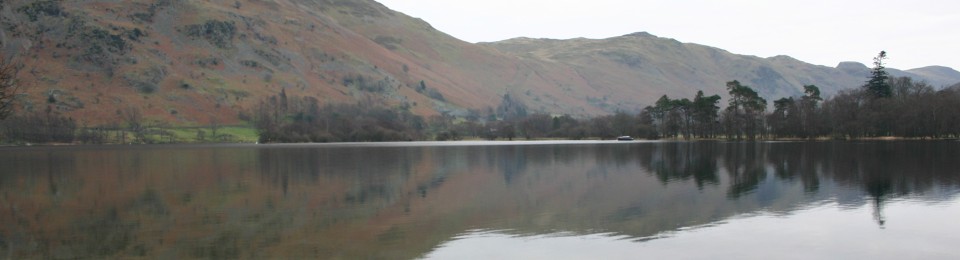
2) The isolation. Look up at the photograph on the top of this blog. I took that shot from the field at the back of the hotel. In any direction you look in from there, all you can see are hills and mountains. The photo to the left of this text shows more of them. In fact, the hills and mountains serve to block pretty much all mobile phone signals. Once you arrive there, you are cut off from the outside world very effectively. Well, unless you ask for a log in for the hotel’s free Wi Fi to get onto the internet… 🙂 If you want to be incommunicado, this is the place to be. In fact, I completed Gods of the Sea over last Christmas because it was easier to open a word file and do some typing than it was to log into the wi fi to check the internets. Productivity was improved! Also, it has been scientifically proven (by me, just now, I shall post the results of my extensive experiments in a paper I shall send to the Lancet) that bleak, isolated, pretty locations are not only restful but also pretty cool and very good for the brain.

3) Dog Friendliness.  The hotel for us absolutely defines the gold standard of the concept of ‘dog friendliness’. Some hotels claim to aspire to this but they all fall short. This is a place where your dog can walk in, put his or her feet up on the reception counter, and be given a biscuit from the jar that is always behind the bar. When Santa Clause appears in the bar on Christmas morning to give all guests a present, there are presents for the dogs too. There are also lots of places to walk them and a lake to swim in. And yes, dogs do go swimming in the lake on Christmas day… Insane creatures that they are.

The water here is almost frozen...

4) The walking. You go to the lakes to go walking. With your dog if you have one. There are lots of places to explore in the local area, some of them more hardcore than others. One year we made the ill judged decision to take a seven mile hike around the lake on Boxing Day in some of the worst ice and snow seen for many years. It’s a route we’ve done before and found easy, even after 3 days of eating our entire body weight in food every day, but the solid ice made the gentle rolling hills far more treacherous. Especially when you have a sure footed canine on a lead trying to pull you into the valley because ‘there’s some interesting smells over there’. Crampons and ice picks may have helped. A sled, a few more dogs and some time to train them to all pull in the same direction would have been ideal. This year, we intend to pay more attention to the weather report before we leave.

5) Finally, apropos of the above, there is one thing that makes going to the Lake District a fun and interesting Christmas experience and that is the fact that it is more likely to:

SNOW!!!!!!!!!

There are other reasons, many of which would take too long to adequetly explain here. The upshot of it all is that, while I have in the past enjoyed Christmas at home (both at our home, my parents’ home or that of my in laws) the experience of spending a relaxing Christmas in a hotel where the people doing all the work are being paid to do it is one certainly worth doing at least once in your life.

You can find other participants to this blog chain here:

Participants and posts: orion_mk3 – http://nonexistentbooks.wordpress.com (link to this month’s post) Ralph Pines – http://ralfast.wordpress.com/ (link to this month’s post) pyrosama – http://matrix-hole.blogspot.com/ (link to this month’s post) AbielleRose – http://stainedglassinthenight.wordpress.com/ (link to this month’s post) writingismypassion – http://charityfaye.blogspot.com/ (link to this month’s post) Domoviye – http://lets-get-happy.blogspot.com/ (link to this month’s post) AuburnAssassin – http://clairegillian.com/ (link to this month’s post) Areteus – https://lurkingmusings.wordpress.com/ (link to this month’s post) Diana Rajchel – http://blog.dianarajchel.com/ (link to this month’s post) Alynza – http://www.alynzasmith.blogspot.com/ (link to this month’s post) SuzanneSeese – http://www.viewofsue.blogspot.com/ (link to this month’s post) robeiae – http://thepondsofhappenstance.blogspot.com/ (link to this month’s post) SinisterCola – http://acgatesblog.wordpress.com/ (link to this month’s post) MamaStrong – http://inamamasworld.blogspot.com/ (link to this month’s post) kimberlycreates – http://www.kimberlycreates.com/ (link to this month’s post) Cath – http://blog.cathsmith.com/ (link to this month’s post)

[Guest Post] 5 Ways of Getting Good Information Cheaply

Tags

, , , , , , , , , , , ,


This guest blog comes to us courtesy of Dan Clarke, who writes blog articles on how to do public speaking among other things. Here he talks about something which is close to my heart as a former scientist, a teacher and a writer – research and how to do it effectively without resorting to Wikipedia all the time.
5 Ways of Getting Good Information Cheaply
One big problem some writers have, is finding all the necessary details to make their story work. Most writers, I hope, have never been arrested, many can’t explain the newest computer programs in any great detail, and nuclear physics is beyond most peoples general retinue of skills.
So how can writers find the information for their stories or articles, without spending lots of money, taking a college course, or doing something illegal?
It’s actually fairly easy, if you use any of these 5 methods.
  1. Interview People
    Most people like talking about themselves, their jobs or their hobbies. When you need to know how something works, how a job gets done, or an interesting fact, look around your community and find people who can help.
    You’re planning a romance story involving firemen? Ask the fire department, if you can have an hour long tour and ask firemen how they do their jobs, what’s the most dangerous thing they’ve experienced and anything else you can think of.
    You want to learn about hacking into a computer for a mystery, go to the local high school or better yet, college or computer security firm, and ask for a basic idea of how to do it, along with any computer jargon you’ll need. They probably won’t give you step by step instructions, but it will be enough general information for most readers.
  2. Visit Museums, Schools, and Libraries
    If there is a museum nearby, consider visiting and asking the curators some questions. Museums are full of interesting facts and people that generally enjoy talking about them. When you have to know about ancient and not so ancient history, or technology and animals, call up the museum and ask if you can talk with an expert.
    Colleges and universities are like museums, although actually meeting the professors can be a bit harder. Either phone or send an email to the office that you need, be it history, sciences, math, etc, and politely ask if you could meet a professor. Be sure to explain what you need, and if its by email, provide a list of questions you will be asking.
    Reference libraries are another great resource, that are sadly underused. Most large libraries and all university libraries have reference librarians. These people, or computer systems in cheaper libraries, and point you in the right direction for various facts and statistics. All you have to do is ask.
  3. Volunteer, Learn By Doing
    If you live in a city or even a small town, you can learn a lot of useful things for your book by volunteering. You may just do it for a week, or you could do it on a full time basis, either way first hand experience can be vital to making a book seem real.
    If you want to know how an election is run, volunteer with a local political party you support, or at least like. You can watch how they plan meetings, get a bit of an insiders view of what is happening and its a good way to make new contacts.
    Want to know what its like to be homeless or a runaway, volunteer at a food bank or safe house. You can do some good for your community and learn how people survive on the street.
    For stories about actors, join a local acting group, even if you have no acting abilities you can see things from behind the scenes as you work the lights, make costumes or other things.
  4. Read Blogs and Forums
    Many people will post on blogs and forums about their trails and experiences at work, hobbies and life. If you spend a few days going over the various blogs and forums related to what you’re researching, you can find lots of useful information.
    Web forums can be even better than blogs, as you can ask questions directly, and often recieve useful answers.
    The important thing is to not just focus on one or two forums or blogs. You could easily get bad information, you need to back check and confirm through other forums, blogs and resources to make sure you have the right info. But simply knowing what to ask after reading a blog, is better than flailing around blindly.
  5. Table Top Role Playing Games
    Bear with me here.
    I’m a role player, I love table top games, and own many RPG books. Some of them, many of them actually, are inaccurate, unscientific and try for cool rather than accuracy.
    However there are a few RPG companies that focus on realism. Science fiction, military, and horror RPG companies often have a few books that deal with the realities of various era’s, sciences, tactics and groups.
    More importantly its done in an easy to read manner, that’s easily understood by laymen. So if you’re too shy, or unable to talk to experts, and don’t want to pay lots of money on thick reference books, buying a 10 or 20 dollar RPG book, that focuses on realism can be the answer.
If you’ve searched the internet, looked through the books on your shelves, and mined your family members for information, remember there are other sources of information. Get out and talk to people, do interviews, join groups and look in unexpected sources. Don’t rely entirely on easy research via Wikipedia and Google (use them at first then expand), do some footwork and get what you need.
Biography
Dan Clarke, is a teacher, freelance writer and occasional public speaker in Nanjing, with five years experience at finding information and faking being an expert. He currently blogs at Speaking in Public, providing information on public speaking from the very first step to the last.

A good writer goes to war

Tags

, , , , ,


This week there were three important things going on. Two of them were important mainly to Americans while the other is an occasion which is often under-celebrated but is still dear to the hearts of all British Sci Fi geeks (and geeks worldwide, of course).

I speak, of course, of Thanksgiving, the anniversary of the Assassination of JFK and the anniversary of the first ever broadcast of Doctor Who. The last two are inextricably linked because, as legend has it, the BBC had to delay the broadcast of An Unearthly Child (episode one of the first series of Doctor Who) when the news of the Presidential assassination broke. Also, there was a photograph of the Doctor in Dallas at the time of the assassination shown in an episode of the new series, which ties the two together even closer*. As far as I am aware, Thanksgiving has nothing whatsoever to do with Doctor Who, though I can imagine at some point in the future there could potentially be a Pilgrim/Turkey/Superbowl themed episode in which the Doctor faces an alien horde of American Football players. Well, it could happen.**

So, to celebrate the anniversary, I decided to re-watch ‘A Good Man Goes to War’, the mid series climax of series six which set things up for the second half of series six. It was while watching this that I began to have some ponderings.

Now, I am aware that Stephen Moffat’s take on Who has not been as popular with some as it might have been. There has been a lot of noise on the internets about how Matt Smith is not as good as David Tennant (almost as much as there was about David Tennant not being as good as Christopher Ecclestone… and frankly, every Doctor and companion since William Hartnell has had their supporters and decriers) and I can imagine that some of the weirder elements of Moffat’s stories to date might confuse and annoy some viewers. However, I am personally of the opinion that he is the best man for the job of showrunner on this franchise. I shall explain why.

Moffat has an almost unique skill with storytelling. It is obvious in almost everything he does. I would almost hazard a guess that he sees the structure of story in a different way to the majority of writers and uses this to his advantage. Even as far back as Coupling, the quirky sitcom he wrote way back in 2000 and which ran for 4 years, he was showing a strange way of plotting and presenting his stories for television. Coupling showcased stories running in parallel on split screens, real time progression similar to that seen on 24 and other little touches such as replaying scenes from the PoV of different characters. There were in this mix some elements of non-linear storytelling too – touches which might not have seemed relevant on initial glance by the viewer but which later, when other elements are brought to light, take on a whole new meaning. Moffat would sometimes spend an entire episode building up to a joke, taking a throwaway comment from the start of the story and imbuing it with comedic meaning later. Not all of these touches were unique – some of them were seen in other comedy shows such as Father Ted and the IT Crowd – however, Moffat made good use of them. He also demonstrated in Coupling an ability to really understand human relationships and write a damned good romance plot without mawkish sentimentalism or over the top drama. Whether it was the occasionally rocky long term relationship between Susan and Steve (a couple with names frighteningly similar to him and his wife…), the doomed and often unrequited affairs of ubergeek, Jeff, or the ‘we’re just friends, honest’ romance between Patrick and Sally he managed to make the viewers feel connected to the people involved. It hurts when Jeff got rebuffed because he said something inappropriate and you felt sorry for Steve when he gets dumped (again) for something he said or did.

These are the skills that Moffat brought to the episodes he wrote during Russel T Davies’s reign as showrunner of Doctor Who. The benefit of those skills is quite clear in episodes like The Girl in the Fireplace and Blink, both considered to be among the best episodes of any Doctor Who series ever. He pulls out all the stops in those skills in series 5 and series 6 when he pulls together an elaborate pair of series long stories in which elements seemingly appear randomly but are, in fact, important parts of an overall scheme which does not make sense until the final episodes. Some think that it was ambitious of Russel T Davies to run storylines that ran entire series instead of sticking to standalones, Moffat has gone one better and threaded a single story (the mystery of River Song – warning, SPOILERS) through not only two series he has managed himself but also at least two episodes (Silence in the Library and Forest of the Dead) in a series he was not in charge of. Some of that story is running in reverse and there are bits of it scattered all over the place in little clues and tid bits. That level of plotting takes, I think, an exceptional mind capable of managing to organise many different threads under what is almost certainly a very high pressure circumstance.

Now, not to say there are no faults to be seen here. Sometimes he goes too far with the silliness (though even the most ludicrous of his plots, such as ‘A good man goes to war‘ and ‘The Big Bang‘ where incredibly silly things are done to time and space, he seems to pull it off with panache and have us believing it is all possible). Some of his elements are overused, such as the Weeping Angels (a great idea but better in small doses) and I do worry that someday he may try to be too clever and lose all his audience. However, overall, everything he has written so far for the series has not suffered for these flaws and I hope that this continues to be the case.

So, say what you like about Matt Smith as the Doctor. I personally like him and think he does a great job but I know some don’t. He, however, is not entirely to blame for the success of the current run of Doctor Who. I lay that fault entirely at the feet of a man who clearly sees the patterns of time and space in much the same way as The Doctor does, especially where they relate to storylines and plot and bizarre surprises.

* Series 1, episode One – Rose. The conspiracy theorist has a photo which places Christopher Ecclestone in the crowd at Dallas.

** If anyone in the BBC wants me to write this episode, you may contact me through this blog. I am always willing to oblige in these matters 🙂

Terry Pratchett: Tracing the evolution of a writer

Tags

, , , , , , , , , , , , , , , ,


This is something I have been thinking about for a while now. In fact, I’ve been thinking about this ever since I started reading fantasy and science fiction. I have been pondering the ways in which a writer develops. Not particularly thinking about how they improve their writing to the point where they become good enough to be published but rather considering what happens to your writing after you get published.

After all, none of us are static. No one is born a great writer and it is ludicrous to assume that the progression of the writing craft simply comes to a stop once the first novel hits the shelves. Instead a good writer is always looking to improve on what they did before and this is what I want to discuss today. To do this, I am going to use the example of Terry Pratchett.

Now, for those of you who have been in a cave for the last 20 years or so and don’t know who Terry Pratchett is, I suppose I should enlighten you. Those already up on Britain’s most popular and prolific fantasy comedy writer may feel free to skip this paragraph altogether and move onto the good stuff later…

Terry Pratchett is the writer of far far too many to count novels set in the  Discworld – a fantasy world which sits on the back of four elephants who are sat on the back of a turtle. As a world with such ludicrous metaphysics, naturally strange things happen there (many of them powered by that elusive element never found in the real world – Narrativium) and this leads to comedic situations. Pratchett has also written a number of novels set in other worlds – Strata, the Bromeliad trilogy (Truckers, Diggers and Wings), Nation and, of course, The Carpet People (his first publication in 1971). He has an OBE, a Knighthood and a number of publishing awards to his name. He is largely considered to be a very prolific writer with an average speed of one book a year. In 2007 he announced that he had been diagnosed with Alzeimers and, as well as making generous donations to various charities for that disease he has also stated his support for the right to die. He has stated that he intends to take steps to end his own life before his disease progresses to a critical point.

So, brief biographical information out of the way. If you want to know more, feel free to look him up on his Wikipedia page Time for the real meat of this piece. How has Pratchett developed as a writer since his first publication?

In order to keep things simple, I am not going to discuss The Carpet People or any of the non-Discworld novels. I am keeping thing solely in the province of his best known creation. The first Discworld book was entitled ‘The Colour of Magic’. It was published in 1983 – which totally blows my theory about the origin of its name being due to either a pun on the title of the novel, The Color of Money (published 1984), or the Robert De Niro film of the same name (released 1986). The Colour of Magic introduces us to the Discworld as a vibrant and chaotic fantasy realm and takes us on a travelogue which spans a significant part of the disc. We meet one of Pratchett’s most memorable characters – the cowardly wizard, Rincewind – and are introduced to a plethora of characters and plotlines, each of which parodies an element of fantasy literature. For example, the character of Hrun the Barbarian is your typical  musclebound thug of an adventurer, the classic Conan the Barbarian stereotype, while Bravd the Hublander and the Weasel (two characters who have brief appearances in the story) are clearly derived from Fritz Lieber’s Fafhrd and the Grey Mouser. A part of the intention behind the Discworld is also to subvert many of the fantasy cliches and so Rincewind, our main hero for the first few books, is a wizard who is neither brave nor capable of casting spells. Admittedly, the last one is due to him being unable to learn spells due to one of the eight, great spells that helped create the universe being stuck in his head, but even after he later gets rid of that impediment he still has a major problem actually using any magic. We also later (in the sequel, The Light Fantastic) get Cohen the Barbarian, the ludicrously wonderful subversion of the Conan schtick in the form of a barbarian hero who is still adventuring well into his eighties.

From these parodies in the early books, there slowly develops a complex and involved world. As the series develops we see more and more of the world and meet more characters. For many of the early books there is still the sense that Discworld is a parody of a fantasy realm and that Ankh Morepork, Pratchett’s fantasy city, is a play on the concept of Lieber’s Lankhmar.

At some point, however, things change. It is a slow change and a subtle one, taking place over a number of novels and with the development of several storylines and characters. I think it begins properly with the first Night watch book, Guards! Guards!, as Pratchett clearly needed a grittier and more realistic setting for the somewhat noirish adventures of Captain Vimes and the members of the Night Watch. This series takes the ruler of Ankh Morepork, the Patrician, and turns him into a more rounded character by planting him in the position of the ‘City Mayor’ as popularised by many a US cop show. It also rounds out the city, letting readers see the seedier side of the streets and goes into more detail regarding the role of the Thieves Guild in enforcing the law. At some point between Guards! Guards! and the latest offering, Snuff, Ankh Morepork ceases to be a parody of Lankhmar. Instead it becomes something more akin to a strange hybrid of Lankhmar with London and New York of the early 19th Century. The characters take on a decidedly Regency cast to them, something which is emphasised in Snuff’s parodying of Austen’s Pride and Prejudce, and there are themes inherent in the storylines which harken to concepts of the industrial revolution and the social, political and economic changes which eventually led to the Victorian era. These issues are especially apparent in the Moist books – Going Postal, Making Money and the soon to be released, Raising Taxes – where Vetinari is seen to be actively in the process of modernising the city and such issues as mobile phone companies and the gold standard are challenged with satire.

In other words, Discworld represents Pratchett’s evolution as a writer from someone who only wants to poke fun at the fantasy trends of the time to someone with the confidence and ability to tackle serious, real world issues by poking fun at examples from literature and history.  I believe that all writers undergo this process of maturation. Initially, in a desire to get published, many writers are conservative about what they want to write about – seeking popular topics which may allow good sales. However, post publication, they begin to gain more confidence and feel as if they can stretch their muscles more and be experimental in what they write. In Discworld, Pratchett gives us the opportunity to see that process in action in a way that is not possible with many writers. We have 28 years of books, all set in the same world by the same writer, to show it.
Guest Post: Dr Hansen’s REmedies for curing Writers’ Block

Tags

, , , , ,


I would like to introduce to you all my first guest poster (you may applaud). For this slot, John Hansen is supplying some words of wisdom on Writers’ Block, that insidious syndrome which afflicts all writers at some point in their career. Since it is now about half way through NaNoWriMo I imagine a lot of writers out there are feeling the sting of this affliction.

As authors, we all become ill, at some point in our lives, with the highly contagious writers’ block epidemic. This irksome disease is often transmitted through mad and unsuccessful attempts at writing stories and, sadly, there is no vaccination for it, nor can one build up immunity to it. It lurks in words and soon-to-be-formed pages, watching, waiting, prepared to infect yet another helpless writer. And as much as we, as writers, try to prevent writers’ block from infecting us in the first place, a vaccine has yet to be developed, but it will never. So if we cannot prevent writers’ block that begs the question: how can we cure it?

There are a number of successful home remedies used to cure writers’ block, but you requested Dr. Hansen’s opinion and it’s Dr. Hansen’s opinion you shall get.

  1. Don’t force yourself to keep writing – This, surprisingly, is a very common mistake. When some authors get writers’ block, they seem to think that by forcing themselves to continue writing, they will overcome the writers’ block. This is not true at all since that is not how writers’ block works. It’s like saying that if you break your leg, the best way to heal it is to force that leg to be constantly active as if the pain would suddenly go away because of this. It just doesn’t work.
  2. Relax, take a deep breath – So if you shouldn’t force yourself to write, what should you do? Well, first of all, don’t worry too much about writers’ block. It will go away soon, I assure you. Instead of cursing at yourself to come up with the next sentence and the next sentence and the next sentence (this does not make for quality writing), I advise you to sit back, turn away from your computer and take a deep breath. Don’t get worked up over writers’ block – that never helps – just calm yourself, clear your thoughts and pay no heed to the blinking cursing on your computer screen that seems to be sneering at you.
  3. Walk out of the room – The best cure for writers’ block seems too easy to be effective, but it is. After your have relaxed, stand up, stretch your legs and walk out of the room. I recommend walking around your home for a few minutes and then return to your computer afterwards. This will help to rejuvenate the creativity within in you, dispel all that anxiety, and a little fresh air – not the stuffy atmosphere of your room – will clear your head of those irksome cobwebs.
  4. Splash water on your face – You wouldn’t believe how well this works. If writers’ block has you so stressed out that you can no longer concentrate, simply go up to your sink, fill your hands with cold water and splash it on your face, again and again. This will help to revive your sleepy muses and invigorate your creativity. Cold water does wonders. After several splashes of that icy water, you’ll be ready to conquer that gosh darned writers’ block, guaranteed.
  5. Find something to distract yourself with – A great way to rid yourself of writers’ block is to find something else to occupy your time for awhile, even as short as a minute. Talk to someone, watch a funny YouTube clip, visit those beloved online forums, admire your blog site stats – do anything you want; it doesn’t matter as long as you are distracting yourself from writers’ block with an alternate activity. The advantage of this is that it will help to clear your brain of all thoughts, worries and whatever else lurks within the confines of that messy head of yours and will allow for a fresh start when you return to your computer.
  6. Don’t be afraid of failing: just write! – Once are finally ready to conquer those malicious words, it is time to return to your computer. Do not let your computer’s imposing presence deceive you; you are its master, you are its keeper, you control it and all of the words it will form. As frightening as it may be, to overcome your writers’ block don’t stray away from your computer; just strut right up to it and write. And write. And write. Once you have done this, you can kiss writers’ block goodbye. At least for the day…

John Hansen is the author of several short crime stories and an unpublished crime fiction novel. He has a very interesting, unpredictable (sometimes good, sometimes bad), creative, disturbing, random, insightful and humorous mind. You can him at home, cursing at either his computer. Or sometimes you can find him on his couch, staring at the blank TV screen as if it is some magical, awe-inspiring promiseland. But in most cases, it isn’t. John’s blog, The Incessant Droning of a Bored Writer (http://incessantdroningofaboredwriter.wordpress.com), is a book blog with an edge of mystery/thriller/crime fiction that includes book reviews, author guest posts, author, agent and publisher interviews, (somewhat) insightful posts about writing written by yours truly, along with its fair share of cool facts, randomness and all around insanity. Be sure to subscribe to it if this post was of interest to you since you’ll get much more like this!

Review: Deep Black Beyond

Tags

, , , ,


It’s review time again and this one is of a short story collection by Annie Bellet.

The review may be found here

In other news, you may remember me mentioning on Twitter as part of my regular word count updates that I was doing ‘audition pieces’. Well,  I have just had word that those auditions were successful and I will be starting on a ‘work for hire’ project next week. Details are currently secret but if it goes as planned the outcome should be rather cool and will allow me to achieve the unthinkable – make use of skills I have been developing for decades and actually get paid for using them.

Feel free to speculate wildly in the comments about what this project is if you wish.

Reflections on Self Publication

Tags

, , , , , , ,


There is apparently a war going on in the writing world between ‘traditional publishers’ and ‘self publishers’. A lot of bad blood is being spilled, a lot of blogs are being written about how one way or the other is ‘the only right way’ and there seems to be intense polarisation between those who support ‘ye olde fashioned way of publishing such as how our forefathers have been doing it since ye time of Caxton’ and ‘the hip new thang which has become possible cos we has the internets and stuff now’.

I am not going to delve too deeply into the arguments for and against self publishing, I am not even going to talk about the apparent evils of traditional publishers or how it is possible to make millions of dollars by publishing your own book (if you happen to get lucky and have a good product to start with and do a lot of work…). Those arguments have been done to death and people are still flogging them, despite the fact no one seems set to change their positions. Instead, I am going to reflect upon my own opinions of self publishing based on my experiences as both a reader and a writer.

I’ve always been a bit of a self publishing sceptic. To my mind, a book is not properly published unless it has been judged by someone with some expertise to be worth publishing and then given a thorough editing and cleaning and polishing before being dressed up in its prettiest marketing clothes to walk about in the public eye for purchase. Editors at publishing houses act as a filter – picking out the wheat of good literature from the chaff that makes up the majority of their slush pile. If you get past an editor then you have passed some form of test or maybe a rite of passage which proves you worthy to call yourself a Writer rather than someone who merely writes. With this mindset in place, I’ve therefore been somewhat derogatory of self published works. They’ve not passed the test, they’ve not had to convince an editor or an agent that their work is worthy. All they’ve done is rattle off a few thousand words, done some formatting and either sent it to Lulu to be printed or uploaded it to Createspace. Logically, therefore, this prejudice implies that all self published works will be badly written and not worth buying.

And this is where my brain goes ‘hang on, you’re being prejudiced’. This is where that argument falls down because I am indeed being prejudiced by assuming that everything in one category has the same characteristics – a major failure in logic. I don’t like being prejudiced. I am not sure anyone does and I really hate my brain when it points out these nasty little truths to me. More to the point, my prejudice was based entirely on circumstantial evidence with not one whit of actual evidence to back up my claim. You see, because I had the strong belief that ALL self published books were badly written and badly edited I religiously avoided actually reading any. Obviously, this sort of hypocrisy cannot stand!

So, I was quite pleased to be able to do reviews for the ePublishing a Book site. Because the site is quite self publishing focused they want reviews of self published books for preference and so I have been forced into reading and commenting on some self published books. I faced this task with a high degree of trepidation, not knowing what I would find in the darkest depths of hell that I imagined existed in the self publishing world.

I posted a request for authors with self published novels to contact me and tell me where I could get hold of their books for review and I got a lot of replies. So many that, at the rate of 2 reviews a month which I am obliged to do, I am not going to be short of things to read and review for a long time. I’ve read a few of these books now and written the review for one of them (which is due to be posted tomorrow – watch this space for details) – and I have come to a conclusion about self published books:

Some of them are actually not at all bad and some of them are even rather good.

I suppose I should not have been surprised at this revelation. After all, there are a lot of good writers out there and not all of them make it through the publishing filter. This may be because one of the flaws in the filter is that it doesn’t necessarily take out only those books that are really badly written. Quite often it takes out books which are very well written and merely don’t fit with current marketing projections. However, I was surprised which is why I felt it necessary to write this blog post to atone for my previously snobbish nature about self publishing.

Ok, here is the caveat… one of the books I read and reviewed and really liked was actually a previously published author who had recovered the rights to the book and decided to push out a reprint by themselves. This, of course, is one area where self publishing is potentially useful with publishers rarely wanting to touch reprints but you could argue that this might have skewed my subjective assessment of the books I read. I accept that and as a scientist I take it into account and will continue to collect data and testing the hypotheses until one of them breaks. However, given that all of the books I read so far have been enjoyable and I’ve seen no really terrible ones, I am going to read the rest of the ones I have on my list with an open mind and hopefully enjoy them without the trepidation that comes from expecting them to be awful.

Not really feeling it.

Tags

, , , , , , ,


It may be the change in season – some form of SAD caused by it getting darker earlier after the change in the clocks – or possibly something to do with some other aspect of my lifestyle at the moment – diet, sleep patterns, something like that. It may simply be the cycle of the moon or some hormonal flip or even a low level flu or other bug. Whatever it is, I’ve not been feeling in the best of moods lately. Today seems to have been the deepest trough, however, and the major effect seems to have been on my own self esteem.

In short, I have spent the last few days in the absolute and inviolable belief that everything I have written, am writing and will ever write is utter rubbish. I came to realise this when I found this thread in the Absolute Write  forums – Convinced WIP is awful. I also realised on reading this that it is not so unusual for writers to feel this way on occasion. In the rational part of my brain, I know full well that this is a ludicrous thing and probably indicative of a mild depression – possibly triggered by not yet adapting my body clock to the new daylight times. My intellectual brain is citing various pieces of evidence at me such as:

1) There are lovely, wonderful people out there who have said that they like your writing.

2) You have actual publications and apparently some people who are not you, your family or your friends have bought and read them.

3) Lots of other writers have the same feelings and it is not indicative of you, your writing or anything like that but merely an expression of some deeper neurophysiological issue.

However, as anyone with an endocrine system knows only too well, in cases like these the intellectual part of the brain never gets a vote and the rampant craziness is given free rein on the mind.

As a result of this, I have actually done very little writing today. I did achieve my daily word count goal but rather than write something interesting and creative as part of a story I slogged out 700 words on a guest post I have promised to another writer. And I wasn’t 100% certain that I liked those words. I’m still not. I may delete the whole thing and forget all about it at which point I may as well have not bothered writing anything in the first place. I had intended to go through some stories and chapters I had got some beta reader notes on and make the changes but every time I tried to do that I just could not summon up the enthusiasm. I’d also intended to schedule a guest post someone had kindly done for me, which should have been a 5 minute job and therefore an easy win and I couldn’t even do that.

Instead my day involved sitting with the dog on the settee and watching DVDs and surfing the internet. I suppose you could call that research but I never really ever intended to write a story about sitting on the settee with a dog.

So, here is the question. How do you get over these slumps? What techniques do you use to overcome the feeling that everything is futile and worthless? I suppose in my case my technique is avoidance. I have removed myself from writing in the hope that my keen will return following the rest. Are there any other methods?

Tomorrow I intend to be more proactive and actually do something. But then I said that yesterday as well.