• …
  • About
  • Vampire Month Alumni
  • World Book Night

Lurking Musings

~ Musings of a newly published writer

Lurking Musings

Author Archives: D.A Lascelles

[Guest Post] Why Spy by Aaron Smith

22 Thursday Aug 2013

Posted by D.A Lascelles in Guest posts

≈ Leave a comment

Tags

Aaron Smith, Edward Snowdon, Espionage, Game of Thrones, Ian Fleming, James Bond, John Lecarre, JRR Tolkien, Liam Neeson, Nobody Dies For Free, Spy, Spy Genre, Star Trek, The Walking Dead, Tom Clancy, True Blood


The last time I did a guest post here at Lurking Musings, the subject was horror and some of the ways in which I find it to be a rewarding genre to write within. I’m still writing horror stories, with a few new ones coming out this year, but I’ve never been one to stick to the same thing all the time, so today I’m here to talk about a different genre and how I became interested in it and how all the pieces recently came together for me to participate in it.DSC00358

There are certain things that I suppose it was inevitable that I would eventually do once I took my first steps on the road of being a writer. Looking back on my life and the interests I’ve always had, the sort of books and movies I’ve enjoyed, I had to eventually write something in the espionage genre. On one hand, I’m surprised it took this long, but on the other, I’m glad it did. I didn’t rush into it. I waited (though not consciously) until the pieces came together and the time was right, and I’m quite happy with the result.

Looking back on my life, I can pinpoint the exact event that made me a lifelong fan of the spy genre. It was a flood.

The year was 1984, I was seven years old, and we lived in Paterson, New Jersey, just across the park from the banks of the Passaic River. It was April and it rained constantly. That grimy old river could only take so much and it overflowed, vomiting dirty water up into the park, drenching the baseball field, submerging Totowa Road, intruding on our street, and filling our basement to within an inch of coming onto the main floor. In fact, it was so bad that the mayor of the city had to come in a rowboat and coax the old lady next door out of her house! We had to get out of there.

So we packed our suitcases and escaped. It was me, my parents, my four-year-old sister and my toddler brother. We ended up spending a week at my grandparents’ house. Grandma and Grandpa had something we didn’t. At the time, they were still pretty new and quite expensive: the amazing technological wonder known as the VCR!

My father, happy to be in the presence of one of the marvels of the modern age, wasted no time running out to the local lawnmower shop/ video rental place (I’m not making that up. Somebody actually ran that very odd combination of businesses, as there weren’t too many places yet that concentrated solely on renting out movies) to get his hands on something he’d been wanting to see but had missed when it ran in theatres a year earlier.

So, despite the protests of my violence-hating mother, that night I encountered a character who would become one of my favorite fictional heroes: Bond. James Bond. The film was Never Say Never Again, the “unofficial” Bond movie, which was a remake of Thunderball and not part of the Eon Productions series, but it featured Sean Connery, making his return to the role after more than a decade away, so it certainly counts as a real Bond movie in my book.

That was it. I was a lifelong Bond fan, not just of the movies but of the original Ian Fleming novels and some, though not all, of the continuations written by later novelists.

Bond was my gateway drug into the world of spy fiction and I discovered many other such characters over the years, in books, in movies, and on television. There were the books of Tom Clancy and John LeCarre, the Jason Bourne movies, and Taken, starring Liam Neeson.

Eventually, I started writing seriously and began to have work published. I wrote in genres including mystery, horror, fantasy, science fiction, and even did some war and western stories. Occasionally, one of my stories would include elements of the spy genre, but it took a long time before I finally set my sights on penning a true espionage novel.

It was a convergence of three events that I think—now that I look back on it—finally got me to try writing in the spy genre. I found a big bargain and managed to acquire the first twenty James Bond movies on DVD for under a hundred dollars, so I was able, for the first time in my life, to watch them all in order and relive many of my favorite 007 moments. I discovered a wonderful British series called Spooks, which ran for 86 thrilling episodes and turned out to be one of the most addicting and also heartbreaking TV series I’ve ever watched. And I said—and I have no idea where this particular combination of words came from—“Nobody dies for free,” which I immediately knew was going to eventually be the title of a spy novel. So the ball started rolling and it didn’t stop until I’d written the book.

But, strangely, for all the years that I loved the spy genre and all through the time it took me to write Nobody Dies For Free and then go through the process of editing it and eventually seeing it published, it never occurred to me to really sit back and ponder the question of just why stories of secret agents and clandestine missions have been so popular for so long. In writing this blog entry, that’s the very question I’ve decided to attack, and I’ve come up with four answers that I suspect are quite valid. I know they apply to me and I’d be curious to hear what others have to say about it once they’ve read this little essay.

Secrets and Scandals

When it comes to most aspects of life, but especially when the government is involved, many of us understand the need for some degree of secrecy. Certain things must remain classified, for the more we in the public sector know, the more those who are currently considered our enemies also know. But despite this, many of us wish we could personally know everything. The recent Edward Snowden business is evidence of this. We want to know exactly what our government (and all the other governments in the world) are doing, especially the dirtier business. Realistically, we can’t have access to this information. But in the world of the spy novel or movie, we can. For the time it takes to watch a film or read a book, we are insiders, seeing the world in all its intricate ugliness and backstabbing brutality as we share an adventure with the protagonist. Human beings are curious creatures who can’t resist an opportunity to inspect the president’s dirty laundry or sneak a peek at the sins of the king. Spy fiction satisfies our need to be part of the shadow realm.      

Patriotism

The world is a mess. It always has been and it probably always will. Most people seem to have mixed feelings about the countries in which they live. I’m glad to have been born American, I respect what the ideals behind the nation’s founding stand for, but that doesn’t mean I have to like everything my government does. For example, I’m currently quite irritated by the fact that the president’s new health care system is going to cost me several thousand dollars in wages this year. If I polled a thousand other Americans, I’m sure I’d get hundreds of different complaints about the way the country is run and how it interacts with both its allies and its enemies. And I’m sure my friends in Europe and Japan and Canada and various other places have conflicted feelings about their own countries. But I think most of us want our nations to be the best they can be. Spy stories, with their heroic government operatives, give us this courageous, honorable (and sometimes ruthless in that honor) side of the nation’s activities. Regardless of party affiliations or political opinions, we can all root for a James Bond or a Jack Ryan to do the right thing and act in the best interests of his fellow citizens, rising above the political mess to save the nation and maybe even the world.

A Socially Acceptable Mythology

Fans of certain genres of fiction are lucky to now live in a time when Game of Thrones, The Walking Dead, and True Blood are among the most popular series on television, when superhero movies are hugely successful, and when some of the world’s most popular authors are writing about vampires and teenaged wizards. But this wasn’t always the case. It wasn’t so long ago that people of certain ages might be laughed at if they publicly admitted enjoying Star Trek or comic books or the works of JRR Tolkein. So I’ve come to suspect that one of the reasons for the success of the spy genre for most of the twentieth century may have had something to do with the way it contains the very same elements as classic adventure fiction and mythology but puts it in a setting that seems to be a bit more adult-oriented, thus making it all right for a grown man in the 1950s and 60s (including President Kennedy) to be seen reading Casino Royale or From Russia With Love. As for those elements I just mentioned, let’s look at some of the basic ingredients of some of the most popular science-fiction and fantasy stories and compare them to what you might find in a secret agent movie.

Someone is chosen to go off on a quest to stop a great evil from causing harm to the world. They’re sent by an older, wiser person, usually an intermediary between them and a king or other such ruler. They are given some sort of special weapon which will aid them in their mission. They travel through many exotic locations, encountering strange beings, until they finally come face to face with the great evil and its frightening minions.

So was I just talking about Frodo Baggins being guided by Gandalf to put an end to Sauron’s plans, with a ring in his possession as he travels from the Shire to Rivendell and eventually to Mordor, meeting Aragorn and others along the way? Or did I mean James Bond being handed a mission by M, given a gadget-enhanced car by Q, and sent across the globe from London to Istanbul to the Caribbean to the Swiss Alps to face various henchmen with the help of a few beautiful women and Felix Leiter, until he finally confronts Blofeld in a final showdown? Or I could have meant the plot of Star Wars, or an episode of Spooks. The façade shifts, but the classic storytelling elements remain the same.

The Hero in his Prime

If you really want to narrow the types of heroes in fiction down to the least number of possible types, I’d say there are three. On one hand, you have the young hero being thrust toward destiny and fumbling his way along the path while struggling to make sense of the new point of view that’s been forced upon him. Luke Skywalker, Frodo Baggins, Harry Potter, Neo from The Matrix.

On the other hand, you have the old wizard/ guide, an older character, maybe worn out from decades of trying to keep evil in check, but possessing great experience and wisdom. Obi-wan Kenobi, Merlin, Gandalf, Van Helsing.

And then, smack in the middle of the two extremes, you have a balance between age and youth, action and experience. These are characters old enough to know how to handle a dangerous situation, but still young enough to do the fighting themselves rather than sending in a young apprentice. Captain James T. Kirk, Han Solo, Indiana Jones, and Batman, to name a few examples. This might be the sort of hero who readers and viewers most often dream of being. In the spy genre, particularly the more action-oriented espionage stories, this is the category into which many of the primary protagonists fall: James Bond, Jason Bourne, the Saint, the Mission Impossible characters, and the various lead field agents throughout the 10 year run of Spooks.

So there we have four big ideas about what might be responsible for the ongoing popularity of the spy fiction genre. As I said earlier, I hadn’t really thought about those things until I started to write this essay, but I now realize that I included all those elements in my own spy novel, the recently released Nobody Dies For Free. I hope readers of my book will enjoy it as much as I’ve enjoyed some of the other spy stories I’ve mentioned here today.  
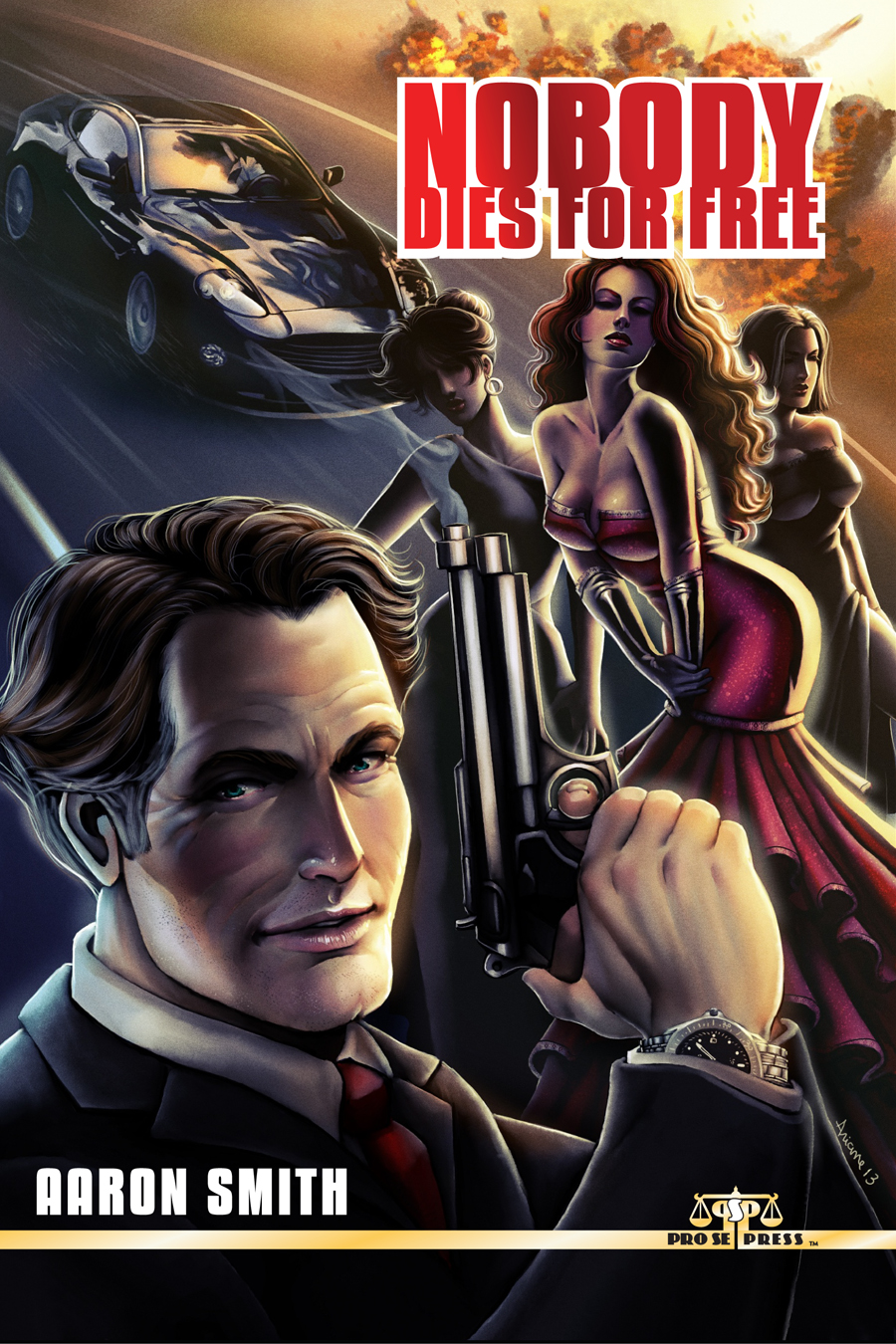
Nobody Dies FCHere’s a look at the cover of Nobody Dies For Free, along with the back cover blurb.

After years of loyally serving his country in the CIA, Richard Monroe wants nothing more than early retirement and a peaceful life in Paris with the only woman he’s ever truly loved. But when an assassin’s bullet takes his happiness away, Monroe embarks on a quest to find the man responsible for the tragedy. Monroe is soon recruited back into the clandestine services, but with a difference. Now he’s a lone agent reporting to a supervisor so mysterious that the official agencies don’t even know he exists. In his new position, Monroe will deal with situations too delicate and too dangerous for the CIA or FBI to handle. On his first assignment, he discovers a connection between the mission and the criminal mastermind behind his wife’s killing. Business becomes personal again and Richard Monroe sets out to teach his enemies a brutal lesson: NOBODY DIES FOR FREE!

Nobody Dies For Free is available in print or for Kindle or Nook.

At Amazon: http://www.amazon.com/Nobody-Dies-Free-Aaron-Smith/dp/1490367586/ref=sr_1_7?s=books&ie=UTF8&qid=1374860949&sr=1-7

Amazon UK: http://www.amazon.co.uk/Nobody-Dies-Free-Aaron-Smith/dp/1490367586/ref=sr_1_1?ie=UTF8&qid=1374861049&sr=8-1&keywords=nobody+dies+for+free

Barnes & Noble: http://www.barnesandnoble.com/w/nobody-dies-for-free-aaron-smith/1115568615?ean=9781490367583

For further information on Nobody Dies For Free and all my other books, visit my Amazon author page at http://www.amazon.com/Aaron-Smith/e/B0037IL0IS/ref=sr_tc_2_0?qid=1374366653&sr=1-2-ent

Or visit my blog at http://godsandgalaxies.blogspot.com/

 

[Guest Post] Paige Dearth – write what you know.

18 Sunday Aug 2013

Posted by D.A Lascelles in Guest posts

≈ Leave a comment

Tags

Believe Like a Child, books, guest blogging, guest posts, Paige Dearth, Thriller, When Smiles Fade, Write what you know, writing


Making Connections Paige Dearth

Today we focus on the work of Paige Dearth, author of Believe Like a Child and When Smiles Fade.

In her debut novel, Believe like a Child, the main character Alessa is the victim of child abuse from her uncle. The story is one of redemption and of a woman taking control of her own life.

In When Smiles Fade, her latest novel released this year, the main character Emma is also abused as a child as you can see from this synopsis:

Emma was unloved from the moment she was born. Her earliest memory is being severely beaten by her father, Pepper Murphy, when she was just eight-yearsold. Seething with resentment over the sacrifice of his dreams for a woman he cares little about and children he never wanted, Pepper chooses to blame his older daughter. Her mother, Valerie, makes matters worse with her verbal abuse, leaving Emma isolated with a man that had no boundaries in punishing his daughter, taking his abuse to unimaginable levels. Emma’s father’s coldblooded beatings and the ultimate abuse to which he subjects her, lays the foundation of the person she becomes. As she matures into a resourceful teenager, she is unwilling and unable to stifle her desire for revenge. Reaching her breaking point she can no longer control the impulse to fight back and finally takes matters into her own hands. Having learned the art of hatred from her father and the mastery of manipulation from her mother, young Emma now sets out to make a better life for herself, leaving the memory of the abused child she had once been behind her. Hardened by the heartless brutality she encounters and the dangerous situations she must overcome in the course of her journey, she faces every challenge that comes her way in her quest for a normal life for herself and for those she loves. Finally a person emerges from within that guides her toward a better life until she learns of a secret that sets her on the path of ultimate redemption.

Both stories contain inspiration taken from Paige’s own life. She herself was a victim of child abuse at an early age and spent her childhood not believing that she had the potential to much in the way of ambition. When she finally went to college at the age of 29, she did not even believe that she was capable of passing the college level courses and yet she finally left college with an MBA 8 years later and a feeling that she had conquered her fear of learning. There followed a successful career in corporate America and finally a writing career that has seen her earn a finalist place in the thriller category of the National Indie Excellence Book Awards. Paige’s own life is an example of someone seeking to improve their lot.

So, both novels mirror events in Paige’s life, she has used her real life to inspire her writing. This ties in with the common author’s adage of ‘write what you know’. This saying is often mocked, especially in fantasy and SF, because you cannot ‘know’ what it is like to be a Dragon or an Orc or a wizard. However, this is applying an ad absurdum argument because there are still elements of a person’s life which will apply to any fictional character. Likewise in a suspense thriller, there are almost certainly going to be things in there that an author has not experienced but the trick is to take the things that have happened to you and apply them. Writing what you know is all about adding a level of emotional veracity to the writing that is conveyed to the reader. The use of the term ‘what you know’ is actually a misnomer as it really is not about knowledge at all. Knowledge is what you get from books and, these days, from the internet – whether by looking something up on Google or (as commonly happens) asking a question on a forum populated by experts in that area. Instead it is all about the experience – the emotional and physical impact that this has on you as an individual. I believe that this level of veracity is important. You don’t need to necessarily add emotional context to every event in your story but it does help if you have some personal life experiences you can call upon if needed. They may not be as traumatic as those described here, I would not wish such things on anyone if it could be at all avoided, but any life event can be useful – the tastes of food, the smell of the inside of a car, what it feels like to spend all day in a library reading ancient books. An author should be prepared to reflect upon their experiences and consider what they can learn from them and what they can use to improve their writing.

You can find out more about Paige on her website: www.paigedearth.com.

You can buy her books on the following links:

Believe Like a Child (US)

Believe Like a Child (UK)

When Smiles Fade (US)

When Smiles Fade (UK)

Later this year she also plans to release her third novel so please keep an eye out for that.

[Guest Post] Jill Sanders

08 Thursday Aug 2013

Posted by D.A Lascelles in Guest posts

≈ 1 Comment

Tags

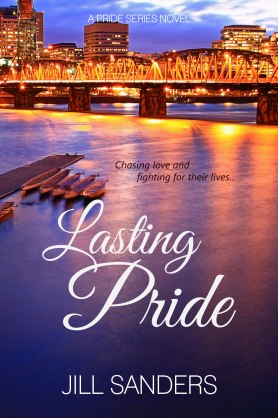
Jill Sanders, Lasting Pride, Romance, romantic suspense, Secret Seduction


Today we have a visitor in the form of Jill Sanders, a highly successful romantic suspense author with a #2 Bestseller on Amazon and a shortlist in the Amazon Breakthrough awards. She is here to promote her latest releases. That’s right… Releases. Because, not content with merely producing one novel like other authors do, she’s produced two of them. So below we have extracts from the latest in Jill’s Pride series, Lasting Pride, and her new novel, Secret Seduction, which is the first part in the Secret series. Read, enjoy and please click the links to find out more about Jill and her work.

Click the image below to go to her site for a giveaway and to find out details of the other blogs involved in this tour!

blogtour

LASTING PRIDE
An hour later, she walked into his room to wake him and check on him. When she walked in, she was shocked to see his large bed empty. There was a soft light coming from under the bathroom door. The first thing that flashed in her mind was fear that he’d passed out on the bathroom floor. Rushing into the large room, she looked around and she saw him. Lying in the large jacuzzi tub with it’s jets still on and she could see steam rising from the water. His head was rested against a pillowed head rest and his eyes were closed, he looked completely relaxed and wonderfully naked.4LastingPride

Walking over, she took in her fill of him. The man had some great muscles, she could see the bruises running up and down his side that he must have landed on.

He was resting so that his left shoulder and arm were dangling out of the water, keeping his stitches dry. Her eyes ran down his chest and enjoyed the view of his pecks. His stomach was tight and she could just make out a very sexy six pack. His sandy blond hair ran in a light trail, pulling her eyes downwards. Noticing that he was hard all over, she smiled. Then, she moved down to his thighs, which were very muscular and covered with a light coating of blond hair. He was too tall for the bathtub so his feet hung off the ends, resting on the ledge of the tub.

Looking back to his face, she watched his dark eyelashes. How was it, that this man was lucky enough to get very long eyelashes? She was cursed with short thin ones.

His face looked totally relaxed. Walking closer to him, she sat on the edge of the tub.

“Damn it Ric, you should know better than to fall asleep in this thing.” When he opened his eyes, she saw him focus, then she noticed the wicked look in his eyes. She tried to pull away, but he was too quick. Before she knew it, she was crushed to his wet body. Her sleeping t-shirt and shorts were soaking wet. Her hair, which had just dried from her own shower, was wet and in her eyes now.

“I was just dreaming of you and this,” his mouth was on hers again. This time, the passion was undeniable. He held her head to his with his right hand as she tried to get away. “Mmmm, you taste so good,” he tried to pull her closer.

***

SECRET SEDUCTION:

1Xseduction768When he’d barged in, she’d jerked her head up, slamming it on the corner of the sharp metal faucet.

“Ouch, damn it, Jason!” She rubbed her head with her fingers, near the spot she’d just hit.

Recovering, he quickly shut the door behind him, locked them in, and walked over to her. He dropped his bag next to hers then took her head in his hands and looked at the small injury.

She was still bent over the sink, her wet hair dripping in her eyes and face. “Here, let me see. Oh, man. You’ve got a small cut here. The faucet must have been sharp.”

“Can’t I just have a few minutes to clean up without having you barge in here acting like you’re a white knight trying to rescue me?” He could see tears of pain in her eyes as she looked up at him. Then again, he thought, maybe they were from the shampoo dripping into her eyes.

“Shh.” He pulled her head back towards the sink. “Here, let me help.” He started splashing water over her soapy head.

She braced her hands on the sink ledge and held on. He could see her shifting her feet to bend over and knew that the position was probably uncomfortable for her.

“There was so much flour in my hair, I just had to clean some of it out,” she said over her shoulder, while trying to look at him.

He turned her head back and placed it over the sink, then he cupped his hands, scooping the water up and gently dumping it over her hair, washing the bubbles from it.

She became very still while holding onto the side of the sink for support, so he continued rinsing her hair until it was clean. When he was done, he bent over and picked up the small hand towel she’d dropped.

He turned her around so she faced the mirror and slowly rubbed her hair dry. He leaned her head down so he could gently part her hair where the small cut was. He noticed the bleeding had stopped thanks to the cold water, but he still made sure it was clean before continuing to dry her hair.

***

Find out more about Jill Sanders and her work:

Jill Sanders survived 80’s pop music, and life as an identical twin in a chaotic family of nine.  A feat by any standard!  She was born and raised in the Pacific Northwest, relocating to Colorado for college and a successful IT career at IBM in Boulder.

Narrowly escaping before all creativity was squashed, she jumped at the chance to trade the mundane world of computers for the sexy, exciting world of her own imagination.  She now lives in charming rural Texas writing wonderful novels such as the Pride series.

Her debut novel, Finding Pride, was shortlisted in the Amazon Breakthrough Novel Awards 2013, and has since climbed to #2 on Amazon Bestsellers – Romantic Suspense. Each book in the Pride Series has found a regular home on Amazon’s Bestseller lists.

Stay tuned for Jill’s newest romantic suspense series – The Secret series.

Coming soon, a new Contemporary Romance Series of three sisters struggling to save their ranch in Texas in the Cowgirls Ride series.

This Christmas unwrap a steamy Christmas romance tale – Red Hot Christmas.

To learn more about Jill, visit her website www.jillmsanders.com, where she blogs daily, or follow her on Twitter: @jillmsanders.

[AW Blog chain] Devil Child

05 Monday Aug 2013

Posted by D.A Lascelles in Film, Musings

≈ 20 Comments

Tags

Childs Play, Devil Baby of Hull House, devil child, Hellboy, Ira Levin, Jane Addams, Old Wives tales, pregnancy experience, Roman Polanski, Rosemary's Baby, The Demon Child, The Omen, Urban Legends


So, after a long absence I am finally back on the old AW blog chain gang, picking up litter from the highways and turning it into readable blogs while men with sunglasses, police uniforms and guns watch us… it’s a hard life. but someone has to do it.

This month the Blogchaintopicomogrifier (patent pending) has beeped and churned and made flashing lights to produce the title of ‘Devil Child’ on its little tickertape printer thing*. At least I think that is what it read. That tickertape font is hard to read sometime, what with all the +++++’s in the middle of everything.

So, ‘Devil Child’. It conjures up several images. The juxtaposition of the traditional root of all evil with something that is considered to be innocent is an intriguing one that does generate a lot of interest. Films have been known to play on the perceived innocence of children. The Omen franchise, for example, bases its entire horror premise on the fact that awful things happen to people, such as sheets of glass decapitating them, quite by accident while a cute, small child smiles happily and entirely innocently several miles away with a perfect alibi. Not to mention various ‘creepy doll’ concepts such as the Childs Play series in which the doll Chucky (coincidentally voiced by the same chap who played Grima Wormtongue in Lord of the Rings) becomes possessed of the devil and wreak murderous havoc.

One film in particular, however, really ramps up the creepy with this concept. Rosemary’s Baby. This film is the perfect example of sixties occult cinema***, filled with some very sinister satanic imagery and derives most of its horror from the psychological effects such things have on the protagonists. It is also filled with various not so subtle references to things linked to pregnancy – cravings, abdominal pains and so on – to the extent that it could be interpreted as a metaphor for the darker aspects of the pregnancy experience. You could also discuss the quite nasty rape implications inherent in the film. In a dream sequence after she faints, Rosemary is raped by the devil and this is bad enough but worse than that when she wakes up and finds she is pregnant her husband tells her that while she was unconscious he decided to have sex with her anyway because he did not want to waste the chance. That to me does not sound like the actions of a concerned husband. Or even a decent human being.

But differences between a ‘happy household’ in the 1960s and today aside, I really wanted to talk about the urban legend that allegedly inspired the book by Ira Levin which inspired Roman Polanski to make Rosemary’s Baby. The Devil Baby of Hull House.

Jane Addams

Hull House was opened by Jane Addams in 1889 as a Chicago based community to help provide social and educational opportunities for working class people. It achieved this by providing lessons in everything from academic subjects such as art and literature to domestic tasks such as sewing. They also provided free concerts, discussions on current affairs and clubs for children and adults. However, far from being known as a place of egalitarian and charitable education and social mobility, Hull house came to be known for something far more sinister. One story goes that the atheist husband of a Catholic wife refused to allow an icon of the Virgin Mary (some versions say Jesus Christ) to be hung on their wall, declaring that he would rather have the devil himself in residence. Another version, the Jewish version, claims that the husband, for want of a son, declared he would rather have the devil himself than another daughter. Whatever the husband declared, whether he cursed god or the prospect of a daughter, the wife gave birth to a creature that has been described as follows:

“The doctor stood and revealed the child cradled in his arms. A monster writhed within the scratched and bloodied arms of the terrified physician. It was larger then a one year old child, its skin like a reptile’s, both scaly and rough. Sharp horns jetted out of its head on either side and a thin, long object swayed in the air, the tip shaped like a two-pronged fork, swayed about the infants head.” (Daniel Cumerlato, founding partner of Haunted Hamilton).

And:

“No amount of denial convinced them that he was not there, for they knew exactly what he was like with his cloven hooves, his pointed ears and diminutive tail; the Devil Baby had, moreover, been able to speak as soon as he was born and was most shockingly profane” (Jane Addams, The Long Road of Women’s Memory, Chapter One, p3)

Jane Addams allegedly had the child locked in the attic of Hull House and made attempts at having it baptised and rumours about the child ran amok in Chicago. Addams strenuously denied the rumours, claiming (quite rightly) that there was no evidence for it other than hearsay. She did later talk at length about the incident in her book, The long Road of Woman’s Memory. Chapter one is subtitled ‘Women’s memories – Transmuting the past, as illustrated by the story of the Devil Baby’ and in it she talks about the ‘power of an Old Wives’ tale’, describing what we would now refer to as an Urban legend in the many visitors who had come to the house to see the baby, convinced that it existed. She gives a fairly involved memoir about her recollections of some of these, including a list of the phrases she had to repeat endlessly to throw off these sightseers and their bizarre counterarguments. However, it seemed as if the more she denied it, the more convinced her visitors were that she was hiding the baby somewhere in one of the many rooms of the house.

Addams makes a lot of good points in that chapter. This story is the perfect example of an Urban legend where a rumour spreads and so many are convinced of it they cannot be persuaded of the truth. The only variations noted by Addams are religious ones – she mentions there are slight differences between the Italian catholic versions of the story and the Jewish ones – so there is a lot of consistency in the legend which only adds to the veracity of it as more and more become convinced of its truth. There is also no way to tell how this story began – no real evidence of any of the variant origin stories.

So, the Devil Baby of Hull house is an example of the power of human imagination gone wild and stories like this have not only inspired films like Rosemary’s Baby, playing on the fears of potential parents over the nature of their offspring, but also such franchises as Hellboy. Can you think of any similar stories, maybe from your local area? Feel free to comment below.

*We could fit it to a proper printer and even a decent LCD screen. Frankly, we could even turn it into a smartphone app but if you are going to have something called a ‘Blogchaintopicomogrifier’ it has to have valves, and Jacobs ladders and switches and flashing lights and steam coming out of it and, yes, print any output onto a tiny slip of paper in a hard to read font that is destined to eventually be thrown at Astronauts coming home from space **

** Yeah, you see America only created NASA and the associated space program because it needed some method to dispose of all the waste tickertape that Wall Street was producing. Clearly the most environmentally friendly and efficient method was to spend billions of dollars to send men to the moon so you can then drive them through the streets of some city and throw waste paper at them. Note how there seems to be no money for a space program now that everything is ‘paperless’ and we have smartphones and LCD screens and decent printers? Coincidence? I think not…

*** And I really, really, really, hope that no one is planning a modern remake of this. They’d do something silly like use CGI and completely miss out the tension…

Now, this is a blogchain and there are rules. The rules are that you must go and look at the other articles in the chain. If you don’t, there will be dire consequences, possibly of a gynaecological nature… List of links to the other blogs is below:

Participants and posts:
ishtar’sgate – http://chickenscratchbc.blogspot.ca/ (link to post)
orion_mk3 – http://nonexistentbooks.wordpress.com (link to post)
BDavidHughes – http://bdavidhughes.com/
Ralph Pines – http://ralfast.wordpress.com/
articshark – http://www.drslaten.com/blog
pyrosama – http://matrix-hole.blogspot.com/
Anarchic Q – http://anarchicq.com/
meowzbark – http://www.lizzylessard.com/
MsLaylaCakes – http://www.taraquan.com/
grace elliot – http://graceelliot-author.blogspot.com/
milkweed – http://www.thistlequill.blogspot.com/

Dianna Hardy Giveaway!

26 Friday Jul 2013

Posted by D.A Lascelles in Giveaway

≈ 8 Comments

Tags

books, Cry of the Wolf, Dianna Hardy, entertainment, Fur and Fangs Giveaway, Giveaway


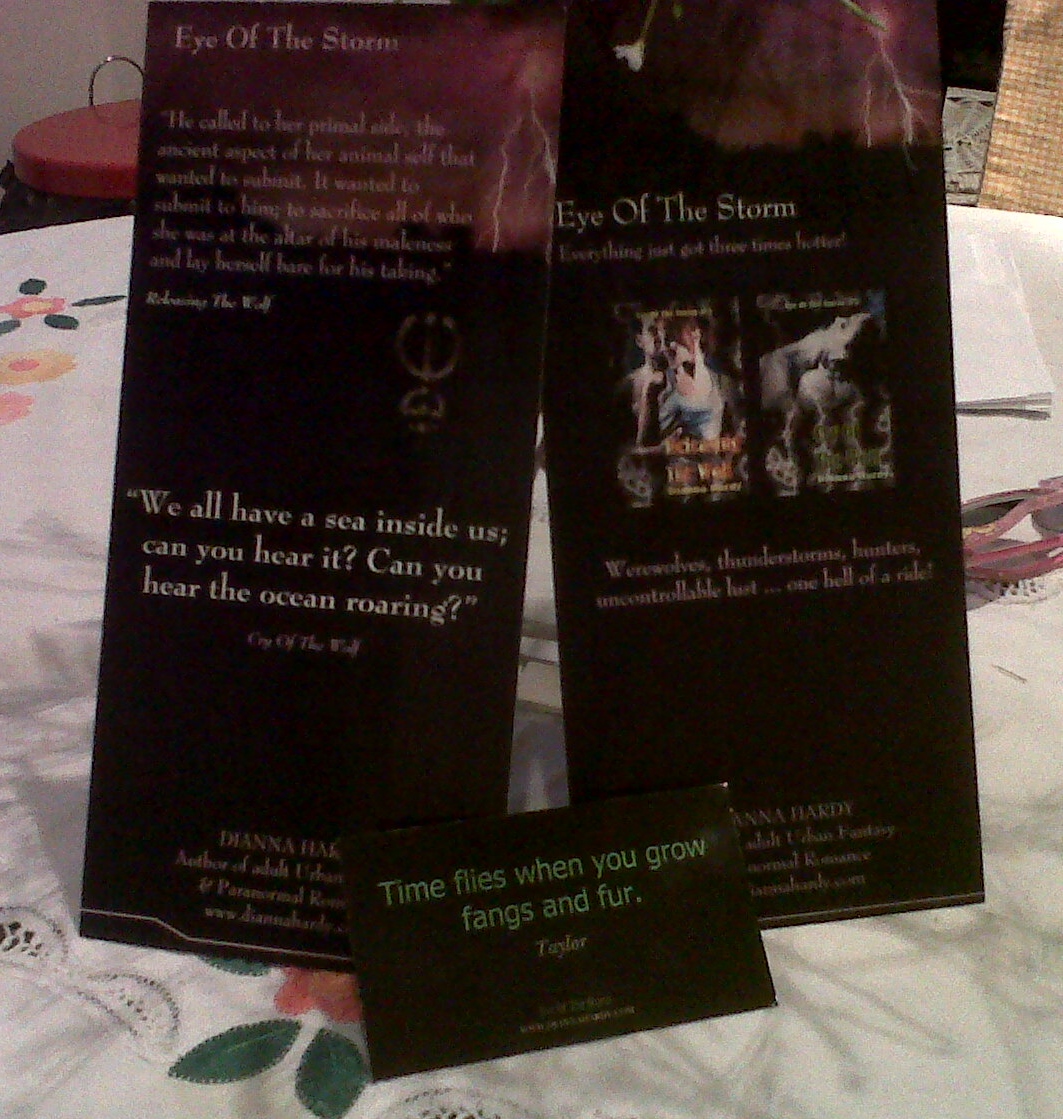
Yesterday you were treated to an extract from Cry of the Wolf. Today you are to be treated to a giveaway of swag related to all things Dianna Hardy. This swag bag contains goodies such as a fangs and fur fridge magnet and quote bookmarks.

Tameside-20130725-00291

To enter this giveaway, click on the Rafflecopter link below and perform each of the tasks listed to gain extra entries. If you comment on this post below you also gain an entry into the big giveaway on Dianna’s own blog as well. You only have a week to enter this giveaway so you had better get clicking before the timer runs out!

a Rafflecopter giveaway

Dianna Hardy: Cry of the Wolf Blog tour

25 Thursday Jul 2013

Posted by D.A Lascelles in Guest posts

≈ 1 Comment

Tags

blog tour, Cry of the Wolf, Dianna Hardy, paranormal romance, Romance, The Witching Pen, Werewolf, writing


Today we are taking part in a blog tour for Dianna Hardy. You might remember Dianna from her appearance in Vampire Month and her talking about the Witching Pen series. Here she is giving us a review of her latest series, Eye of the Storm, with an extract from Cry of the Wolf. Tomorrow, look out for a giveaway for exclusive goodies!

Extract from Cry of the WolfCryOfTheWolfCoverFrontSMALL

Looking to pass the time, she made her way to her desk where Lawrence’s books were scattered from where she’d abandoned them almost twenty-four hours ago. Now, where had she left off?
Right. Mythology.

It didn’t take her long to find the passage she’d read earlier, and it was an absorbing read: a god and a goddess ruled by anger had split themselves apart, creating, for all intents and purposes, duality. But they quickly discovered they could not live without each other. Loneliness and loss consumed them, and it came to be that the only way they could rejoin since their separation was when the lightning (the god) penetrated the earth (the goddess).

Interesting…

In these moments, Yemet’s determination renewed, as did her anger, and she vowed to find a way to rejoin with Himet.

One night, under the full moon, which reflected Himet’s love for her when the sun could not, Yemet led her most prized and loyal animal – the wolf – to the top of the highest mountain. She let her grief, her sorrow, her loneliness and her anger pour out of her until she manifested a storm. Himet responded, joining in her dance, and at the exact moment he sent down his lightning, she placed the wolf in its path and infused herself with it.

Himet cried out in terror, but he could not pull back the lightning. It hit Yemet while she was in the physical form of the wolf – whilst she was mortal.

“Why?!” he asked her, his sorrow consuming him.

“I could not see, but now I do,” she replied with her dying breath, “to have all of you, I must yield all of me. Take my life, Himet. I trust you with it. I give it freely.”

© Dianna Hardy, 2013. All rights reserved.

Bio:

Dianna Hardy Colour Portfolio SmallAuthor of The Witching Pen and the Eye Of The Storm series.

Dianna combines a titillating mix of paranormal romance and urban fantasy into her writing, to bring you stories that are action-packed, fast-paced and not short of heat, with the focus on both character development and the plot. She writes both full-length novels and short fiction. She has also written poetry and esoteric books and articles.

Although quite active online, Dianna is a self-confessed hermit, preferring the company of nature and animals to the hustle and bustle of people. She loves anything paranormal (she doesn’t really consider it “para”), organic food, walking barefoot, the smell of the woods after rain, and summer days.

However, she is also sustained by coffee, chocolate and the occasional vodka.

She lives in the UK with her partner and their daughter, where she devotes her time to parenting, publishing and writing.

Links

Website: www.diannahardy.com

Facebook: www.facebook.com/authordiannahardy

Twitter: www.twitter.com/thewitchingpen

Amazon: www.amazon.com/Dianna-Hardy/e/B003AGRHFC

Google +: www.plus.google.com/u/0/110398750519005724804/posts

The Witching Pen website: www.thewitchingpen.co.uk

This post is part of a blog tour. Check out the other stops on the tour… Click the picture below to see the full list.

Werewolf Love Blog Hop

The truth is out there?

11 Thursday Jul 2013

Posted by D.A Lascelles in Musings

≈ 2 Comments

Tags

alien civilisations, aliens, Close Encounters of the Third Kind, Douglas Adams, Dyson sphere, E.T the Extra-Terrestrial, Eukaryotes, Europa, images of aliens, Independence Day, Io, NSA, Prokaryotes, Pulsars, Science, SETI, Spring-Heeled Jack, Star Trek, Terry Pratchett, UK SETI, Vulcans


I used Grammarly to grammar check this post, because even primitive, prokaryotic parasites should display good grammar.

My trawlings of the internet brought this article to my attention:

http://uk.news.yahoo.com/new-hunt-for-aliens-who-%E2%80%9Cmove-stars%E2%80%9D-150112482.html

It seems that the British version of the SETI project (UK SETI research network) is focusing its efforts on finding evidence of aliens capable of moving stars or building giant structures in space. This being in addition to SETI’s usual activities of eavesdropping on potential alien communications like some interstellar version of the NSA*.

This sort of research is great for reporters. It makes good copy and impresses the readers with lots of imaginative images of alien civilisations and the advanced technology their no doubt superior intelligence has created. As a society, modern humanity has been brought up on the Hollywood stories of E.T, Close Encounters of the Third Kind and Independence Day. Aliens in these stories are intelligent with highly advanced technology including ships that are capable of achieving the near impossible (according to current human understanding of physics) speeds necessary to travel the vast interstellar distances needed to get here from our nearest neighbour. They also have some form of interest in Earth – whether as a target for conquest, often to mine for our plentiful resources, or as a potential ally (however junior) in some form of galactic federation (for example the Vulcans in Star Trek). They can also be obsessed with capturing and probing helpless humans either for scientific research or, according to Terry Pratchett and Douglas Adams, as the alien equivalent to Cow Tipping. These are our common held beliefs about alien life, mired in stories of the fantastic that range back even so far as the tales of Spring Heeled Jack.

There are, however, a lot of assumptions in those images of aliens. They assume that not only are they sentient and civilised but that they are infinitely more intelligent and civilised than we are. Why should this be the case? Given that the greatest chance we have of identifying life on other planets might currently be finding bacteria or even just the remnants of bacteria deep in the oceans of Europa or hidden in the rocks of Io, why should we expect any other alien species to be any more than that? These alien bacteria are unlikely to blow up the Whitehouse or give us access to the secrets of eternal life or warp drives. Even if an alien race were more complex than our own earthborne prokaryoates**, to the extent of being multicellular and sentient, then why should they be necessarily more advanced? Could there not be a race of quiet, unassuming aliens out there somewhere in the universe, sitting in caves, drawing on walls and hitting rocks together in the vague hope of one day discovering fire? Given that our entire strategy for finding aliens is predicated on the assumption that they are at least as advanced as we are (to the extent of using EM radiation to communicate and entertain) there is very little chance we’d find any evidence of our extraterrestrial cavemen. Considering that there has been, to date, approximately two hundred thousand years of human existence on earth and we have only been transmitting EM waves from our televisions and radios for just over 100 of these, how likely do you think it is that some other civilisation is going to be producing such waves themselves or picking up on ours? Assuming, of course, that they do utilise EM radiation in the same way we do and don’t communicate using some other method that we have never considered. While the chance of alien life actually existing are a lot higher than previously believed, the universe is so vast in both time and space that the chances of us picking up on each other are very low indeed.

There are, of course, several reasons why we have these assumptions about alien life. The main practical ones revolve around the fact that we basically have no hope of finding any form of life more primitive than 20th century humans. Until we ourselves get to the point of being able to travel to other planets to look for ourselves, we are somewhat limited by our ability to detect things like EM waves and interpret them in some way. Sometimes we can’t even do that right and mistake something like a pulsar for evidence of alien life. There are potentially hundreds of thousands of years worth of alien development that lack such obvious signs but we cannot detect them unless there is a major shift in our technology. So we are limited to what we can detect and that assumes aliens with technology at least as advanced as our own. Also, any alien civilisation that came to visit us would be definitely more advanced because they would have to have developed the appropriate methods of interstellar travel.

However, these prosaic reasons pale in comparison to those based on human nature and wish fulfilment. We have always looked to the

An artists idea of what a Dyson sphere may look like. For scale consider that the yellow thing in the middle is a star like our sun.

stars and wondered about them. In the past we made them the home of the gods, now we consider them the home of aliens. Some theories even conflate the two by stating that the aliens came to earth and became our gods. A number of science fiction franchises are even based on this theory including both the original and more recent Battlestar Galactica series. Psychologically, humanity appears to feel the need to have something bigger than it out there to look up to. Having risen to the top of the foodchain on earth, we offset our responsibility for the planet and all who live on it by deferring it ‘upstairs’ – to superior beings be they gods, aliens or even abstract ideals such as the Fates.

Also, aliens with vastly superior technology and intelligence make for far better stories than quiet ones who just want to get on with discovering fire or inventing the printing press. When we defeat the former we look like epic heroes valiantly battling against impossible odds and a superior foe***. Defeat the latter and we are colonialist dicks imposing our ‘superior’ ideals and technology on the poor defenceless natives and frankly we have done enough of that in our time. In the absence of any other concrete evidence at all about aliens, we will naturally tend to default to an assumption where they are bigger and better than we are. All in all, it is far better for our psychological well-being for aliens to be more advanced than we are.

So, while scientists are busy out there trying to eavesdrop on alien telephone conversations or looking for Dyson spheres, spare a thought for the simple prokaryoates potentially clinging to a semblance of organic life on some volcanic vent deep on an extrasolar planet or the spear wielding, eight armed, crocodile headed people of Arachnia who have not yet heard of Marconi or Alexander Graham Bell and wouldn’t even know how to build a Dyson vacuum cleaner never mind a Dyson Sphere.

* All this talk of the NSA eavesdropping on the internet and not one person thinks to stand up for the rights of aliens to their privacy. Typical humanocentric attitude. Someone should seek to regulate SETI’s privacy invading practises.

** Prokaryotes, for those without knowledge of A level Biology, is a posh science word for the group of organism that include bacteria. It refers to a Kingdom of living organisms that lack a nuclear membrane among other features I won’t go into here. Eukaryoates, which is what we are, do have a nuclear membrane. It is generally considered that Prokaryotes are a more primitive form of life in evolutionary terms. Certainly all the multicellular creatures on earth have nuclear membranes, though as this grouping includes several humans who believe in some very silly political ideas it may seem a little disingenuous to call them ‘advanced’.

*** Or at least having superior pathogens, as in the case of War of Worlds. We humans may not have interstellar travel or heat rays but we sure know how to cultivate a deadly cold virus.

Tennis and Football stars from Newcastle by Dr. Jo Bath

04 Thursday Jul 2013

Posted by D.A Lascelles in Guest posts

≈ Leave a comment

Tags

books, city of newcastle upon tyne, Dr. Jo Bath, Football, guest blogging, guest posts, history, Mary Brown, Munitionettes, Muriel Robb, nooks and crannies, Publication, refined ladies, sports, St James Park, Tennis, The British Ladies' Football Club, welsh championships, Wimbledon, wimbledon champion, Women, writing


Today’s guest post is by Dr. Jo Bath, co-author of The Newcastle Book of Days, which is a collection of ‘On this Day’ style anecdotes and historical snippets centred around the city of Newcastle Upon Tyne. Being as how it is a city close to my heart, being close to where I was born, my interest is especially piqued by this book. I even remember some of the events described, including the building of the Metro described below. Here she talks about some of the stories she came across when writing the book, including one that is very relevant in Wimbledon season…

Muriel Robb

One of the best things about writing a Book of Days has been the freedom to explore more or less any aspect of local history that caught my eye. Of course, some things were always going to be included in one form or another. You can’t cover Newcastle’s history without referring to, for instance, the Great Fire which devastated the Quayside on October 6th 1854, the development of Grainger Town or the birth of the Metro (the largest urban transport project of twentieth-century Britain). But what really excited me were the nooks and crannies of the city’s history, the almost-forgotten figures and stories which have all, in their way, made the place what it is today.

I’m sitting in my office listening to the tennis, and that reminds me that Newcastle has a Wimbledon champion all of its own in 23-year-old Jesmond-based Muriel Robb. Admittedly her victory was on July 2nd 1902, so the contest was very different from the modern game. Wimbledon merely hosted the English National Championships (though participants did come from further afield – Robb had already won the Irish, Scottish and Welsh Championships). At the time, the women’s game was quite sedate, with underarm serves delivered by refined ladies in floor-length dresses and straw hats. But Robb was a blast of fresh air. Despite the handicap of corsetry, she was a relatively speedy mover and probably the first woman to serve overarm. Contemporary Arthur Myers said that “her command of the ball was so striking, her forehand drives so deadly, and her overhead service so effective, while her self-possession was so apparent,” that her opponents were often placed at a disadvantage.
Remarkably, due to a strange decision Robb’s Wimbledon final, against defending champion Charlotte Sterry, was the longest women’s Wimbledon final in history. The match was drawn at a set each when rain stopped play. Rather than playing a deciding set the next day, the committee decided to wipe the scoreboard and start from scratch! This time, Robb won comfortably – after playing a total of 53 games. Despite her powerful play, her health was never that robust, and she retired later the same year. She died less than five years later, of unknown causes – the youngest Wimbledon champion ever to die.

armstrong_munitionettes

Armstrong Munitionettes

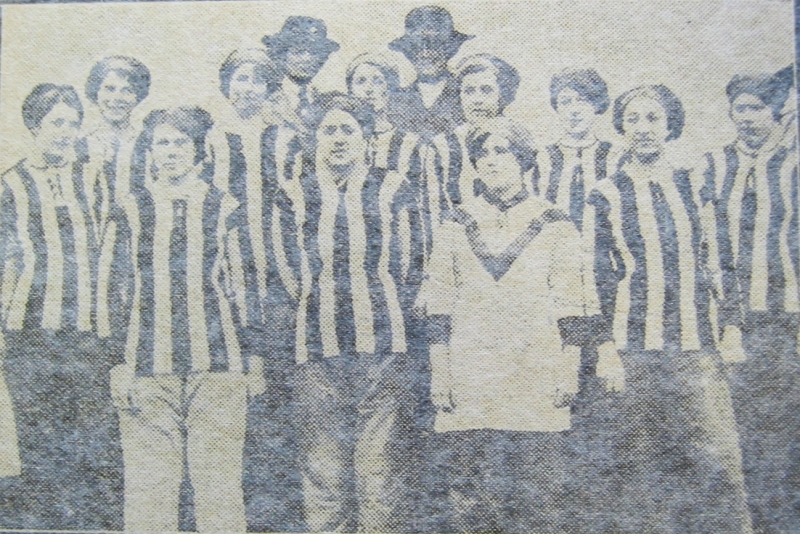
Speaking of female sports players, Newcastle’s ladies (as you might expect) were also pioneers on the football field. The British Ladies’ Football Club played at St James’ Park on April 20th, 1895, only a month after they formed, and a crowd of 8,000 gathered to watch the “spectacle”. The reporter for the Sporting Man was obviously confused by the whole thing, and spent all his time describing the women’s attire. He concluded that “the young women presented a pretty appearance on the field, and this was in great measure due to the nice assortment of colours, as well as the dainty way the women set them off”! The quality of football played on this occasion is unclear, but certainly twenty years later a new generation of teenage girls embraced the sport with enthusiasm. The Munitionettes League was formed in 1917, made up of teams from the women workers of the factories of the north-east, and was the first ever league for women’s football. Made obsolete by the end of the war, the League lasted less than three years, but St James’ Park, host to the cup final, saw some remarkable young women in action. Mary Brown, playing for Palmer’s of Jarrow, not only played in the 1919 final (March 22nd) but at 14 was the youngest-ever footballer, of either gender, to play for England!

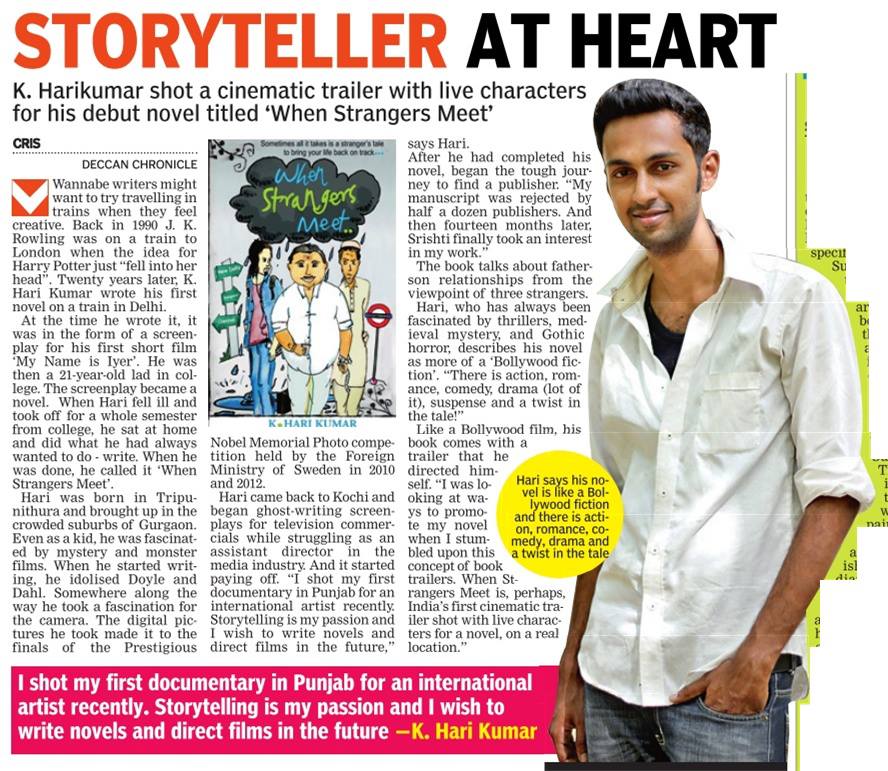
K. Hari Kumar – a success story you may not have heard of (yet)

26 Wednesday Jun 2013

Posted by D.A Lascelles in Publicity

≈ Leave a comment

Tags

'The Man Who Loved me', Bollywood, Book trailer, Cinematography, drama, entertainment, film, IFF Melbourne, India, K. Hari Kumar, The Visitor, When Strangers meet


Despite worldwide communications through an extensive series of phone and internet connections that reach even to the most remote parts of the planet, individual countries are often oblivious to what is going on in other parts of the world. The recent incidents in Turkey are a very serious example of this – an issue highlighted by blogs and online support but largely ignored by the media until brought to light. Even in the global village we have built walls around our own interests and barely peek above them to see what the neighbours are up to. To potentially stretch the metaphor too far, we only care when their hedge gets too tall or they make loud noises at 3 in the morning.dp1

Which is why you have almost certainly not heard of K. Hari Kumar. Unless you are one of the million people who read his blog or buy his books. That’s right, one million blog readers and a book that has sold out many times over. The reason you have never heard of him is because all those readers are from India and we Brits and Americans have not bothered to peek over the hedge to see what they are up to over there. I’d not heard of him until I was asked to do this blog on his behalf. He’s big in India but, like many UK pop stars yearning to break the US market, now wants to make big in other parts of the world.

So, I am here to introduce you to K. Hari Kumar and his work. Read on to find out all about an Urban Fiction novel with a Bollywood flavour and the young cinematographer who wrote it.

K.Hari Kumar is the author of the English novel When Strangers Meet… He’s also a two time International award nominated Photographer.

Having born in to a Tulu family in Tripunithara, he grew up in the thick suburbs of the Millennium city, Gurgaon. He did his schooling from DAV Public School, Gurgaon. After completing his engineering in 2011, K.Hari Kumar left for his hometown in Trichur, Kerala. Since then he has been assisting couple of ad-filmmakers from Cochin and has ghost-written dozens of conceptual screenplays for TVCs of reputed brands. Storytelling is his passion and he is working on his second novel. He wishes to assist mainstream filmmakers and eventually make Feature films in future. His earliest attempt ‘The Man who loved me’ was selected for the prelims at ‘IFF Melbourne’ in the year 2011. The film had K.Hari Kumar in the seats of Lead Protagonist, Screenwriter, editor & Director. It was made with a digicam. He has directed 4 short films and a cinematic documentary till date. He chose not to act in his 4th short film ‘The Visitor’ which is a horror short film shot entirely in Black and white, as an ode to classic Noir of the 50s.

An interview with The Deccan Chronicle

An interview with The Deccan Chronicle

K.Hari Kumar’s greatest fascination is tales about the supernatural and is an ardent lover of Hitchcock movies.

K.Hari Kumar’s blog ‘Strangeronmyshelf.in’ is an innovative concept where upcoming short-filmmakers, writers, poets, photographers, musicians etc are given a free of cost platform to portray their works of creative art. The blog now boasts of a small family but he wishes to extend it to a large family of Strangers who shall help others to showcase their dreams on the world wide web thereby promoting mutual cooperation as well. The blog has over eight lakh hits already.

He is currently travelling across the major metros of India, promoting his novel to the farthest possible extent.

In promoting When Strangers Meet, he put together an interesting alternative to the concept of a book trailer. An actual trailer using live actors.

Reviews of When Strangers Meet :

‘A simple story narrated in a gripping style which forces you to turn pages’ – Yatin Gupta (IBN)

http://iyatingupta.com/book-review-when-strangers-meet-k-hari-kumar/

‘I think this book appeals to me because of its realism. The plot appealed to me personally with a father-son relationship being involved. And it touched me. What I like in this book is Hari’s narration.’ – Leo (Bookworm musing)

http://abookwormsmusing.wordpress.com/2013/05/20/book-review-when-strangers-meet-by-hari-kumar/

‘A light, entertaining and enjoyable read with a message. Surely unputdownable. ‘ -Nimi Vashi (Reader Cosmos)

‘You might say that the plot can be predictable, yet the author will catch you off guard with a twist at the end. An entertaining read!’ – Debdutta Sahay

TITLE: When Strangers meet… A Story of a Lifetime (IYER&JAI)

AUTHOR: K.Hari Kumar

PAGES : 216

PUBLISHER : Srishti Publishers and Distributers

GENRE: Urban Fiction; sub: Drama,Suspense,Bollywood

Goodreads: http://www.goodreads.com/book/show/17789080-when-strangers-meet

Kindle Amazon : http://www.amazon.com/When-Strangers-meet-ebook/dp/B00DA06W6I/ref=la_B00DA9YEUA_1_1?ie=UTF8&qid=1371702384&sr=1-1

BLURB:

What happens when an irritating but lovable wise-cracking ‘Stranger’ called Iyer meets a frustrated and arrogant teenager, Jai, on a fateful day in a congested room at the metro station? Catastrophe!!!

Meanwhile, Pathan never had the pleasure of happiness in his life yet he thanked Allah for every second of it…

Abandoned by fate and friends, surrounded by responsibilities and poverty… This hard-coated man from the city of Delhi knew only thing and that was to keep faith in Allah… Now he is set on a journey to turn around his fate…

The tale from the Iyer’s past will change Pathan’s present and Jai’s future… And trust me…
Sometimes all it takes is a stranger’s tale to change the track of your life…

Three Men… One fateful day… and a Story of a Lifetime…

The Stranger is coming this May… are you ready to receive him? 😉

Official page: www.facebook.com/kathaharik

Blog: www.strangeronmyshelf.in

Interview with Neelima Vinod

09 Sunday Jun 2013

Posted by D.A Lascelles in Guest posts

≈ 5 Comments

Tags

books, Buffy the Vampire Slayer, Dracula, good poems, greatest weakness, guest blogging, guest posts, Interviews, Neelima Vinod, paranormal romance, poetry books, sense of rhythm, Unsettled, Vampire Month, Vampires, writing, Yakshi


Today we are back with Neelima Vinod, author of the recently released novella, Unsettled. Neelima was originally supposed to be contributing this interview to Vampire month but circumstances conspired and instead she sent us a piece of fiction. I promised her the chance to answer the Vampire month questions when her book finally came out and so here are her answers…70112929-019 copy

1) What is the earliest memory you have of writing? What did you write about?

I remember writing  letters to my grandparents on blue envelopes that doubled as writing paper. I wrote to them at great length about the things that I did and the books I was reading. I wrote poems a great deal as well. When did you decide to become a professional writer? Why did you take this step? After my sons were born. It’s been seven years since I made that decision. I had always chosen to do jobs that had a lot to do with language like editing, and literature, like teaching. But  it was not enough. I needed to write more. So I wrote for magazines and blogs. I worked on writing fiction and poetry that I would like.  I searched a long time for my voice. When I was presented with an opportunity to write a novella last year, it happened easily.

2) What would you consider to be your greatest strength as a writer? What about your greatest weakness? How do you overcome this weakness?

My strength has to be my love for poetry- that gives me a sense of rhythm when I write. The amazing part of the digital age is the immense access you have to poetry. Although poetry books are not flying off the shelves, there are archives and archives of good poems and readings. This ability to read almost any poem out there has opened my world.  My weakness is that I keep editing what I write. That slows my pace. What I try to do now is write continuously without being overburdened by the possibility of change. Yet I keep faltering….

3) Tell us about the place where you live. Have you ever derived any inspiration from your home or from anywhere you have visited?

Well my ebook ‘Unsettled’ is straight out of the place where my ancestors lived. The same hundred roomed house, no ghosts though! I’m romantically attached to Kerala in southern India,  especially my mother’s ancestral homeland. I visit Kerala often and  the images of the sunny green palm studded landscape seem to have seeped into my heart and mind.

4unsettled-200x300) Which book, if any, would you consider to be your greatest influence and inspiration?

Wuthering Heights is a book that I love- it’s the first book about haunted love that held my undivided attention.  The Victorian writers set the stage for the paranormal excesses that we see today.

5) What drove you to write about Vampires?

The story ‘Unsettled’ has a vampire seductress- what is called a yakshi in subcontinental literature. I grew up listening to stories about yakshis- my mother and grandmother are good story tellers. As they spoke about their lives, I lived those lives too and the idea of a yakshi appealed to me a great deal.  A yakshi is normally pictured as insensitive in stories and movies, though she is also worshipped in some parts. The female stereotype irked me a great deal- the idea seemed absurd that a beautiful woman would hang on a tree and devour innocent men who could not help being tempted by their delicious floral scent. The yakshi will make a night of it and then devour the innocent man and leave his nails and hair like trophies for all to see. Why is she so angry? I often wondered. So I decided that my yakshi would be less woman, though she is terribly attractive, and more human.

6) What do you think is the attraction for Vampire fiction? Why is it such a popular topic?

There are so many people in one person- a part of each of us is fascinated by negativity as it is as much a part of life as all things bright and beautiful. People read vampire fiction for thrills- it makes you feel terribly alive when you read it.

7) In a fight between all the greatest Vampires of fiction, who do you think would come out on top?

You can’t beat Count Dracula….he’s a precursor of all the fanged blood suckers that come after.

8) What about in some other contest such as sexiness or dress sense? Who would win that one?

I’m hoping Thathri, my yakshi would win that one Her kohl drenched eyes and lustrous hair give her a slight advantage.

9) How well do you think one of your characters would fare against the winner(s) of the above?

Well the Count may just get smitten by the yakshi…she’s far too seductive to ignore.

10) Tell us the basic premise behind your latest novel.

The story is about a search for love. When a couple who fall out of love go in search of the scrolls of love, they come face to face with a paranormal reality. A yakshi guards the scrolls at the hundred roomed house- she has been haunting the Big House for centuries. Although the book is about an outward search, it is a psychological drama of a seductress who is angry at the deck of cards called life she’s been given. The story goes back and forth in time- there is the present disillusioned Indian couple and there is a story that happened five centuries ago.  We all search for love but suppose our search is the very basis of the existence of someone else’s memory? What then? That’s what I wanted to talk about.

← Older posts
Newer posts →

Twitter Updates

Tweets by areteus

Like me on Facebook

Like me on Facebook

Enter your email address to follow this blog and receive notifications of new posts by email.

Join the Lurkers

  • Alex James's avatar
  • D.A Lascelles's avatar

Enter your email address to follow this blog and receive notifications of new posts by email.

Join 913 other subscribers

Recent Posts

  • Release Day! Lurking Omnibus
  • Release Day! Gods of the Deep
  • Captain Rachel Drake
  • (no title)
  • Lady Catherine De Berg

Blog at WordPress.com.

  • Subscribe Subscribed
    • Lurking Musings
    • Join 129 other subscribers
    • Already have a WordPress.com account? Log in now.
    • Lurking Musings
    • Subscribe Subscribed
    • Sign up
    • Log in
    • Report this content
    • View site in Reader
    • Manage subscriptions
    • Collapse this bar
 

Loading Comments...