Tags
Autumn colours, Edvard Vermogen, Fantasy photoshoot, Japanese undead, Location photography, models, Onryo, Onryo Empress, Photoshoot, Prestwich, Prestwich Clough, Realm, Realm Fantasy Wargame, Undead Fiends, Wizards
You may remember that over the last year or so I have been collabo rating with the team at Quattrofoto to produce a series of photographs themed around the background I wrote for the Fantasy Wargame Realm. We did the first two shoots in the studio where we met the Onryo Empress and her court, the druid Edvard Vermogen and the Vaetari Audenti – especially the Imperatrix Sanguinia. Both of these shoots were successful in achieving some awesome images. However, since shoot two was originally planned to be in a woodland and the weather scuppered our plans, we decided to get together in October 2013 to take those woodland shots.
Thankfully, it did not rain this time. However it was still October and that meant the Autumn chills were upon us. Our poor models (especially Jessica and Alex in their kimonos) were somewhat cold. Actually, all of us were cold, even those of us who had thick layers of wool or coats to wear. However, we persevered through the  hardships and produced what I hope will be some wonderful shots once they are edited. We also had tea in a flask, thick woollen cloaks and good company to keep us warm as can be seen in the photo to the right. It is unfortunately one of the disadvantages of an outdoor location shoot that we were exposed to the weather, whatever it chose to throw at us. That included a very cold and strong wind. But at least the threatened rain did not appear so we did not need the bin bags that were packed to use as emergency waterproofing for the equipment.
Note that the photos in this blog post are my shots taken on the day, mainly of things happening in set up. Samples of the official Quattrofoto shots will be posted here later, as soon as they are ready.
 We decided to set up our outdoor studio in a little clearing in the middle of Prestwich Clough which had a rather interesting looking earth mound in it that was covered in trees. This proved to be a quite impressive backdrop, especially with the bright autumn colours to create a nice contrast. It was, of course, gloomy due to the tree cover but that was not a problem. Thanks to the portable lighting rig that was brought along it was possible to create any lighting conditions we desired. Compared to the extensive kit available in the studio this set up was rather basic, only two flashes linked to the camera by a remote control. However, this simple set up could create a vast number of effects and was more than adequate for our needs.

Jess as the Empress of Onryo demonstrating the benefits of having a real wind on location.
I mentioned that the disadvantages of being out of the studio were that we were exposed to the weather. However, this was one of very few disadvantages (lugging the kit to and from the location was another…). For the most part there were many advantages. For example, that exposure to the weather also meant that we could do some floaty robe effects without thrusting a very cold fan right into the model’s face because there was a natural breeze that did that job for us perfectly. We even attempted to get some shots of the Empress and her entourage surrounded by floating leaves by having some people (the photographer’s partner and daughter) stand behind the light rig and throw leaves into the wind. This rather cool concept did not quite work, mainly because the timing of the leaves flying and the shutter activating were off by just too much. Maybe if we had persevered for a few more tries, practised the co-ordination between the models, the camera operator and the leaf throwers we may have achieved this. However, we decided to progress onto other ideas. It was, however, great fun watching the volunteer leaf throwers hurling leaves at the two models. And leaf hurler seems to be the perfect job for a young child on a photoshoot.

The leaf throwers prepare to do their duty
Space is another thing we had more of than in the studio. In the studio, with the lights in place, space was very limited and therefore shots with more than one model were difficult. Especially if you are trying to tell a story that involves two groups of characters in conflict. You don’t want to have any photographs showing backs of heads so the arrangement of your models has to avoid that. In the open air there is a lot more space in which to spread out and get good vignettes where every character’s face is visible, even if they are apparently facing each other.
 Another difference between the studio and location, at least in this instance, was the time. The studio set up required a lot of time to get ready for use and a lot of faffing with settings on all the lights to get it all working the way the photographer visualised it. Here the light set up was limited – two lights – and there was an added bonus of the photographer having acquired a device which let him adjust the settings of both lights from the control system of his camera. This meant less wandering around to each light in turn to adjust them, taking a photo, doing all the adjustments again and so on. Therefore the turn around on shots was a lot quicker – we sometimes got what the photographer considered a perfect shot in a couple of minutes rather than the twenty or thirty minutes as was the case before. Initial set up was also a lot quicker. I had planned in my schedule a lot of time for this and was therefore surprised to find them all ready to go and waiting around bored when I came back from guiding some of the models to the location.
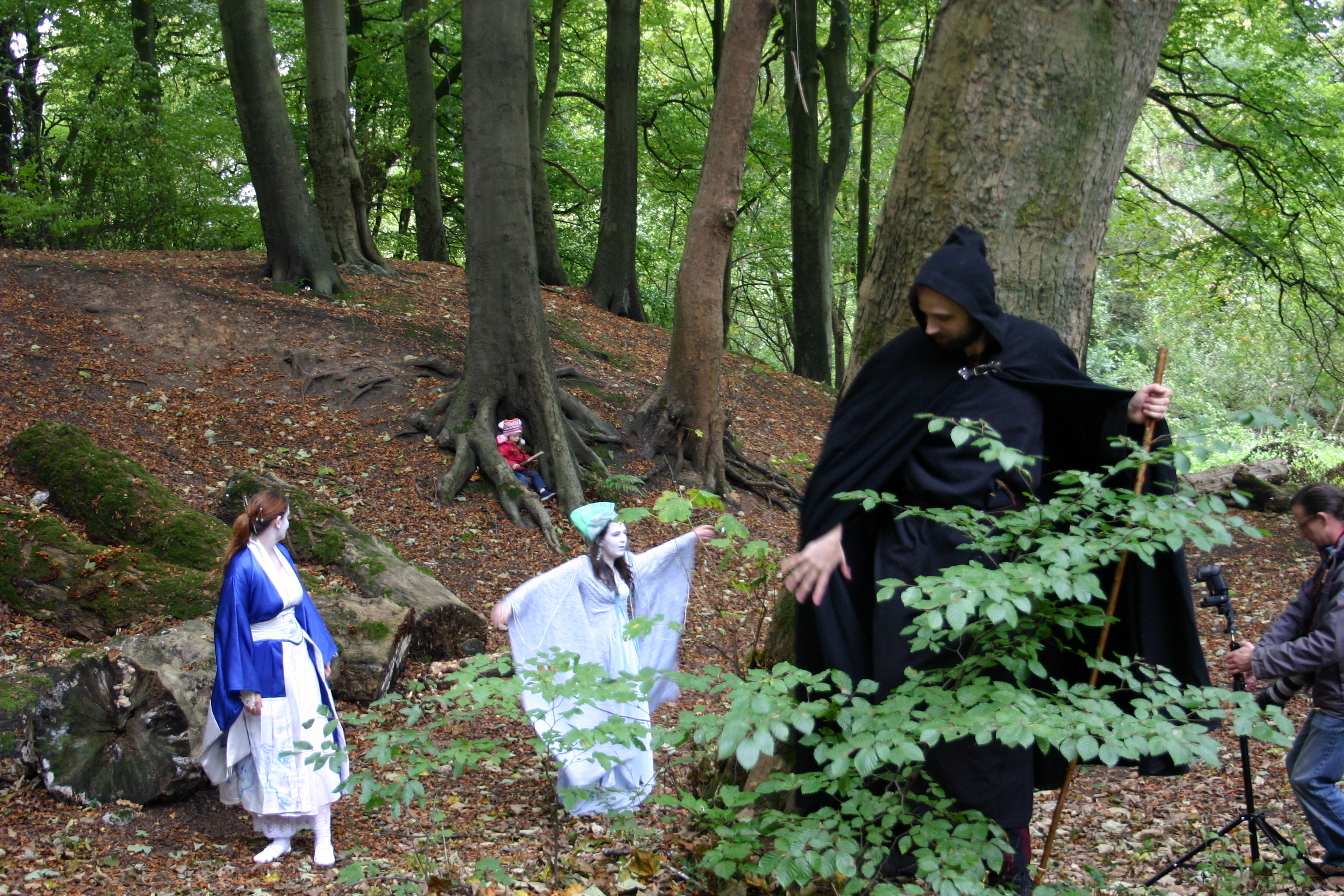
My role on the day was ostensibly ‘shoot director’ as usual as well as generally trying to get everything organised – location scouting, making sure everyone knew what was happening, sorting out the basic logistics. However, myself and Lucy (who you may remember mentioned in the previous photoshoot blogs) also had another very important role. You see, another issue with a location shoot is uneven ground and so while you might be able to leave a light stand on a smooth studio floor and expect it to stay standing, this is not the case on location. Especially when there is a strong wind blowing and your lights have reflector umbrellas on them. So, two able volunteers who were not taking photographs, being models or throwing leaves around had to stand next to the light stands and hold them in place. Most of the time that was me and Lucy. I like to think we performed ably as inanimate pieces of photography equipment. Certainly no lightstands fell over in the wind, though the strength of some of the gusts we experienced almost caused them to take a tumble a couple of times. This did however mean I could use my own camera, albeit one handed as one hand was always holding the lightstand, and take photos of my own from quite close to the action – literally a lightstand’s view of the models. In the photo above, you can see one such shot which includes the reflector in the top left hand corner.
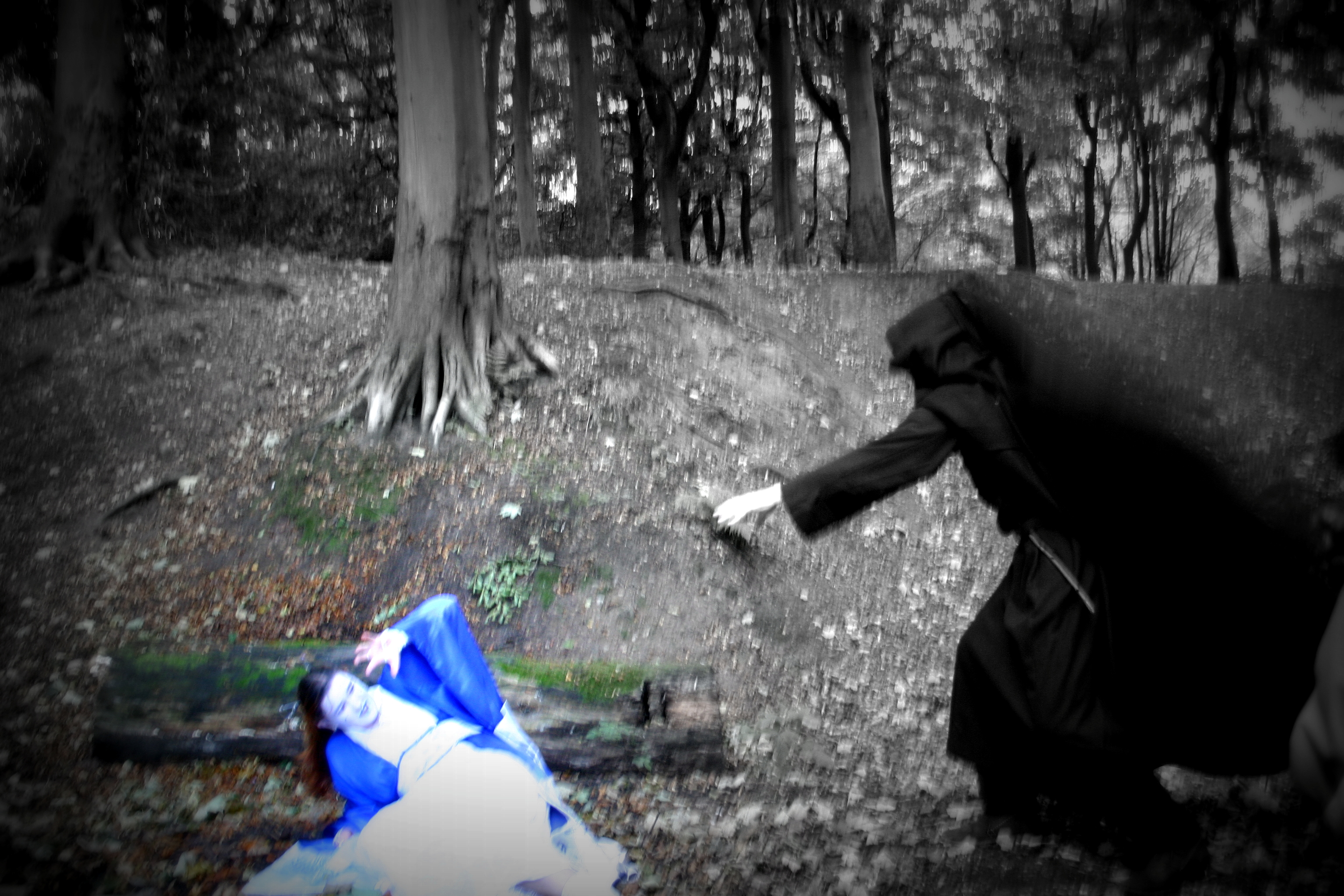
Playing around with colour settings. The blurry shadow effect is a camera artefact that I decided worked for the scene being shot.
We took two basic scenes on the day. First of all we went to the top of the mound and took some shots of Jess and Alex as the Empress and one of her sorcerer courtiers. Then, as the quite spectacular light we were getting through the trees on top of the mound faded, we moved to the base of the mound to make use of the interesting scenery there – old logs and gnarled trees and lots of undergrowth – to take some shots of our two undead fiends chasing a single wizard, played by Andy Mason. There were also individual shots of each of the characters alone. By the time we finished all that, it was getting on to sunset and so we headed home to let everyone warm up and find food. We even got a chance to preview some of the shots as they were uploaded to a tablet. Hopefully soon there will be properly edited shots with photo-shopped special effects to marvel at. Until then, please accept my efforts as a poor substitute.
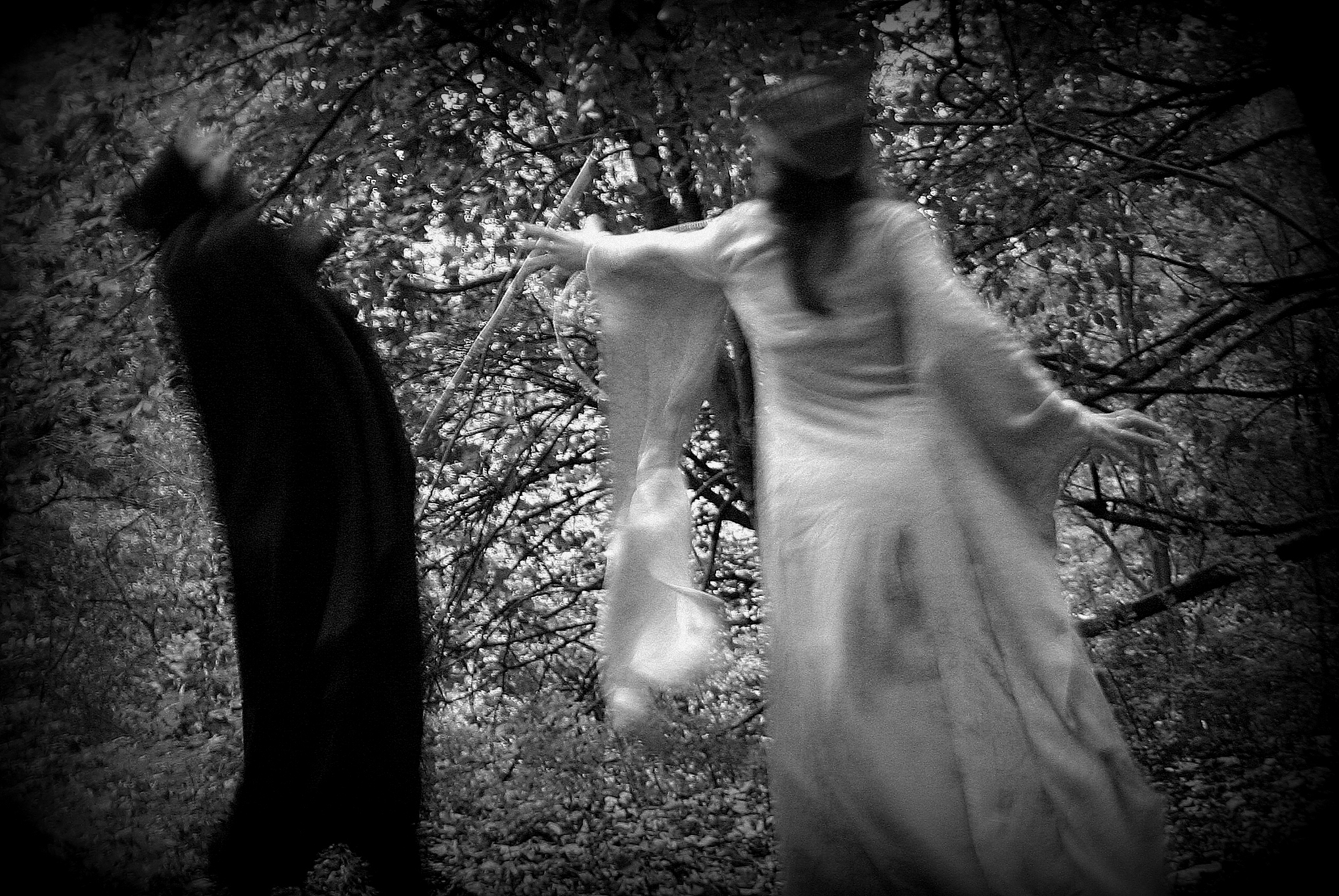
An action shot my camera was too slow to catch properly so there is a lot of blurring


 considered to be innocent is an intriguing one that does generate a lot of interest. Films have been known to play on the perceived innocence of children.

 st of the phrases she had to repeat endlessly to throw off these sightseers and their bizarre counterarguments. However, it seemed as if the more she denied it, the more convinced her visitors were that she was hiding the baby somewhere in one of the many rooms of the house.
 It seems that the British version of the SETI project (UK SETI research network) is focusing its efforts on finding evidence of aliens capable of moving stars or building giant structures in space. This being in addition to SETI’s usual activities of eavesdropping on potential alien communications like some interstellar version of the NSA*.


 Often, it tends to be someone relatively unknown at the time of casting. They may have done some previous acting for which they got recognition (Tom Baker was Rasputin in Nicholas and Alexander in 1971 and Koura in The Golden Vioyage of Sinbad in 1973, before he became the Doctor,and David Tennant was in Casanova) but by and large the first time you hear their name as a child who watches Doctor Who is when the casting is announced. There have been exceptions to this, of course. Christopher Ecclestone had been in a couple of things (I think he’d done some films somewhere in Hollywood you might have heard of 🙂 ) and William Hartnell had a remarkably robust film career (including several Carry On films) but by and large unknowns have taken the part over well known actors. So, perhaps the speculation needs to be looking not at well known actors but at those on the fringes – the up and coming talent rather than the established names? A couple of names that have popped up in this mould include
 Doctor is often portrayed as – there are calls for some variety. There has long been interest in the Doctor being a woman, of course. I even commented on an article which
 I think it will certainly be interesting to see how this pans out. Internet and tabloid speculations have a habit of being wrong, especially when you consider the aforementioned tendency for a relative unknown to be given the job – that generally precludes anyone the media considers unless they are keeping a very careful eye on up and coming talent. Personally, I am unfortunately predicting a situation of no change – a white male. It may be a white male with some interesting other feature – an accent. an eccentricity, some new approach to the character – but it will be, by and large, the same basic character. I do not think that those involved in the series yet have the impetus to make such a radical change as to colour the Doctor’s skin or give him ladyparts save in jest (as happened in

 but that is only one of the many references. Small towns with a troublesome population and the need for a strong sherrif is a common wild west cliche and in many westerns the hero comes from outside the town to take on that difficult job. In Defiance, a tough outsider comes to a town with a troublesome population, mostly comprised of squabbling aliens, and ends up with the job of lawman.
 US. It was a time and place when the population was smaller outside of the big East Coast cities, people gathered in small communities and there was endless space for expansion. America was truly a land of opportunity because land and gold and whatever else you wanted was simply there for the taking. This translates well into a post apocalyptic setting as most of those features are also present then – low populations, resources such as land less tied up by governments and laws and a need for people to work together to survive.


