• …
  • About
  • Vampire Month Alumni
  • World Book Night

Lurking Musings

~ Musings of a newly published writer

Lurking Musings

Tag Archives: Leeds Armouries

Updates and news

21 Tuesday Jul 2015

Posted by D.A Lascelles in Musings

≈ Leave a comment

Tags

Book Signings, events, facebook, Graphic novels, How to Kill a Vampire, Kindle Special offers, Leeds Armouries, Leeds Central Library, Leeds Steampunk, News, Ravenmaster of the Tower of London, Salford Media City, Salford University, Sequential art, Steampunk, Vampire


It has been a while since I did a post on here that was not a review, something which I intend to rectify over the next few months as a number of ideas for posts have been bubbling up in my brain and just need to be committed to blog. Well, some of them need to be committed full stop, possibly with the full strait jacket and padded walls treatment, but I am sure I can keep them all under control.wpid-imag1791.jpg

For now, you will have to satisfy yourself with this digest of random snippets.

First, Vampire month has proven to be a very popular feature on this blog. It makes for a very busy March for me but that effort is well worth it especially when one of your contributors gets their post referenced in an article as happened to Jonathon Ferguson. Of course this is an article from quite a while ago (late last year in October 2013) but it seems to have emerged out of the social network woodwork like some termite to go viral again. Rumour has it the article that LM is referenced in was posted on the Facebook page of the Ravenmaster of the Tower of London but I have looked and cannot find it there (but then I did not look that hard… if anyone spots it let me know 🙂 ). The upshot is that Vampire month is totally now and thing and I am aiming for international acclaim as soon as possible so please help to make this happen.

You can do this by sharing posts, spreading the word and commenting on the blog posts or Facebook posts I make on the subject. You can also help by volunteering to contribute to Vampire month next March… contact me to discuss how you can do this.

Secondly, we are coming up to a Month of conferences.

First off we have the Literally Literary Steampunks at Leeds Central Library event on the 1st August. Here Leeds will play host to a number of authors including LSM regulars such as Craig Hallam, JP Bernett and Alex James. There promise to be readings and other events and the chance to talk to authors and, of course, buy their books. See the Facebook page linked above or the webpage on the flyer for details.

Then, we have the Mancster Con which is set to kick off on the 29th August 2015 at the University of Salford Media City campus. This conference seeks to celebrate Sequential Art in the North West, by which we mean graphic novels and comics. There is a small, elite team of non comic writers, several of whom you may be familiar with from this blog, who intend to infiltrate this event ninja style and who are setting up on a panel entitled ‘Irony in Fantasy’. In this we intend to talk about common tropes in fantasy novels and I for one will be asking everyone for their opinion on this issue in a later blog and through my Facebook page so I have some ammunition to use. What tropes do you think are common? Why are they common?

This week (until Sunday) both the US and UK Amazon versions of Lurking Miscellany are on special offer. Go to the relevant site to see what bargains you can gain…

Finally, I have been making progress on a number of projects but nothing significant is ready for release yet. Gods of the Deep is getting there slowly, Mercury Snowstorm is gaining new stories to add to it and I’ve been pondering ideas for an upcoming anthology collaboration with R.A Smith, Ninfa Hayes and a few others. Hoping to have something ready to launch before Mancster con…

If you want to contribute to this blog, either with reviews or articles, feel free to contact me. Plenty of space for any blogger who wants a guest spot. I am currently pondering a more regular review section and would like some more people who might want to contribute to this… If interested contact me.

###

D.A Lascelles is the author of Lurking Miscellany, Transitions (Mundania Press) and Gods of the Sea (Pulp Empires). He lives in Manchester UK. You can sometimes see him writing about Zombie porn on https://lurkingmusings.wordpress.com/ but he mostly blogs about books, vampires, science fiction and Terry Pratchett. He is inordinately proud of the fact that one of his Pratchett articles was referenced on the French version of the author’s Wikipedia page.

Facebook: https://www.facebook.com/DaLascelles

Twitter: @areteus

Buy Lurking Miscellany (paperback)

Buy Lurking Miscellany (Kindle)
 

[Vampire Month] Jonathon Ferguson interview

18 Tuesday Mar 2014

Posted by D.A Lascelles in Vampire Month

≈ Leave a comment

Tags

aliens, Curator, Dracula, Eiko Ishioka, Gary Oldman, Harry Houdini, Henry VIII, How to Kill a Vampire, Indiana Jones, Jonathan Ferguson, Leeds Armouries, Mikhail Kalashnikov, Nancy A Collins, Royal Armouries Leeds, Sonja Blue, Vampire, Vampires


Today we have an interview with Jonathan Ferguson, Curator of Firearms at the Royal Armouries in Leeds. He recently gave a talk entitled ‘How to kill a Vampire’ which I was lucky enough to attend and it was this talk which led me to approach him about a slot in Vampire month.

1) When the general public imagine a curator, I think they generally consider someone older and dressed in tweed. Have you ever found people surprised when you tell them your profession?
It happens less as time goes on, possibly because I’ve succumbed to a bit of tweed! But when I was an assistant curator at Edinburgh Castle I got that a lot.mug

2) What led you to study history and when did you decide to make it a career?
As far back as I can remember really. Indiana Jones was definitely involved! Along with a love of ancient Egypt and an interest in arms and armour, this led down the archaeological path rather than that of written history. It’s always been about the tangible, physical objects for me, though a couple of weeks in Somerset mud convinced me that museums were the way to go!

3) Who is your favourite personality from history?
Well, I should probably be referencing a firearms designer like Mikhail Kalashnikov, having been asked to comment on his recent death by the BBC. However, I think I’ll have to go with Harry Houdini, because whilst he ‘wanted to believe’ in the paranormal, but was also a sceptic and tireless exposer of frauds. I actually have a pet snake named after him!

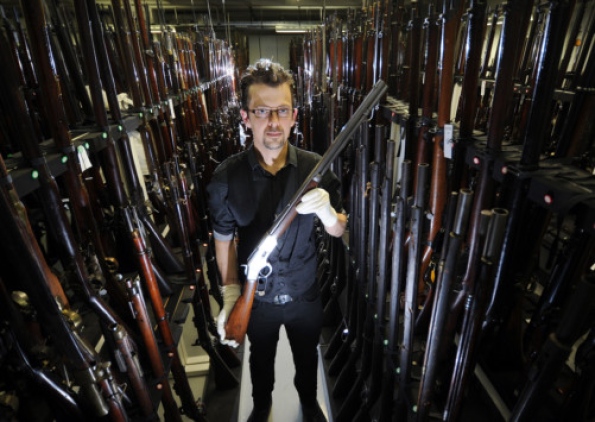
Me pic with Winchester in Store 24) What is the most interesting exhibit you have handled?
I should probably choose something like a gun belonging to Henry VIII himself, our incredible combination axe/gun, or the experimental grenade launcher I’ve been looking at recently. But my inner geek says that it’s an original ‘Pulse Rifle’ from ‘Aliens’. Movie props can certainly be as valuable as antiques, and increasingly are being seen as important pieces of material culture in their own right. The vampire kit sits somewhere between the two, and certainly ‘up there’ in terms of interesting exhibits!

5) Curator of firearms handling a Vampire Hunting kit – how did that come about?
I began my research on vampire killing kits in my own time back in 2007, before I began to specialise in firearms. But they actually originate within my field, from the antique firearms world. I would categorise them with ‘firearms curiosa’, one of many weird and wonderful things like belt-buckle guns and flintlock rocket launchers (yes, those exist). But of course they are much more than that; a physical way to access the ephemeral world of superstition and the supernatural.IMG_6068

6) You’ve studied both the real world folklore and the fictional tales of Vampires – is truth stranger than fiction?
In terms of defying our 21st century, western logic, definitely. In western fiction, vampires are created by other vampires, or through some deliberate evil or magical act. Yet in folklore, you might be ‘turned’ simply by a cat walking over your dead body! Fiction tends to be a bit more consistent with its lore, even if it’s consciously trying to subvert it

What do you think is the attraction for Vampires? Why are they such a popular topic?
It’s probably the sheer number of themes that the subject lends itself to; threat, death, rebirth, consumption, power, and sex. All but the last are shared with other monsters that prowl our imagination, but only the vampire, particularly the fictional variety, gets to look good doing it!

Share your favourite Vampire story
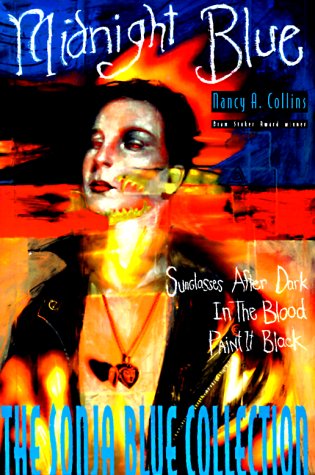
I have lots, but my all-time favourite has to be the ‘Sonja Blue’ series of books by Nancy Collins, partly because it was the first present my now-wife ever gave me, in the form of the ‘Midnight Blue’ book of collected stories. Though never mainstream, I think it’s been very influential. Dark, gritty, and ultra-violent; the antithesis of ‘Twilight’!

In a fight between all the greatest Vampires of fiction, who do you think would come out on top?
I like to think Sonja would be up there, but I’ve a feeling Dracula would still come out on top somehow. After all, he always comes back!

What about in some other contest such as sexiness or dress sense? Who would win that one?
Well, if we’re talking style, I think it’s Dracula again, as played by Gary Oldman. That’s thanks to those wonderful Eiko Ishioka costumes, from the fantastic red muscled wolf armour to the smart victorian suit and top hat..

Tell us about your latest work.
On the vampire front, I’m preparing for the ‘Seriously Staked’ vampire conference at Goldsmiths on March 8. In my day job, I am lead curator on the Armouries First World War project at Leeds. We’ll be providing more context and a more personal focus to the arms and armour of a conflict that defined modern warfare. There will be a physical exhibition and an online feature, both due to open in time for the August 4 centenary of the invasion of Belgium in 1914.

Jonathan Ferguson is Curator of Firearms at the Royal Armouries in Leeds. His research interests include their use, effect, and depiction in popular culture. His sceptical interest in the paranormal is more of a hobby, stemming from the gift of a Ladybird version of ‘Dracula’ at a young age. However, he is especially enthusiastic when the two things overlap! He has made several television and radio appearances, including National Geographic’s ‘How Sherlock Changed the World’, and BBC Radio 4’s ‘The Lifecycle of a Bullet’.

The Royal Armouries holds in trust for the public one of the finest collections of arms and armour in the world, from exquisite pieces of the gunmaker’s art, to the most functional military weapons, and from the medieval period to the present day.

Find them on Twitter and Facebook

https://www.facebook.com/pages/Royal-Armouries/215812575369
https://twitter.com/royal_Armouries

[Vampire Month] Third time’s a charm

01 Saturday Mar 2014

Posted by D.A Lascelles in Musings, Vampire Month

≈ 2 Comments

Tags

IIsabella Favilli, Jonathon Ferguson, Leeds Armouries, Megan Cashman, Vampire Killing Kits, Vampire Month, Vampires, Zoe Adams


So, here we are in the third year of Vampire month. It does not seem like three years since I first had an idea to bring together three authors who all had Vampires in common, ask them some questions and get them to write me a guest post. However, that is how long it has been.[Guest Post] What is Horror? by Rebeka Harrington

For those new to this, Vampire month is dedicated to all things vampire and takes place over the month of March. I could have been predictable and had October be Vampire month, and lost it among a plethora of ghouies, ghosties and long leggity beasties. I could also have thought slightly out of the coffin* and played on the angst ridden romance side of most Vampire stories and had February as Vampire month – tying it all to Valentine’s day. However, I looked at March, all alone and bereft after Valentine’s day, with only a single mentally challenged hare to keep it company while everyone wishes it would just hurry up and finish so they can concentrate on Easter properly, and thought: There’s a month that need some love. Some dark, angsty, abusive Vampire love.

Or maybe, you know, I actually had the idea too late to get everything ready in time for February and really could not wait til October to do it and dumped it all on the first available month I could find and now I am stuck with it.

Decide for yourself which of the above stories is true…

2013-10-30 20.17.06So, on with the month. This year I have what can only be described as an eclectic mix of contributors in that we only have two of them who are actually authors and one of them is being brave enough to submit herself to the process a second time. The other two slots are taken up with an artist and the very left field addition of a museum curator. I’m very excited by both these additions.

So, here is the lineup:

Artist and Digital Imager Isabella Favilli

Author Megan Cashman

Author (and returning alumni) Zoe Adams

Curator of Firearms (and expert on Vampire killing kits) Jonathon Ferguson

Look out for post from all of them as the month progresses.

*like thinking outside of the box but with an undead bias, obviously…

How to kill a Vampire

03 Sunday Nov 2013

Posted by D.A Lascelles in Musings

≈ 4 Comments

Tags

Blade, Bram Stoker, Buffy, Buffy the Vampire Slayer, Dracula, Ferguson, Halloween, How to Kill a Vampire, Jonathan Ferguson, lectures, Leeds Armouries, Leeds Vampire, Royal Armouries, Royal Armouries Leeds, supernatural, Ultraviolet, vampire fiction, Vampire Killing Kits, Vampires, Varney the Vampire


Jonathan Ferguson takes questions

Jonathan Ferguson takes questions

It was Halloween over the school half term break and so the Royal Armouries in Leeds were putting on some themed events. This allowed them to get out all their exhibits that were related to witchcraft or other supernatural occurrences and show them off to appreciative audiences.

One such event was a lecture by their curator of firearms, Jonathan Ferguson, entitled How to Kill a Vampire, which took place on the evening of the 30th October in the museum’s own lecture hall, the Bury Theatre.

This two hour lecture was split vaguely into two parts. In the first he talked about the traditional methods used, both in real life and fiction, to kill the undead. This was full of fascinating facts, even if the lecturer was somewhat hesitant in his delivery, and outlined the differences between mythological and fictional creatures such as zombies (reanimated corpses), Revenants (a lesser used term in the modern days for a visible ghost or animated corpse) and Vampires (which are typified by their tendency to drain lifeforce or blood). Some of it was common knowledge – stakes, garlic, sunlight – but through reference to folklore sources and archaeological evidence he quite ably linked the methods used to slay vampire in fiction (referencing everything from Varney the Vampire to Buffy and Blade) to what has been used in (mostly) eastern European villages for centuries to put an end to supposed curses – disease, ill fortune – that are attributed to vampires.

The Leeds Vampire Killing Kit

The Leeds Vampire Killing Kit

The practise of effectively scapegoating a recently deceased person is a common one in several cultures and generally arises because of anomalies in the decay process of a corpse. Maybe they do not decay fast enough because of sterile soil, for example, and this singles the corpse out as a vampire. According to Ferguson, in cases like this where villages attributed their woes to such a corpse, they generally went through several steps to ‘kill’ the vampire, trying all of the methods they could think of and only stopping if the bad things stopped happening. These methods involved a host of improvised weapons – mainly farm implements like sickles and even the traditional ‘stake’ so popular in vampire fiction is based on nothing more than a convenient fence post – and usually ended with the complete destruction of the body using fire (after which, as Ferguson states, there is usually nothing left anyway). There were some lesser known methods discussed too. For example, piercing the body with nails, which may be linked to the stake as well. One possible theory as to why this method was used might be linked to the ways corpses bloat due to trapped gases post mortem – another anomaly in the decay process that might be observed as supernatural in the uneducated. Piercing the flesh with a nail (or a stake) allows the gases to escape – restoring the corpse to normal. The ‘Vampire’ is slain. It was interesting to see the comparison between these rather morbid methods of solving a misunderstood problem by dismembering a helpless corpse and the more active methods employed in fiction, especially the evolution (and plausibility) of such esoteric devices as wooden bullets (or graphite ones as used in Ultraviolet), silver bullets and ultraviolet bombs and bullets. The ludicrous idea of using a small stake and thrusting it into the heart accurately while in combat with a Vampire (as seen multiple times in fiction but especially in Buffy) was also touched upon with reference back to Bram Stoker’d Dracula and Varney the Vampire where the protagonists use mallets to hammer the stakes through the breastbone.

The lecture then neatly segued into the second half which was more focused on the

A museum employee points out interesting features of the Vampire Killing Kit

A museum employee points out interesting features of the Vampire Killing Kit

Vampire Killing kit that the museum had acquired. Here Ferguson was clearly more in his comfort zone as his delivery was more confident and natural. A typical vampire killing kit usually comprises a number of items which are purported to be useful in dealing with vampiric threats – stakes, bottles of holy water and garlic essence, bibles or books of common prayer, crucifixes and guns loaded with silver bullets*. The controversy around these items is whether they were genuine 19th or early 20th century artefacts, created either as curios for tourists visiting eastern Europe or because someone really did think they needed protection from Vampires, or more modern fakes. Ferguson discussed in detail the evidence for and against these arguments, citing references from auction houses, folklore and even internet forums to build a convincing case that the balance of probability places the majority of these items firmly in the category of fakes. Such points as the inclusion of guns with silver bullets suggests that the earliest these items could have been made was after 1928 (rather than the late Victorian period as usually claimed) and certain facts about the methods of manufacture and the materials used are also damning. Most convincing of all, of course, is the confession of one poster on an internet forum who admitted to having produced a number of these items in the 1970s.

This does not, of course, stop Vampire Killing kits being sold on ebay and in real world auction houses for thousands of dollars (indeed, Ferguson described how he acquired the museum’s kit from a local auction house after a house clearance in Yorkshire). Nor does it demean the value of them as museum pieces – even if they were made as recently as the 1970s (and there is some evidence that the one Leeds have may have been made earlier, possibly even the 1920s) they are still antiques** and a well done fake with an intriguing story about why it was made in the first place is something just as worthy of museum space as a genuine article. In this respect they are much the same as the fake suits of armour displayed in the Tower of London. These were put there by the Victorians to demonstrate ‘armour through the ages’ but later historic research shows they do not represent the armours used in those periods. However, the Tower keeps them in place as examples of historic misconceptions. Ferguson mentioned that when this kit is on display he labels it clearly to show the belief about its authenticity, allowing the visitor an insight into how such fakes can arise and why.

At the end of the lecture, the audience were allowed to ask questions and to go up on stage to view the kit. It was quite fascinating to see it close up and it was even possible to handle the items inside it under guidance from a member of the museum staff.

In all this was a very interesting way to spend an evening on the night before Halloween.

* Yes, this is normally believed to be for Werewolves but the boundary between Vampire and Werewolf is often blurred in myth, especially with a concept of shape-shifting vampires and some cases like the Greek Vrykolakas which are wolf like vampires. According to Ferguson the first movie reference to the use of silver bullets for Vampires was in 1928, though silver as protecting against and harming evil is a common theme in folklore.

** As something made in the 1970s myself, I would like to say that I now feel old…

Twitter Updates

Tweets by areteus

Like me on Facebook

Like me on Facebook

Enter your email address to follow this blog and receive notifications of new posts by email.

Join the Lurkers

  • Alex James's avatar
  • D.A Lascelles's avatar

Enter your email address to follow this blog and receive notifications of new posts by email.

Join 909 other subscribers

Recent Posts

  • I’m (apparently) a cover designer!
  • Release day! Coch a Gwyn
  • Cyberpunk look
  • Eastercon Artshow
  • Interview: Gillian Polack

Blog at WordPress.com.

  • Subscribe Subscribed
    • Lurking Musings
    • Join 129 other subscribers
    • Already have a WordPress.com account? Log in now.
    • Lurking Musings
    • Subscribe Subscribed
    • Sign up
    • Log in
    • Report this content
    • View site in Reader
    • Manage subscriptions
    • Collapse this bar
 

Loading Comments...