• …
  • About
  • Vampire Month Alumni
  • World Book Night

Lurking Musings

~ Musings of a newly published writer

Lurking Musings

Tag Archives: writing

Why I blame Erica Hayes

29 Tuesday Jul 2014

Posted by D.A Lascelles in Guest posts

≈ Leave a comment

Tags

Erica Hayes, guest post, Lurking Miscellany, Self Publishing, Transitions, writing


I did a guest post on Erica Hayes’ blog today… and I have to say that it is all her fault (in a good way).LurkingMiscellany-lg

http://erica-hayes.blogspot.co.uk/2014/07/guest-author-da-lascelles-on-why-its.html

Click on the link to go to the post and see why.


[Spoilers] Twisting the cliche

04 Wednesday Jun 2014

Posted by D.A Lascelles in Musings

≈ 4 Comments

Tags

Battlestar Galactica, clichéd, clichés, Cliche, Dwarves, elves, Fantasy, Game of Thrones, George Lucas, GRR Martin, Inigo Montoya, Lannister, Red Wedding, Robb Stark, Science Fiction, SF, Spoilers, Stark, Trial by combat, writing


I am guessing that most people out there have watched the recent episode (series 4, episode 8) of Game of Thrones by now? If not, you may want to look away and come back when you have as there may be spoilers ahead… I am delaying posting this blog a few days to help prevent this but I am worried there may still be those out there who haven’t seen it even then.

You see, I want to talk about clichés here. In particular, I want to talk about how they might be of benefit to a writer. They are often seen in a bad light – ‘don’t write that, it’s too clichéd’ is a common refrain. However, attempts to make things more original often fail to get anywhere. So, being clichéd is bad because it is too derivative of previous works whereas being original can also be bad because the readers do not connect with the material, finding it too strange or unfamiliar. There is also, of course, the very relevant truth that there are no new stories, only old ones retold. When you do find something you think is original, quite often it turns out to be derived from another source you maybe only barely remember* or coincidentally happens to follow the lines of a much older story.

So what is a writer in search of originality to do? How can you maintain the very fine balance between cliché and the familiar? The answer seems to be to twist the cliché in order to subvert the audiences’ expectations.

Now Game of Thrones as a series and as a set of novels is actually not all that original in terms of the fantasy concepts it throws up. It includes a lot of old standbys – dragons, quests, knights, barbarians, battles, pantheons of gods, young children going off on quests (actually it has several of these…), the list goes on. However, fantasy was for many years a very staid and static genre where everyone was trying hard to be Tolkien (so many elves living in forests, so many dwarves living in mines) so in many ways even small changes from these clichés is a bonus and GRR Martin’s does manage to do this very well, mostly by making the characters very realistic and three dimensional. He also manages to avoid Elves and his only dwarf is a human who just happens to have been born short rather than a member of an ancient, gold obsessed race. But he does more than this, he often twists expectations so that what you think is going to happen doesn’t. There are a few examples of this I could mention, one of which is this week’s big shock end (which I admit was not a shock to anyone who read the books).

Let’s take Robb Stark to begin with. In the second series his story looked like it was well mapped out in cliché land. He was the eldest son of a man executed for treason, raising an army to defeat those who had killed his father and fighting against a mad king to boot. In your old fashioned fantasy epic the conflict therefore becomes Stark vs Lannister and in that tale the only ending cliché would accept is Robb winning and becoming king. Subconsciously we all know this. Robb has to win, it is imprinted in everyone’s understanding of story. The hero prince sets out on a quest to avenge his father’s death… come on, we have seen this story a million times.

And yet that is not how things work out… instead Robb makes a political error, a very human one, and as a result is murdered during the infamous Red Wedding, leaving no one in a position to lead his rebellion which crumbles.

Another example is the trial by combat in this week’s episode. To be honest, I was a little sceptical of Tyrion managing to get away with the same trick twice.** Remember, he used trial by combat to get out of a previous murder rap and honestly no writer would allow a character to get away with something that audacious again. So I was sort of expecting there to be an ending that did not include Tyrion’s champion walking away unscathed. However, that combat threw another revenge based cliché at us – the brother of a murdered woman seeking vengeance on the man who killed her. Again the story imprinted in our bones screams at us ‘of course he is going to win!’ and I don’t know about you but I was certainly seeing good old Mandy Pantinkin in his most famous role as Inigo Montoya in that scene and we all know how that works out rather well. And for a moment it looks as if he will win. He actually does win, in fact. His enemy is down and helpless. Then there is a sudden change in fortune… Again, he makes a critical error, an error based on his human nature. Had he merely killed his enemy he would have won. Instead he had to gloat and therefore lost spectacularly.

Both examples given show how characters are being set up by the author (and in some cases the script writers of the series in some of the material that is newly added) to apparently be following a clichéd path. They even get some way down that path, enough for our minds as readers or viewers to spot the pattern (however consciously or subconsciously) and expect a particular outcome. Then something happens, often a very human mistake, which completely throws that pattern out of the window and the nature of the plot changes – we are horrified by this because the person set up as the hero cannot lose and yet they do. This, I feel, is the main reason these scenes cause such outcry. It is not just because of the gore, it is because of the cognitive dissonance of our well trodden clichés being suddenly wrenched from under us. This is also why it is seen as innovative, despite being riddled with tropes. The places where the expected outcomes are subverted are ones that stick in the mind and suddenly the writer is a genius for doing it. Even an occasional scene like this can be enough to plaster over the many occasions where the writer does follow the standard tales. These scenes also increase the tension because, dammit, even characters you previously believed safe because of some perceived ‘hero’ status can die. Its been happening in SF TV for a while now. A famous example is Mal’s innovative method of resolving the infamous Mexican standoff (clue: Mal definitely shot first, no Han Solo/Greebo confusion here) and recent series like Battlestar Galactica have been constantly violating our expectations with respect to the relative safety of those afforded supposed hero status.

All of this makes me somewhat concerned over the safety of other characters in Game of Thrones. After all, several of them are clearly on clichéd fantasy hero paths. For example, Arya and Bran Stark are each following slightly different classic versions of the typical child hero in a fantasy novel. They each quest to understand themselves and their abilities in order so that they may return some day to wreak revenge on those who murdered their families. A cliché that was old when George Lucas used it. The cliché says that they should succeed. This means that something nasty and fatal awaits them in their future.

Unless, of course, it is by now considered cliché to subvert the cliché which means that, now, it is perfectly fine to let things follow their normal course and let the children achieve their destiny. Sometimes fashions in writing can change so quickly and soon we may well be expecting the opposite to what the story should be… Thinking of such things can easily send someone insane.

For now, the best advice seems to be to be aware of tropes and clichés and try to figure out ways to use the expectations of readers to your advantage.

*This happened to me at least once that I am aware of. When I was writing the background and concepts behind one of the race of aliens in Waypoint I knew I was stealing from Celtic, Native American and Norse myth and was good with that. However, when I wrote about their attitude to technology I unconsciously inserted several ideas from an obscure Doctor Who short story (the People of the Trees), mainly the idea of them worshipping technology as religious icons capable of ‘magic’. I only became aware of this when I re-read that story several years later and the penny dropped. I did change it enough that no one can see where I filed away the serial numbers (and besides it is a common enough concept with primitive cultures in SF that I could just have easily stolen it from Return of the Jedi) but it was fascinating to see how my mind was working there.

** Plus my wife who has read the books as far as the current series knew it wouldn’t work either, despite her rants about all the changes they have made in this series so far, and although she tried hard not to reveal anything I can read her responses well enough to spot certain facial expressions


Writing process questions

26 Saturday Apr 2014

Posted by D.A Lascelles in Musings

≈ 2 Comments

Tags

books, Gods of the Deep, gods of the sea, Neelima, Neelima Vinod, Ninfa Hayes, paranormal romance, R.A Smith, the writing process, Transitions, writing, Writing Process


Neelima Vinod tagged me in the Writing Process Blog Tour. You may remember Neelima from Vampire Month a few years back and she has since been doing rather well for herself. This meme is an interview meme about the writing process so those of you who are interested may find out more about how I do things… maybe…

 What am I working on?

Well, the official answer has to be ‘shaping the minds of the next generation in the hope of getting them into university’ because at the moment I am mostly working on my day job of teaching. However, you want the writer answer and for that I am doing two things. One is working on the final stages of Gods of the Deep, the sequel to Gods of the Sea. That is with an editor and I have a cover waiting to be revealed which is awesome. The other is editing a selection of my short stories for publication in a collection I am calling Lurking Miscellany in honour of this blog. In addition to those two writing based things, I also have something I only found out about yesterday which I am not allowed to talk about. Which is ironic as it will involve me talking…

 How does my work differ from others of its genre?

I am not sure I am qualified to be able to say my work is different to any others. I’d like to think that it is but I consider that to be a question that readers should answer rather than me. If pushed to answer I would like to say that Transitions differs from many other romance works because of the BBW element. However, there is a whole genre of romance fiction based on that concept. I could also say that Gods of the Sea was either a pirate story set in a fantasy universe or a fantasy story set in something other than the Tolkienesque fantasy setting – either way a slight deviation from cliché. However, many of my influences (such as Barbara Hambly) are writers who have done similar. There is a lot of fantasy out there now which is veering away from the Tolkien influences of my youth and I consider this to be a very good thing.

Why do I write what I do?

I started writing while in school and found that I enjoyed it a lot. However, I never really considered what I wrote as worth publishing and so I mainly did it for fun. Of my current published works, I wrote Transitions because of an interest in both Roman history, specifically the history of the town of my birth, and in the paranormal. Gods of the Sea I wrote because there was a call for submissions for a pirate themed anthology and I had an idea for it which I thought might work.

 How does my writing process work?

Chaotically. In the terminology of the Absolute Write forum, I am definitely a Panster (someone who writes by the seat of their pants) rather than a plotter (someone who carefully plans out the sequence of events in their story). Whenever I tried to write like a Plotter I found I could not do it and I actually think that everyone has their own preferred way of working which fits how their own mind works rather than there being any ‘one true way’. I often get ideas when my body is doing one thing (walking, tidying, etc.) and my mind is free to wander, the only problem is that I rarely get time to sit down and get those ideas down on paper. However, any idea that survives in my mind until I get time to write about it is likely to be one worth keeping while those that don’t I am probably better off losing. I also tend to be encouraged by necessity. Both of my published works have come about because there was a pressing need to get something submitted to a project I wanted to be involved in so I stopped wallowing in uncertainty and just got on with it.

I’ve also worked in different ways for different projects. For Gods of the Sea I basically sat down over Christmas and splurged out most of the story over a couple of days. I was not even aware of what I was writing until I reviewed it later. For Transitions, however, it was a more careful process and for that I had actually started out with the beginnings of two very different stories (an historic romance about a Roman soldier and his dying wife and a contemporary romance set in Birmingham) which I then realised could be merged into one.


Thank you Neelima for tagging me! You can read about her process here.

As part of the game, I’m tagging two writers for you to blog hop to.:

R.A Smith is the author of the wonderful Oblivion Storm and its sequel Primal Storm. You can find him on Facebook here.

Ninfa Hayes is the author of Bites and Nannies Inc . You can find her on Goodreads here.

[Guest Post] Paige Dearth – write what you know.

18 Sunday Aug 2013

Posted by D.A Lascelles in Guest posts

≈ Leave a comment

Tags

Believe Like a Child, books, guest blogging, guest posts, Paige Dearth, Thriller, When Smiles Fade, Write what you know, writing


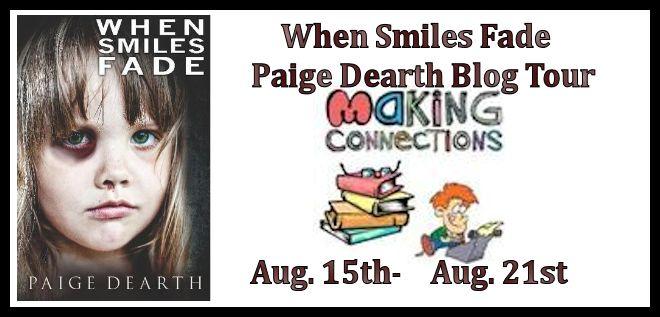
Making Connections Paige Dearth

Today we focus on the work of Paige Dearth, author of Believe Like a Child and When Smiles Fade.

In her debut novel, Believe like a Child, the main character Alessa is the victim of child abuse from her uncle. The story is one of redemption and of a woman taking control of her own life.

In When Smiles Fade, her latest novel released this year, the main character Emma is also abused as a child as you can see from this synopsis:

Emma was unloved from the moment she was born. Her earliest memory is being severely beaten by her father, Pepper Murphy, when she was just eight-yearsold. Seething with resentment over the sacrifice of his dreams for a woman he cares little about and children he never wanted, Pepper chooses to blame his older daughter. Her mother, Valerie, makes matters worse with her verbal abuse, leaving Emma isolated with a man that had no boundaries in punishing his daughter, taking his abuse to unimaginable levels. Emma’s father’s coldblooded beatings and the ultimate abuse to which he subjects her, lays the foundation of the person she becomes. As she matures into a resourceful teenager, she is unwilling and unable to stifle her desire for revenge. Reaching her breaking point she can no longer control the impulse to fight back and finally takes matters into her own hands. Having learned the art of hatred from her father and the mastery of manipulation from her mother, young Emma now sets out to make a better life for herself, leaving the memory of the abused child she had once been behind her. Hardened by the heartless brutality she encounters and the dangerous situations she must overcome in the course of her journey, she faces every challenge that comes her way in her quest for a normal life for herself and for those she loves. Finally a person emerges from within that guides her toward a better life until she learns of a secret that sets her on the path of ultimate redemption.

Both stories contain inspiration taken from Paige’s own life. She herself was a victim of child abuse at an early age and spent her childhood not believing that she had the potential to much in the way of ambition. When she finally went to college at the age of 29, she did not even believe that she was capable of passing the college level courses and yet she finally left college with an MBA 8 years later and a feeling that she had conquered her fear of learning. There followed a successful career in corporate America and finally a writing career that has seen her earn a finalist place in the thriller category of the National Indie Excellence Book Awards. Paige’s own life is an example of someone seeking to improve their lot.

So, both novels mirror events in Paige’s life, she has used her real life to inspire her writing. This ties in with the common author’s adage of ‘write what you know’. This saying is often mocked, especially in fantasy and SF, because you cannot ‘know’ what it is like to be a Dragon or an Orc or a wizard. However, this is applying an ad absurdum argument because there are still elements of a person’s life which will apply to any fictional character. Likewise in a suspense thriller, there are almost certainly going to be things in there that an author has not experienced but the trick is to take the things that have happened to you and apply them. Writing what you know is all about adding a level of emotional veracity to the writing that is conveyed to the reader. The use of the term ‘what you know’ is actually a misnomer as it really is not about knowledge at all. Knowledge is what you get from books and, these days, from the internet – whether by looking something up on Google or (as commonly happens) asking a question on a forum populated by experts in that area. Instead it is all about the experience – the emotional and physical impact that this has on you as an individual. I believe that this level of veracity is important. You don’t need to necessarily add emotional context to every event in your story but it does help if you have some personal life experiences you can call upon if needed. They may not be as traumatic as those described here, I would not wish such things on anyone if it could be at all avoided, but any life event can be useful – the tastes of food, the smell of the inside of a car, what it feels like to spend all day in a library reading ancient books. An author should be prepared to reflect upon their experiences and consider what they can learn from them and what they can use to improve their writing.

You can find out more about Paige on her website: www.paigedearth.com.

You can buy her books on the following links:

Believe Like a Child (US)

Believe Like a Child (UK)

When Smiles Fade (US)

When Smiles Fade (UK)

Later this year she also plans to release her third novel so please keep an eye out for that.

Dianna Hardy: Cry of the Wolf Blog tour

25 Thursday Jul 2013

Posted by D.A Lascelles in Guest posts

≈ 1 Comment

Tags

blog tour, Cry of the Wolf, Dianna Hardy, paranormal romance, Romance, The Witching Pen, Werewolf, writing


Today we are taking part in a blog tour for Dianna Hardy. You might remember Dianna from her appearance in Vampire Month and her talking about the Witching Pen series. Here she is giving us a review of her latest series, Eye of the Storm, with an extract from Cry of the Wolf. Tomorrow, look out for a giveaway for exclusive goodies!

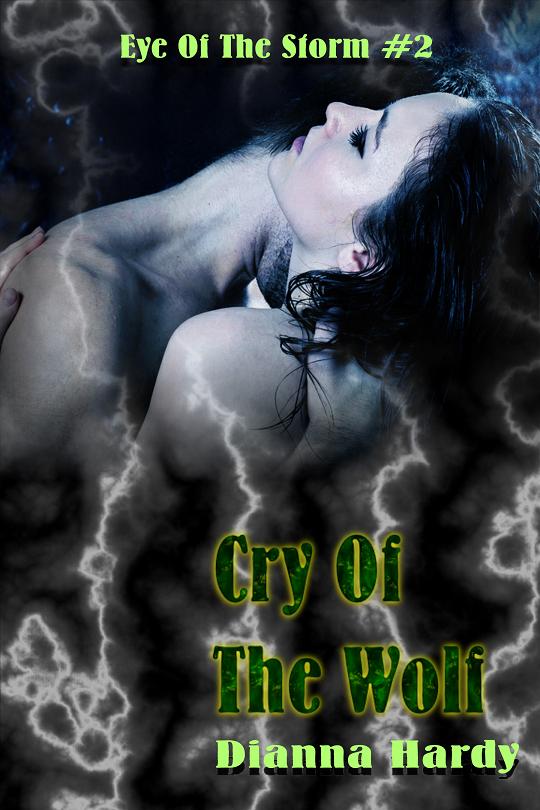
Extract from Cry of the WolfCryOfTheWolfCoverFrontSMALL

Looking to pass the time, she made her way to her desk where Lawrence’s books were scattered from where she’d abandoned them almost twenty-four hours ago. Now, where had she left off?
Right. Mythology.

It didn’t take her long to find the passage she’d read earlier, and it was an absorbing read: a god and a goddess ruled by anger had split themselves apart, creating, for all intents and purposes, duality. But they quickly discovered they could not live without each other. Loneliness and loss consumed them, and it came to be that the only way they could rejoin since their separation was when the lightning (the god) penetrated the earth (the goddess).

Interesting…

In these moments, Yemet’s determination renewed, as did her anger, and she vowed to find a way to rejoin with Himet.

One night, under the full moon, which reflected Himet’s love for her when the sun could not, Yemet led her most prized and loyal animal – the wolf – to the top of the highest mountain. She let her grief, her sorrow, her loneliness and her anger pour out of her until she manifested a storm. Himet responded, joining in her dance, and at the exact moment he sent down his lightning, she placed the wolf in its path and infused herself with it.

Himet cried out in terror, but he could not pull back the lightning. It hit Yemet while she was in the physical form of the wolf – whilst she was mortal.

“Why?!” he asked her, his sorrow consuming him.

“I could not see, but now I do,” she replied with her dying breath, “to have all of you, I must yield all of me. Take my life, Himet. I trust you with it. I give it freely.”

© Dianna Hardy, 2013. All rights reserved.

Bio:

Dianna Hardy Colour Portfolio SmallAuthor of The Witching Pen and the Eye Of The Storm series.

Dianna combines a titillating mix of paranormal romance and urban fantasy into her writing, to bring you stories that are action-packed, fast-paced and not short of heat, with the focus on both character development and the plot. She writes both full-length novels and short fiction. She has also written poetry and esoteric books and articles.

Although quite active online, Dianna is a self-confessed hermit, preferring the company of nature and animals to the hustle and bustle of people. She loves anything paranormal (she doesn’t really consider it “para”), organic food, walking barefoot, the smell of the woods after rain, and summer days.

However, she is also sustained by coffee, chocolate and the occasional vodka.

She lives in the UK with her partner and their daughter, where she devotes her time to parenting, publishing and writing.

Links

Website: www.diannahardy.com

Facebook: www.facebook.com/authordiannahardy

Twitter: www.twitter.com/thewitchingpen

Amazon: www.amazon.com/Dianna-Hardy/e/B003AGRHFC

Google +: www.plus.google.com/u/0/110398750519005724804/posts

The Witching Pen website: www.thewitchingpen.co.uk

This post is part of a blog tour. Check out the other stops on the tour… Click the picture below to see the full list.

Werewolf Love Blog Hop

Tennis and Football stars from Newcastle by Dr. Jo Bath

04 Thursday Jul 2013

Posted by D.A Lascelles in Guest posts

≈ Leave a comment

Tags

books, city of newcastle upon tyne, Dr. Jo Bath, Football, guest blogging, guest posts, history, Mary Brown, Munitionettes, Muriel Robb, nooks and crannies, Publication, refined ladies, sports, St James Park, Tennis, The British Ladies' Football Club, welsh championships, Wimbledon, wimbledon champion, Women, writing


Today’s guest post is by Dr. Jo Bath, co-author of The Newcastle Book of Days, which is a collection of ‘On this Day’ style anecdotes and historical snippets centred around the city of Newcastle Upon Tyne. Being as how it is a city close to my heart, being close to where I was born, my interest is especially piqued by this book. I even remember some of the events described, including the building of the Metro described below. Here she talks about some of the stories she came across when writing the book, including one that is very relevant in Wimbledon season…

Muriel Robb

One of the best things about writing a Book of Days has been the freedom to explore more or less any aspect of local history that caught my eye. Of course, some things were always going to be included in one form or another. You can’t cover Newcastle’s history without referring to, for instance, the Great Fire which devastated the Quayside on October 6th 1854, the development of Grainger Town or the birth of the Metro (the largest urban transport project of twentieth-century Britain). But what really excited me were the nooks and crannies of the city’s history, the almost-forgotten figures and stories which have all, in their way, made the place what it is today.

I’m sitting in my office listening to the tennis, and that reminds me that Newcastle has a Wimbledon champion all of its own in 23-year-old Jesmond-based Muriel Robb. Admittedly her victory was on July 2nd 1902, so the contest was very different from the modern game. Wimbledon merely hosted the English National Championships (though participants did come from further afield – Robb had already won the Irish, Scottish and Welsh Championships). At the time, the women’s game was quite sedate, with underarm serves delivered by refined ladies in floor-length dresses and straw hats. But Robb was a blast of fresh air. Despite the handicap of corsetry, she was a relatively speedy mover and probably the first woman to serve overarm. Contemporary Arthur Myers said that “her command of the ball was so striking, her forehand drives so deadly, and her overhead service so effective, while her self-possession was so apparent,” that her opponents were often placed at a disadvantage.
Remarkably, due to a strange decision Robb’s Wimbledon final, against defending champion Charlotte Sterry, was the longest women’s Wimbledon final in history. The match was drawn at a set each when rain stopped play. Rather than playing a deciding set the next day, the committee decided to wipe the scoreboard and start from scratch! This time, Robb won comfortably – after playing a total of 53 games. Despite her powerful play, her health was never that robust, and she retired later the same year. She died less than five years later, of unknown causes – the youngest Wimbledon champion ever to die.

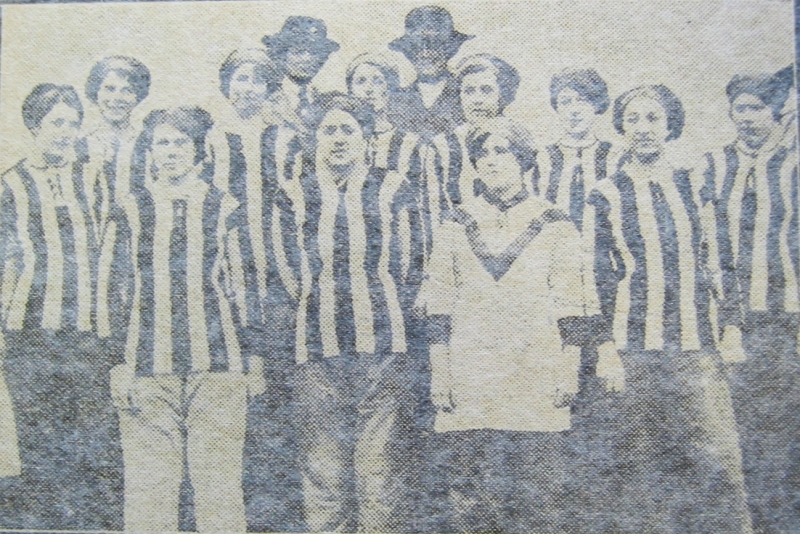
armstrong_munitionettes

Armstrong Munitionettes

Speaking of female sports players, Newcastle’s ladies (as you might expect) were also pioneers on the football field. The British Ladies’ Football Club played at St James’ Park on April 20th, 1895, only a month after they formed, and a crowd of 8,000 gathered to watch the “spectacle”. The reporter for the Sporting Man was obviously confused by the whole thing, and spent all his time describing the women’s attire. He concluded that “the young women presented a pretty appearance on the field, and this was in great measure due to the nice assortment of colours, as well as the dainty way the women set them off”! The quality of football played on this occasion is unclear, but certainly twenty years later a new generation of teenage girls embraced the sport with enthusiasm. The Munitionettes League was formed in 1917, made up of teams from the women workers of the factories of the north-east, and was the first ever league for women’s football. Made obsolete by the end of the war, the League lasted less than three years, but St James’ Park, host to the cup final, saw some remarkable young women in action. Mary Brown, playing for Palmer’s of Jarrow, not only played in the 1919 final (March 22nd) but at 14 was the youngest-ever footballer, of either gender, to play for England!

Interview with Neelima Vinod

09 Sunday Jun 2013

Posted by D.A Lascelles in Guest posts

≈ 5 Comments

Tags

books, Buffy the Vampire Slayer, Dracula, good poems, greatest weakness, guest blogging, guest posts, Interviews, Neelima Vinod, paranormal romance, poetry books, sense of rhythm, Unsettled, Vampire Month, Vampires, writing, Yakshi


Today we are back with Neelima Vinod, author of the recently released novella, Unsettled. Neelima was originally supposed to be contributing this interview to Vampire month but circumstances conspired and instead she sent us a piece of fiction. I promised her the chance to answer the Vampire month questions when her book finally came out and so here are her answers…70112929-019 copy

1) What is the earliest memory you have of writing? What did you write about?

I remember writing  letters to my grandparents on blue envelopes that doubled as writing paper. I wrote to them at great length about the things that I did and the books I was reading. I wrote poems a great deal as well. When did you decide to become a professional writer? Why did you take this step? After my sons were born. It’s been seven years since I made that decision. I had always chosen to do jobs that had a lot to do with language like editing, and literature, like teaching. But  it was not enough. I needed to write more. So I wrote for magazines and blogs. I worked on writing fiction and poetry that I would like.  I searched a long time for my voice. When I was presented with an opportunity to write a novella last year, it happened easily.

2) What would you consider to be your greatest strength as a writer? What about your greatest weakness? How do you overcome this weakness?

My strength has to be my love for poetry- that gives me a sense of rhythm when I write. The amazing part of the digital age is the immense access you have to poetry. Although poetry books are not flying off the shelves, there are archives and archives of good poems and readings. This ability to read almost any poem out there has opened my world.  My weakness is that I keep editing what I write. That slows my pace. What I try to do now is write continuously without being overburdened by the possibility of change. Yet I keep faltering….

3) Tell us about the place where you live. Have you ever derived any inspiration from your home or from anywhere you have visited?

Well my ebook ‘Unsettled’ is straight out of the place where my ancestors lived. The same hundred roomed house, no ghosts though! I’m romantically attached to Kerala in southern India,  especially my mother’s ancestral homeland. I visit Kerala often and  the images of the sunny green palm studded landscape seem to have seeped into my heart and mind.

4unsettled-200x300) Which book, if any, would you consider to be your greatest influence and inspiration?

Wuthering Heights is a book that I love- it’s the first book about haunted love that held my undivided attention.  The Victorian writers set the stage for the paranormal excesses that we see today.

5) What drove you to write about Vampires?

The story ‘Unsettled’ has a vampire seductress- what is called a yakshi in subcontinental literature. I grew up listening to stories about yakshis- my mother and grandmother are good story tellers. As they spoke about their lives, I lived those lives too and the idea of a yakshi appealed to me a great deal.  A yakshi is normally pictured as insensitive in stories and movies, though she is also worshipped in some parts. The female stereotype irked me a great deal- the idea seemed absurd that a beautiful woman would hang on a tree and devour innocent men who could not help being tempted by their delicious floral scent. The yakshi will make a night of it and then devour the innocent man and leave his nails and hair like trophies for all to see. Why is she so angry? I often wondered. So I decided that my yakshi would be less woman, though she is terribly attractive, and more human.

6) What do you think is the attraction for Vampire fiction? Why is it such a popular topic?

There are so many people in one person- a part of each of us is fascinated by negativity as it is as much a part of life as all things bright and beautiful. People read vampire fiction for thrills- it makes you feel terribly alive when you read it.

7) In a fight between all the greatest Vampires of fiction, who do you think would come out on top?

You can’t beat Count Dracula….he’s a precursor of all the fanged blood suckers that come after.

8) What about in some other contest such as sexiness or dress sense? Who would win that one?

I’m hoping Thathri, my yakshi would win that one Her kohl drenched eyes and lustrous hair give her a slight advantage.

9) How well do you think one of your characters would fare against the winner(s) of the above?

Well the Count may just get smitten by the yakshi…she’s far too seductive to ignore.

10) Tell us the basic premise behind your latest novel.

The story is about a search for love. When a couple who fall out of love go in search of the scrolls of love, they come face to face with a paranormal reality. A yakshi guards the scrolls at the hundred roomed house- she has been haunting the Big House for centuries. Although the book is about an outward search, it is a psychological drama of a seductress who is angry at the deck of cards called life she’s been given. The story goes back and forth in time- there is the present disillusioned Indian couple and there is a story that happened five centuries ago.  We all search for love but suppose our search is the very basis of the existence of someone else’s memory? What then? That’s what I wanted to talk about.

Unsettled: A summary by Neelima Vinod

05 Wednesday Jun 2013

Posted by D.A Lascelles in Guest posts

≈ 2 Comments

Tags

books, court poet, divya, guest blogging, guest posts, Neelima Vinod, paranormal romance, raghav, Scrolls of Love, Unsettled, Vampires, writing, Yakshi


You may remember Neelima from her appearance in Vampire Month in March this year. When Vampire Month was going live, she was on the verge of releasing her new novella – Unsettled – but did not really have much to tell us about it. This has now been rectified. Unsettled is out now and here Neelima tells us all about it…70112929-019 copy

Unsettled: A summary

The e-novella ‘Unsettled’ is about a search. We all go out in search of something, don’t we? Life is that. This story is set in the subcontinent- a young couple, Divya and Raghav,  have fallen out of love. They meet Dr. Ray with his unconventional methods. He zeroes in on the primary problem in their marriage. The only thing that can fix it is a search for the Scrolls of Love. Anyone who gets their hands on these scrolls will fall in love again, so goes the myth.

There’s a story behind the Scrolls of Love as well- I go back in time, five centuries ago in fact, to tell you the story of these scrolls of love, actually poems written by a court poet who was banished into Cherakad, a snake-infested forest land. Once a court poet, now a homeless man, the court poet walks into a house with one hundred rooms.

The unhappy couple walk into the same house centuries later. There they meet a femme fatale Yakshi spirit, drowned in centuries of loneliness. She’s a vampire seductress who refuses to bury memories and has a taste(a serious hunger) for young men. She knows what the couple are looking for and she is not the sort who will part with what Divya wants most.

unsettled-200x300Where does the search take them? That is what ‘Unsettled’ is all about.

Here’s a link to the book page: http://indireads.com/unsettled

Here’s a link to my author profile at Indireads: http://www.indireads.com/ir_author/neelima/

Bio: Neelima writes fiction and blogs poetry @ neelthemuse.wordpress.com. She’s written a book with a paranormal twist which will be coming out soon.

World Book Night

19 Friday Apr 2013

Posted by D.A Lascelles in Publicity

≈ Leave a comment

Tags

2000 AD, books, Costa, John Wagner, Judge Dredd, Malorie Blackman, Prestwich, World Book Night, World Book Night event, writing


You may have noticed a new page on the top of this page. This is a page covering the details for World Book Night which, as you may or may not know, is this coming Tuesday (the 23rd of April, which is a special day for lots of other reasons…). On that day,darkjudges I will be at the Costa Coffee in my home town of Prestwich, giving away copies of The Dark Judges by John Wagner. This is a graphic novel based on the famous 2000AD character who also starred in one absolutely awful film and one which is, by all accounts, not bad at all.

Others will be there giving away other books for free including copies of Malorie Blackman’s Noughts and Crosses which, from the blurb, seems to be an intriguing alternate history where apartheid and race relations work in reverse and those with dark skin (crosses) are seen as superior to those with white skin (noughts).

Both books look to be splendid and well worth checking out…

Of these books we only have limited supplies. 40 copies of the Dark Judges and only 20 of Noughts and Crosses. I expect these to disappear quite quickly so anyone who has set their heart on getting hold of either book should make sure they get to the coffee shop early.

The event starts at 6pm and runs until 8pm and as well as the book give away we also hope to have other things to entertain you. There should be readings and discussions and maybe some other giveaways. And we also have the staff of the coffee shop staying in late to keep us in hot drinks. Feel free to pop in and say hi. We will be upstairs…

If you are also a WBN Giver and want to give away your books, feel free to come along and share our space with us. The more we have there the merrier. If you are an author with some giveaways or swag to dispose of, you are also welcome to join us and do a talk or a reading or a competition of some form.

Of course, World Book Night is a charity so you should also check out their website to see how you can help them out. Their aim is to provide access to reading to those who either are unable or unwilling to be regular readers. You can volunteer to be a giver for next year’s event and get a box of books all to yourself to give away for free or you can make a cash donation. Apparently £10 will buy one of the WBN special edition boxes which ensures that twenty people get a free book to read.

A few things here and there

05 Friday Apr 2013

Posted by D.A Lascelles in Musings

≈ Leave a comment

Tags

23rd April, blogging, books, Ed Fortune, Interviews, Joy Phillips, Michael Brookes, Ninfa Hayes, R.A Smith, Starburst Magazine, Transitions, World Book Night, writing


Well, Vampire Month is finally over and I have just got back from a brief holiday during which I had my birthday. It’s been a rather successful month with some great vampire writers contributing some really good articles on a range of subjects. In this first week of april, however, there have been a few things cropping up here and there which need to be shared.bookmarks

First of all, I was interviewed by Michael Brookes over at The Cult of Me blog. The interview went live yesterday and in it you can find out all sorts of things about me. Go over there and check it out. I talk about the first book I ever wrote which, thankfully, no longer exists save as a bad memory and a few other things.

Secondly, I have signed up for Authorgraph. This is a system which allows signatures to be added to ebooks. You can find Transitions on there by following this link: http://www.authorgraph.com/authors/areteus. Basically, you can click the ‘request authorgraph’ button and I will get a notification telling me you are wanting a signature. I can then choose to do this freehand (using a touchscreen or mousepad but be warned my ‘handwriting’ is terrible using a mouse…) or using a font. I can also add an inscription. You basically get a pdf of this with a picture of the book cover sent to you. This app seems to be a good way to fill a niche caused by the ebook revolution. I have heard many say that one thing you cannot do with an ebook is sign it. Now, I will not say that this is going to replace ‘signed copies’ in any way (I am not convinced, for example, that you will be able to sell the signed ebook copies for a greater value) but it is a step in that direction. It will be interesting to see how it works out over the next few years.

Scan this using your mobile phone and an appreopriate tagging app...

Scan this using your mobile phone and an appreopriate tagging app…

Finally, preparations for World Book Night are progressing. Myself, Ninfa Hayes (author of Bites), R.A Smith (author of Oblivion Storm), Ed Fortune (columnist for Starburst magazine) and Joy Phillips (upcoming debut novelist and organiser of innovative new LRP Fall of Vusoria) are getting together to give away free books to anyone in the Manchester area who wants to come and get them. We will be announcing a venue sometime soon (hopefully). It should be a good night and we have around 60 books between us to giveaway. As part of this I have decided to have some bookmarks made up and I have also sorted out a couple of QR tags so that people with mobile phones can scan them and quickly and easily buy a copy of my books in any ebook format. I am rather proud of the bookmarks, which I designed myself using elements of the cover for Transitions.

So, if you fancy meeting any one of us, getting any of our work signed or just want a free book, feel free to pop along on the 23rd of April and all of this will be possible…

← Older posts
Newer posts →

Twitter Updates

Tweets by areteus

Like me on Facebook

Like me on Facebook

Enter your email address to follow this blog and receive notifications of new posts by email.

Join the Lurkers

  • Alex James's avatar
  • D.A Lascelles's avatar

Enter your email address to follow this blog and receive notifications of new posts by email.

Join 909 other subscribers

Recent Posts

  • Gods of the Deep 10th Anniversary
  • I’m (apparently) a cover designer!
  • Release day! Coch a Gwyn
  • Cyberpunk look
  • Eastercon Artshow

Blog at WordPress.com.

  • Subscribe Subscribed
    • Lurking Musings
    • Join 129 other subscribers
    • Already have a WordPress.com account? Log in now.
    • Lurking Musings
    • Subscribe Subscribed
    • Sign up
    • Log in
    • Report this content
    • View site in Reader
    • Manage subscriptions
    • Collapse this bar
 

Loading Comments...