Doctor Who Anniversary

Tags

, , , , , , , , , , ,


If you are not by now already aware that today, the 23rd of November, is the 50th Anniversary of Doctor Who then I suspect you have not really been paying attention. It’s not even as if it is only talked about in geek circles or ‘on this internet thing that kids use these days’. It has in fact been all over the media – on the television and even in mainstream newspapers. Even Google got in on the act with one of their interactive games.50th_iconic_wallpaper_16x9

So yes, the 23rd of November, is the anniversary of the day that the first ever episode of Doctor Who, An Unearthly Child, was broadcast to a television audience that likely had no idea what to expect and which would, years later, officially become the world’s longest running science fiction TV show with 798 episodes as of the end of the last series in May 2013 (presumably the feature length anniversary special will make it 799 and the Christmas special with Matt Smith’s regeneration into Peter Capaldi number 800 which is rather neat numerically speaking). This is not only a major milestone anniversary (a Gold anniversary if it had been a marriage) but one which occurs while the show is still on the air, thereby allowing a special episode to be shown as part of the normal timeline of the series. Many previous milestones were not marked in this way because the show was off the air at the time. This includes the 40th (or Ruby anniversary) which occurred in 2003, two years before the 2005 reboot with Christopher Ecclestone as the Doctor, and the 30th (Pearl) which was in 1993, four years after the show was cancelled in 1989. There were no special episodes for those years.

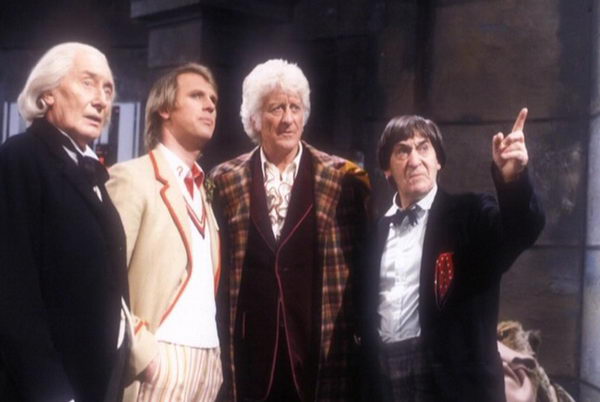
In fact, to get to the nearest anniversary special before this one you really have to go right back to 1983 and ‘The Five Doctors’ which was aired to celebrate the 20th anniversary and that is a hell of a long time to wait between specials, especially ones that include more than one actor playing the role. Before that we have the tenth anniversary episode, The Three Doctors, which was broadcast as the first story of the The%20Five%20Doctors%20(1)tenth series between December 1973 and January 1974.

Obviously the expected pattern is an adventure featuring more than one Doctor. Though only one of them (The Three Doctors) actually managed to achieve all the Doctors present and all played by the original actors. By the time The Five Doctors was being filmed, William Hartnell had unfortunately died (and was replaced by Richard Hurdnall) and Tom Baker had refused to be involved in the project (he was replaced by unaired film footage and other trickery). The 50th anniversary special (The Day of the Doctor) is also not showing the complete set. But then it was never the intention for it to be ‘The 11 Doctors’ (or should it be 12 now that John Hurt is officially confirmed as ‘The War Doctor’, thanks to the recent webisode ‘Night of the Doctor’?*). I suspect that Steve Moffat decided to not even attempt to achieve what would be an almost impossible task to complete satisfactorily – replacing the three deceased actors with convincing copies alone would be difficult enough, not to mention producing convincing enough make up jobs on some of the surviving actors to put them plausibly back in approximately the right age range they were when they first played the role. The closest we are ever going to get to the ’12 Doctors’ on TV is, I am afraid, that which was quite ably achieved in ‘The Name of the Doctor’ with the quite clever use of old footage and glimpses of familiar costumes to give the impression of the old favourites coming back to haunt the current incumbent.

Still, despite this, The Day of the Doctor promises to be interesting, with a fascinating combo of Matt Smith and David Tennant and an appearance by Billy Piper as Rose Tyler.** And while TV is now never going to see much more than that in the way of multi-Doctor stories there is still scope for these to occur in other media. For example, soon after the 1996 TV movie starring Paul McGann, Terrence Dicks wrote the novel ‘The Eight Doctors’ which included appearances by all then existing versions of the Doctor. There was also the IDW comic series, The Forgotten, written by Tony Lee, which included short stories featuring all the incarnations up until David Tennant and a quite epic finale in which all ten appear in the same scene. Finally there is also scope for it in audio dramas with Big Finish using many of the previous actors to do voice work on a range of new stories.The iconic scene from Tony Lee's The Forgotten

 
The iconic scene from Tony Lee’s The Forgotten

So, while I guess my long held dream of there being something equivalent to ‘The Five Doctors’ (one episode I have fond memories of) being produced on television is never going to happen, there is still a lot of good stuff out there. I for one am looking forward to this, the first anniversary special in thirty years…

* An excellent mini episode which allowed Paul McGann’s eighth Doctor the swansong he truly deserved and made me wish we had seen more of the adventures which had led to him being in that situation on TV instead of on audio and in books.

** And I am not going to talk about the speculation about who would be involved or why certain actors were not invited to take part, that is a whole mess of pain and suffering and troll bait right there…

How to kill a Vampire

Tags

, , , , , , , , , , , , , , , , , , ,


Jonathan Ferguson takes questions

Jonathan Ferguson takes questions

It was Halloween over the school half term break and so the Royal Armouries in Leeds were putting on some themed events. This allowed them to get out all their exhibits that were related to witchcraft or other supernatural occurrences and show them off to appreciative audiences.

One such event was a lecture by their curator of firearms, Jonathan Ferguson, entitled How to Kill a Vampire, which took place on the evening of the 30th October in the museum’s own lecture hall, the Bury Theatre.

This two hour lecture was split vaguely into two parts. In the first he talked about the traditional methods used, both in real life and fiction, to kill the undead. This was full of fascinating facts, even if the lecturer was somewhat hesitant in his delivery, and outlined the differences between mythological and fictional creatures such as zombies (reanimated corpses), Revenants (a lesser used term in the modern days for a visible ghost or animated corpse) and Vampires (which are typified by their tendency to drain lifeforce or blood). Some of it was common knowledge – stakes, garlic, sunlight – but through reference to folklore sources and archaeological evidence he quite ably linked the methods used to slay vampire in fiction (referencing everything from Varney the Vampire to Buffy and Blade) to what has been used in (mostly) eastern European villages for centuries to put an end to supposed curses – disease, ill fortune – that are attributed to vampires.

The Leeds Vampire Killing Kit

The Leeds Vampire Killing Kit

The practise of effectively scapegoating a recently deceased person is a common one in several cultures and generally arises because of anomalies in the decay process of a corpse. Maybe they do not decay fast enough because of sterile soil, for example, and this singles the corpse out as a vampire. According to Ferguson, in cases like this where villages attributed their woes to such a corpse, they generally went through several steps to ‘kill’ the vampire, trying all of the methods they could think of and only stopping if the bad things stopped happening. These methods involved a host of improvised weapons – mainly farm implements like sickles and even the traditional ‘stake’ so popular in vampire fiction is based on nothing more than a convenient fence post – and usually ended with the complete destruction of the body using fire (after which, as Ferguson states, there is usually nothing left anyway). There were some lesser known methods discussed too. For example, piercing the body with nails, which may be linked to the stake as well. One possible theory as to why this method was used might be linked to the ways corpses bloat due to trapped gases post mortem – another anomaly in the decay process that might be observed as supernatural in the uneducated. Piercing the flesh with a nail (or a stake) allows the gases to escape – restoring the corpse to normal. The ‘Vampire’ is slain. It was interesting to see the comparison between these rather morbid methods of solving a misunderstood problem by dismembering a helpless corpse and the more active methods employed in fiction, especially the evolution (and plausibility) of such esoteric devices as wooden bullets (or graphite ones as used in Ultraviolet), silver bullets and ultraviolet bombs and bullets. The ludicrous idea of using a small stake and thrusting it into the heart accurately while in combat with a Vampire (as seen multiple times in fiction but especially in Buffy) was also touched upon with reference back to Bram Stoker’d Dracula and Varney the Vampire where the protagonists use mallets to hammer the stakes through the breastbone.

The lecture then neatly segued into the second half which was more focused on the

A museum employee points out interesting features of the Vampire Killing Kit

A museum employee points out interesting features of the Vampire Killing Kit

Vampire Killing kit that the museum had acquired. Here Ferguson was clearly more in his comfort zone as his delivery was more confident and natural. A typical vampire killing kit usually comprises a number of items which are purported to be useful in dealing with vampiric threats – stakes, bottles of holy water and garlic essence, bibles or books of common prayer, crucifixes and guns loaded with silver bullets*. The controversy around these items is whether they were genuine 19th or early 20th century artefacts, created either as curios for tourists visiting eastern Europe or because someone really did think they needed protection from Vampires, or more modern fakes. Ferguson discussed in detail the evidence for and against these arguments, citing references from auction houses, folklore and even internet forums to build a convincing case that the balance of probability places the majority of these items firmly in the category of fakes. Such points as the inclusion of guns with silver bullets suggests that the earliest these items could have been made was after 1928 (rather than the late Victorian period as usually claimed) and certain facts about the methods of manufacture and the materials used are also damning. Most convincing of all, of course, is the confession of one poster on an internet forum who admitted to having produced a number of these items in the 1970s.

This does not, of course, stop Vampire Killing kits being sold on ebay and in real world auction houses for thousands of dollars (indeed, Ferguson described how he acquired the museum’s kit from a local auction house after a house clearance in Yorkshire). Nor does it demean the value of them as museum pieces – even if they were made as recently as the 1970s (and there is some evidence that the one Leeds have may have been made earlier, possibly even the 1920s) they are still antiques** and a well done fake with an intriguing story about why it was made in the first place is something just as worthy of museum space as a genuine article. In this respect they are much the same as the fake suits of armour displayed in the Tower of London. These were put there by the Victorians to demonstrate ‘armour through the ages’ but later historic research shows they do not represent the armours used in those periods. However, the Tower keeps them in place as examples of historic misconceptions. Ferguson mentioned that when this kit is on display he labels it clearly to show the belief about its authenticity, allowing the visitor an insight into how such fakes can arise and why.

At the end of the lecture, the audience were allowed to ask questions and to go up on stage to view the kit. It was quite fascinating to see it close up and it was even possible to handle the items inside it under guidance from a member of the museum staff.

In all this was a very interesting way to spend an evening on the night before Halloween.

* Yes, this is normally believed to be for Werewolves but the boundary between Vampire and Werewolf is often blurred in myth, especially with a concept of shape-shifting vampires and some cases like the Greek Vrykolakas which are wolf like vampires. According to Ferguson the first movie reference to the use of silver bullets for Vampires was in 1928, though silver as protecting against and harming evil is a common theme in folklore.

** As something made in the 1970s myself, I would like to say that I now feel old…

Photoshoot in a windy woodland

Tags

, , , , , , , , , , , , , ,


You may remember that over the last year or so I have been collabomartial artsrating with the team at Quattrofoto to produce a series of photographs themed around the background I wrote for the Fantasy Wargame Realm. We did the first two shoots in the studio where we met the Onryo Empress and her court, the druid Edvard Vermogen and the Vaetari Audenti – especially the Imperatrix Sanguinia. Both of these shoots were successful in achieving some awesome images. However, since shoot two was originally planned to be in a woodland and the weather scuppered our plans, we decided to get together in October 2013 to take those woodland shots.

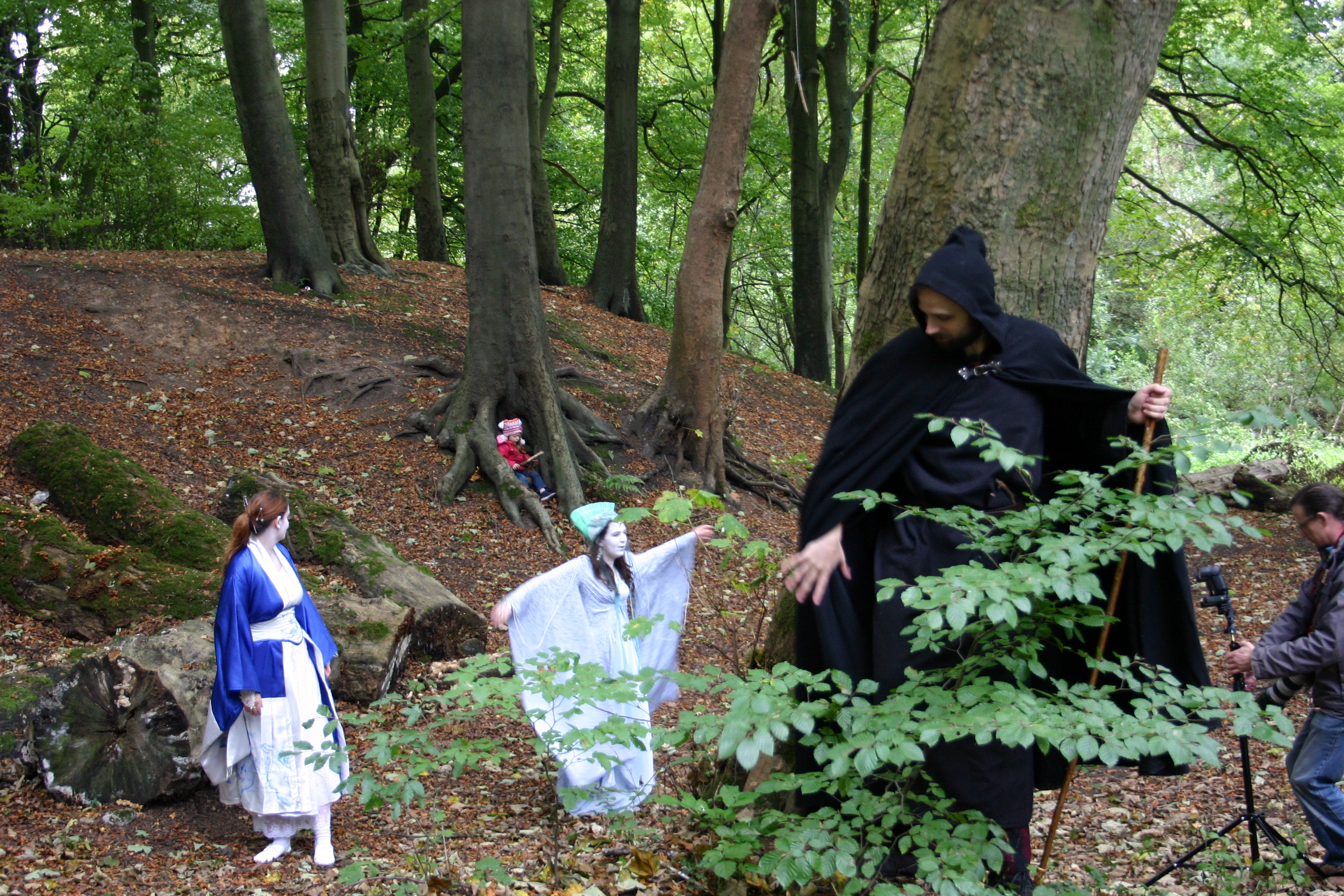
Thankfully, it did not rain this time. However it was still October and that meant the Autumn chills were upon us. Our poor models (especially Jessica and Alex in their kimonos) were somewhat cold. Actually, all of us were cold, even those of us who had thick layers of wool or coats to wear. However, we persevered through the keeping warmhardships and produced what I hope will be some wonderful shots once they are edited. We also had tea in a flask, thick woollen cloaks and good company to keep us warm as can be seen in the photo to the right. It is unfortunately one of the disadvantages of an outdoor location shoot that we were exposed to the weather, whatever it chose to throw at us. That included a very cold and strong wind. But at least the threatened rain did not appear so we did not need the bin bags that were packed to use as emergency waterproofing for the equipment.

Note that the photos in this blog post are my shots taken on the day, mainly of things happening in set up. Samples of the official Quattrofoto shots will be posted here later, as soon as they are ready.

the backdropWe decided to set up our outdoor studio in a little clearing in the middle of Prestwich Clough which had a rather interesting looking earth mound in it that was covered in trees. This proved to be a quite impressive backdrop, especially with the bright autumn colours to create a nice contrast. It was, of course, gloomy due to the tree cover but that was not a problem. Thanks to the portable lighting rig that was brought along it was possible to create any lighting conditions we desired. Compared to the extensive kit available in the studio this set up was rather basic, only two flashes linked to the camera by a remote control. However, this simple set up could create a vast number of effects and was more than adequate for our needs.

Jess as the Empress of Onryo demonstrating the benefits of having a real wind on location.

Jess as the Empress of Onryo demonstrating the benefits of having a real wind on location.

I mentioned that the disadvantages of being out of the studio were that we were exposed to the weather. However, this was one of very few disadvantages (lugging the kit to and from the location was another…). For the most part there were many advantages. For example, that exposure to the weather also meant that we could do some floaty robe effects without thrusting a very cold fan right into the model’s face because there was a natural breeze that did that job for us perfectly. We even attempted to get some shots of the Empress and her entourage surrounded by floating leaves by having some people (the photographer’s partner and daughter) stand behind the light rig and throw leaves into the wind. This rather cool concept did not quite work, mainly because the timing of the leaves flying and the shutter activating were off by just too much. Maybe if we had persevered for a few more tries, practised the co-ordination between the models, the camera operator and the leaf throwers we may have achieved this. However, we decided to progress onto other ideas. It was, however, great fun watching the volunteer leaf throwers hurling leaves at the two models. And leaf hurler seems to be the perfect job for a young child on a photoshoot.

The leaf throwers prepare to do their duty

The leaf throwers prepare to do their duty

Space is another thing we had more of than in the studio. In the studio, with the lights in place, space was very limited and therefore shots with more than one model were difficult. Especially if you are trying to tell a story that involves two groups of characters in conflict. You don’t want to have any photographs showing backs of heads so the arrangement of your models has to avoid that.  In the open air there is a lot more space in which to spread out and get good vignettes where every character’s face is visible, even if they are apparently facing each other.

set up2Another difference between the studio and location, at least in this instance, was the time. The studio set up required a lot of time to get ready for use and a lot of faffing with settings on all the lights to get it all working the way the photographer visualised it. Here the light set up was limited – two lights – and there was an added bonus of the photographer having acquired a device which let him adjust the settings of both lights from the control system of his camera. This meant less wandering around to each light in turn to adjust them, taking a photo, doing all the adjustments again and so on. Therefore the turn around on shots was a lot quicker – we sometimes got what the photographer considered a perfect shot in a couple of minutes rather than the twenty or thirty minutes as was the case before. Initial set up was also a lot quicker. I had planned in my schedule a lot of time for this and was therefore surprised to find them all ready to go and waiting around bored when I came back from guiding some of the models to the location.

My role on the day was ostensibly ‘shoot director’ as usual as well as generally trying to get everything organised – location scouting, making sure everyone knew what was happening, sorting out the basic logistics. However, myself and Lucy (who you may remember mentioned in the previous photoshoot blogs) also had another very important role. You see, another issue with a location shoot is uneven ground and so while you might be able to leave a light stand on a smooth studio floor and expect it toa lightstands view stay standing, this is not the case on location. Especially when there is a strong wind blowing and your lights have reflector umbrellas on them. So, two able volunteers who were not taking photographs, being models or throwing leaves around had to stand next to the light stands and hold them in place. Most of the time that was me and Lucy. I like to think we performed ably as inanimate pieces of photography equipment. Certainly no lightstands fell over in the wind, though the strength of some of the gusts we experienced almost caused them to take a tumble a couple of times. This did however mean I could use my own camera, albeit one handed as one hand was always holding the lightstand, and take photos of my own from quite close to the action – literally a lightstand’s view of the models. In the photo above, you can see one such shot which includes the reflector in the top left hand corner.

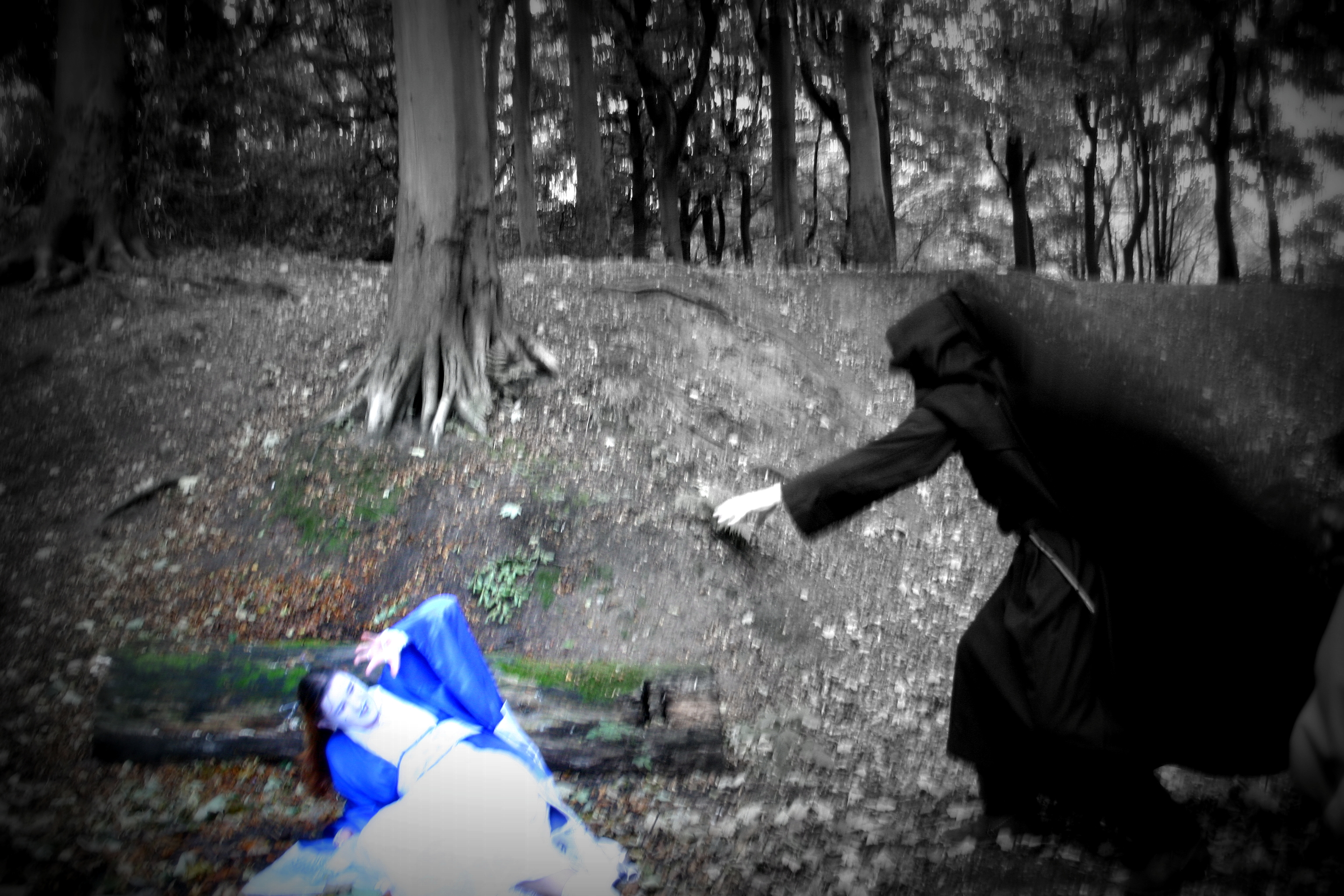
Playing around with colour settings. The blurry shadow effect is a camera artefact that I decided worked for the scene being shot.

Playing around with colour settings. The blurry shadow effect is a camera artefact that I decided worked for the scene being shot.

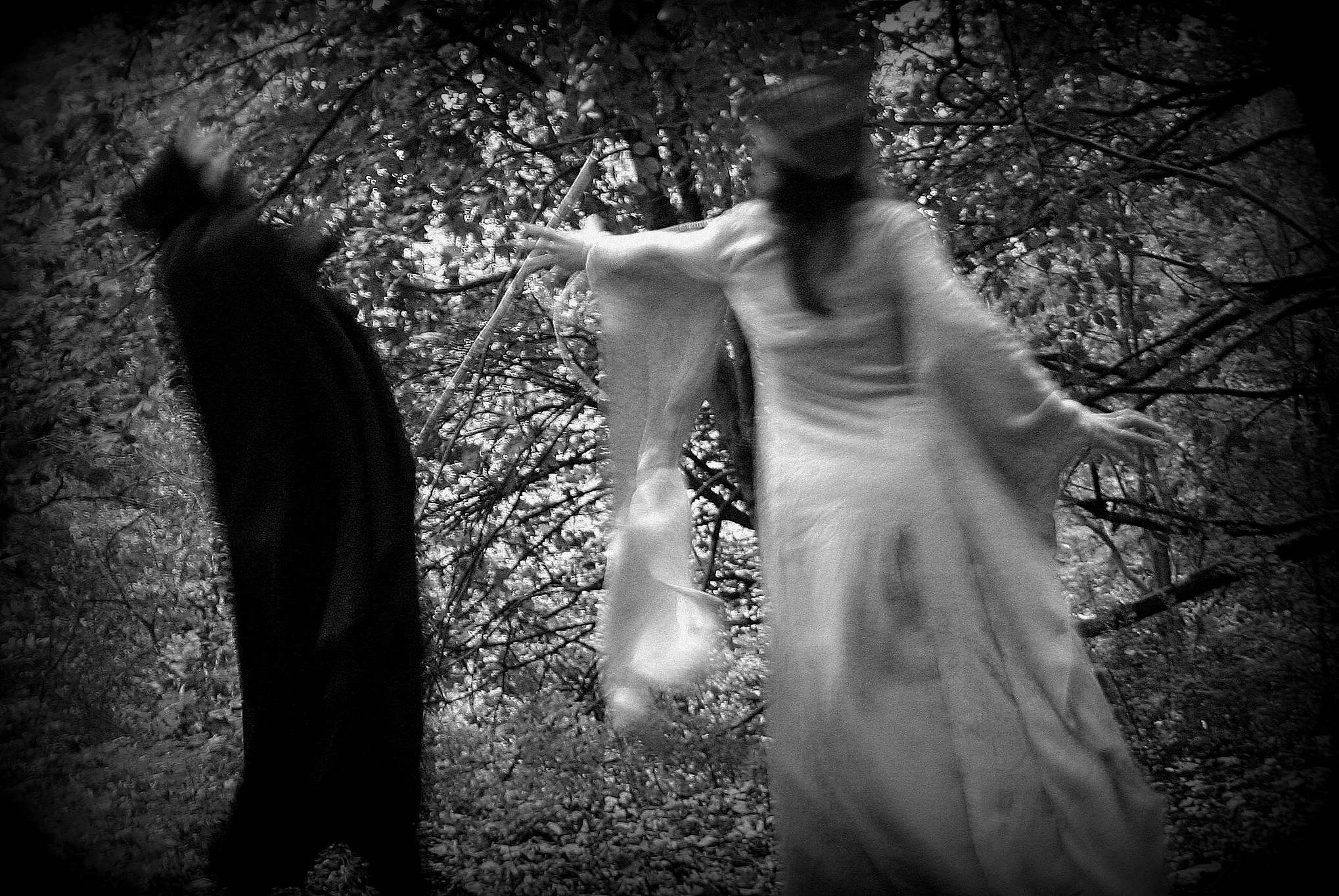
We took two basic scenes on the day. First of all we went to the top of the mound and took some shots of Jess and Alex as the Empress and one of her sorcerer courtiers. Then, as the quite spectacular light we were getting through the trees on top of the mound faded, we moved to the base of the mound to make use of the interesting scenery there – old logs and gnarled trees and lots of undergrowth – to take some shots of our two undead fiends chasing a single wizard, played by Andy Mason. There were also individual shots of each of the characters alone. By the time we finished all that, it was getting on to sunset and so we headed home to let everyone warm up and find food. We even got a chance to preview some of the shots as they were uploaded to a tablet. Hopefully soon there will be properly edited shots with photo-shopped special effects to marvel at. Until then, please accept my efforts as a poor substitute.

An action shot my camera was too slow to catch properly so there is a lot of blurring

An action shot my camera was too slow to catch properly so there is a lot of blurring

[Review] Salvage by Chris Howard

Tags

, , , , , , , ,


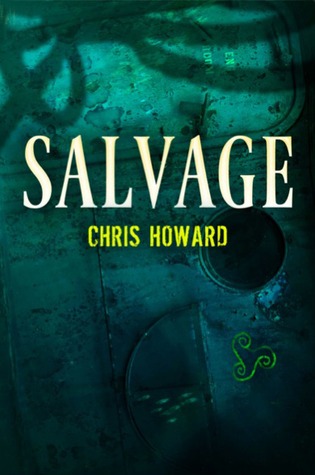
Salvage

By: Chris Howard

Published in 2013 by Masque Books (an imprint of Prime books)

This entertaining novel starts out as an intriguing maritime thriller. A ship, the Serina salvageBeliz, sinks barely twenty miles from Cuba without a trace. The crew of the salvage ship Marcene, led by Captain Jay Wilraven, are hired by a mysterious backer to locate the wreck and bring it to the surface. What seems at first to be a simple job soon turns out to be far from it as the crew encounter their employer’s extreme paranoia and are very quickly the prisoners of the security team foisted on them ‘for their protection’. It is clear that there is more to the wreck than first appears and the crew begin to take steps to try to find out more, working to undermine the brutal regime of the security team without being caught. This part of the novel – involving as it does shipwrecks, mercenaries, floating cities and Cuban pirates – is firmly entrenched in the realms of a modern day thriller, at least initially. You can make comparisons here between the travails of Captain Wilraven and other maritime protagonists such as the recent Captain Phillips as played by Tom Hanks. The drama here is tense and relatively contemporary, only veering off into fantastic and futuristic areas very late in the narrative.

Meanwhile, interspersed among these scenes of hardship and violence, more or less chapter for chapter, is another tale. This involves a scientist by the name of Jon Andreden who works for a company researching submersibles with artificial intelligence. It is in this story that a vague element of science fiction creeps into the plot as the technology evidenced by Andreden and his company is slightly ahead of what is possible in the modern day. Andreden encounters a woman who refers to herself as ‘merely a Toymaker’ and is intrigued by the wonderful technology she shows to him, which is even further away from what is possible in the real world. She is searching for a missing sister and believes that Andreden can help her. This story takes us through several more thriller style episodes with a definite X-Files twist –  involving black ops teams and secret government conspiracies – before delving into deeper science fiction and finally out the other side into the realms of myth, but I won’t tell you which myth as that might be considered a spoiler.

Initially it seems as if the stories of Wilraven and Andreden are completely unconnected. Indeed, I did wonder at first if there hadn’t been some mix up in the ebook formatting that led to two entirely different novels being mixed together. However, I do not think it creates too much of a spoiler to tell you that there is a link and that this becomes apparent as the story progresses and the two do dovetail nicely into a complete tale as Anreden’s missing persons search brings him closer to the fate of the Serina Beliz and the predicament of the crew of the Marcene.

In all this is a finely crafted novel. Both storylines are well written and researched, especially the scenes involving Captain Wilraven and his crew which show a good knowledge (and possibly personal experience) of the life of a salvage crew. A lot of detail is included in all chapters and the author’s interest in the sea is evident. More importantly, this does not devolve into tedious info dumps. The advanced tech used in the Andreden chapters is also very well portrayed and involves some good ideas, with the AI submersible even emerging as a sympathetic character. The human characters are equally well realised, at least the main ones are. If there is one complaint about the characters it is that of the mercenary squad who serve as the main antagonists for one storyline, only two of them really get given any particular attention in terms of depth of character. The rest are kept as two dimensional ciphers. This is a minor criticism, however, and does not detract from the storyline.

I would definitely recommend this novel to those who like mysteries or thrillers, especially those with a marine theme.

Buy from Amazon


Assault or Attrition – An interview with Blake Northcott

Tags

, , , , , , , , , , , , ,


Today we are VERY lucky to have an interview with Blake Northcott, who some may remember as @ComicBookGrrl on Twitter but who has now emerged as Canada’s hot new writing talent. Her previous novels – Vs reality, Relapse and Arena Mode – hit bestseller lists on Amazon in the US and UK and her latest offering, Assault or Attrition, is already fully funded through a Kickstarter campaign.blake-northcott-author

Assault or Attrition, another hybrid of the traditional novel format and the graphic novel like Arena Mode, has seen Northcott work with some promising collaborators such as Steve McNiven (Guardians  of the Galaxy, Civil War, Uncanny Avengers) and Mark McKenna (Star  Wars: Old Republic, Justice League, Combat Jacks) as well as COMICBOOKGIRL19 (The Comic Book Girl 19 Show) among others and is set in the same dystopian superhero continuity as Arena Mode. We talked to her about her work, the trend for self publishing via Kickstarter and the perils of online misogynism.

D.A Lascelles: You’ve done really well in the last few years, seeming to effortlessly hit bestseller lists on Amazon with your books (Arena Mode #1 in Amazon UK). How much of that was luck and how much was due to hard work?

Blake Northcott: That is a funny question. I don’t think anyone gets anywhere without hard work, but maybe there is an element of luck in there, too? Sometimes there is a ‘right place, right time’ event that kind of comes along, and maybe the people in the UK just really wanted to read a book about superheroes?

Either way I’m grateful!

blake-northcott-jon-roc-upchurchDL: Assault or Attrition is part of the same continuity as Arena Mode. What is the underlying story of these two novels?

BN: Arena Mode is more ‘world building’ – it sets up a universe in 2041 where the economy has kinda gone to hell, and superheroes just happen to exist. It follows a lifelong underachiever, Matthew Moxon, though some big challenges.

The story, if I had to sum it up, would be ‘Marvel and DC collides with The Hunger Games’, although that’s pretty simplistic. There’s more to it than that…at least I think there is?

Assault or Attrition deals with the fallout from the first book, and it’s heading in a completely different direction.

 DL: You talk about Arena Mode and Assault or Attrition being a blending of novels and graphic novels. Why did you choose to follow that route rather than opt for one or the other?

BN: Because I love both genres, and always wanted to do a hybrid of sorts – this was my happy medium. I get to write a novel, but have a comic book flavor by adding some artwork, without the need to make one person commit to an entire 22-page issue along with an inker, colorer and all that.

DL: Assault or Attrition has garnered a lot of support from some quite big names in comic art. Are you surprised at this? What was it like working with these people?

BN:  I’m surprised every day!

Working with some heavyweights from Marvel and DC is very humbling. They’re so talented and I’m learning so much from them. They’re all nice….well, one of them is a dick. You know who you are.

That was a joke. Sort of.

DL: Kickstarter seems to be the ‘in thing’ for self published writers looking to fund their writing.  Could you describe your experiences with this method? How do you see the use of this method developing in the future? 

BN: I see a lot of huge publishers elbowing their way into the space at the moment, but that was inevitable. I would like to see it stay kind of ‘indie’, for people who can’t find a home with a major publisher, but there’s no way to keep the sharks out the little pond, it seems – once they see the potential for profit they’ll jump in.

But overall, it’s still a pretty fair marketplace. My experience is that I can get exposure to a new audience that would not normally have seen my books, in a way that simply isn’t possible on Amazon, or anywhere else.

Plus selling a physical book on Amazon is so cost-prohibitive that there is almost no upside to it. Kickstarter allows me to produce a high-quality book, printed in America, and add all sorts of bells and whistles to the packages so people get more for their money.

DL: Self publishing: self inflicted modern vanity press or a way for talented writers to get unusual ideas with a niche market out there?logo2

BN: Self publishing is the ultimate raw material. It’s a lump of clay, and you make whatever you want out of it.

I’m a dorky Canadian woman who does sci-fi/superhero books with comic book art in them. That’s what I’ve made out of it so far, and every single writer does their own unique thing with the platform.

DL: There has been a lot of strife on social media over the ‘fake geek girl’ scandal and a whole host of issues surrounding the sexism in geekdom – specifically in the gaming industry. What is your stance on this? Is Geekdom becoming more enlightened over time or reverting back to more misogynistic roots? How do you think this issue can be tackled?

BN: I think that the trolls can be far more easily dealt with by ignoring them.

That sounds simplistic, but really, the whole ‘You’re a fake geek girl!’ thing can be crushed by just not letting the trolls voice their stupid opinions. There are a handful of dicks out there, but most people aren’t sexist or mean – they just want to engage and share what they love.

And I love debates and opposing opinions – that’s what an open discussion is all about – but when someone is being intentionally rude or aggressive, I block or unfriend  them, and delete their post immediately. It’s that easy. I don’t get all upset and make a big thing about it – I just get rid of them and move on.

Let’s face it – 99% of people are pretty cool. But there is always gonna be that one jackass who wants to screw up the party for everyone. Instead of letting that dick become the center of attention, let’s just move past him and discuss awesome stuff.

***

Assault or Attrition has, at the time of writing, exceeded its funding goal on Kickstarter and so should very soon be available to buy or download. However, the Kickstarter is still open so you can hop on and claim some of the rewards.

You can find out more about Blake on her Facebook and Twitter accounts or read more of her thoughts in one of her regular Man Cave Daily articles.

Assault or attrition cover

Love and other Demons – The Witching Pen Blog Tour

Tags

, , , , , , , ,


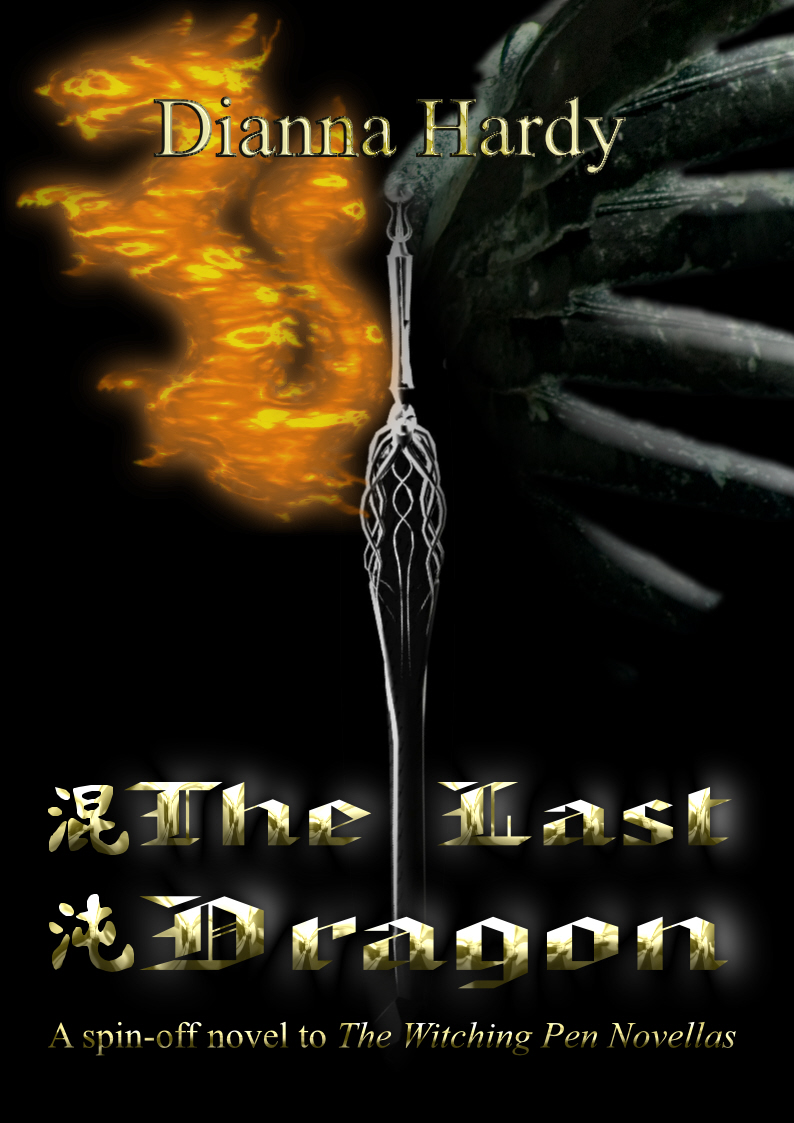
Today we are yet again invaded by the ever wonderful Dianna Hardy as she enters the final, frantic run up to the release of the final book in The Witching Pen series – The Last Dragon. This epic finale emerges from its cave to sniff the air on the 4th of The Last Dragon front cover smallOctober.

Below we have some extracts and also a giveaway. Anyone who comments on this blog will be in with a chance of winning a Dianna Hardy Swag Bag which contains:

– 1 signed M’Angeal Fridge Magnet
– 1 Witching Pen Omnibus Keyring
– 1 Witching Pen Omnibus Bookmark
– 1 Witching Pen Omnibus Postcard
– 1 The Last Dragon Coming 4th October postcard

If you have not yet read The Witching Pen series, these posts may contain spoilers, as we are now on the last book!

See here for all blog tour dates and posts: http://www.thewitchingpen.co.uk/1/post/2013/08/not-long-to-go-now.html

With The Last Dragon released on 4th October, we’re having a little recap at everything that’s happened in this paranormal fantasy romance series so far. After the last post talking about the “love triangle” between Amy, Pueblo and Paul, we thought we’d treat you to a couple of small exclusive excerpts!

Amy Choices

All excerpts of The Last Dragon are copyright © 2013, Dianna Hardy. All rights reserved.

Excerpt 1 (Amy & Pueblo)

“I don’t want you to go.”

“I know, babe. I don’t want to go either.” His warm hand rested on her still flat belly, the both of them lying on the even warmer sand beneath them.

“You’ve got two babes now,” smiled Amy.

Pueblo laughed, rich and deep, sending delightful waves of pleasure all through her body. “As if you’re not enough to handle on your own.”

“Hey!”

“You know it’s true.”

“Would you have it any other way?”

“Not a chance.” His lips captured hers, and she relaxed into the feel of him, not quite managing to forget that it wasn’t quite as real as she’d like. She blinked back tears, refusing to cry in front of him – he’d seen too much of her crying recently. He was doing his best – no need for her to pile on the guilt.

He pulled away.

This isn’t enough! screamed her mind, but she kept her mouth shut. “Tell me about your training. Is it going well?”

“I don’t wanna talk work. I want to talk about you – us…”

“But I want to know you’re all right. You never tell me about what’s happening. Are you safe?”

“Always safe. I have a family to come back to.”

She almost lost the tear-free battle right then … almost. “Will I see you again tomorrow night?”

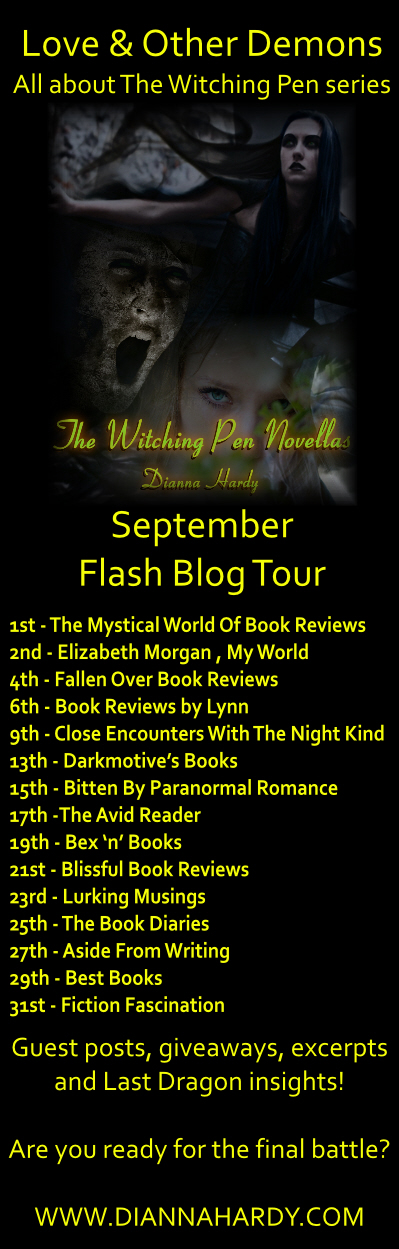
“Every night. Every night you dream, I’ll be here.”TWP n Last Dragon Blog Tour List

***

Excerpt 2 (Amy & Paul)

Amy threw her keys back into her bag, before throwing the bag on the kitchen counter. “I don’t think what I’m asking for is unreasonable.”

“You don’t—Amy, we’re living in an apocalyptic world!”

“And because we’re living in an apocalyptic world, I want to give birth in a nice, safe hospital.” Paul was near the end of his tether, she could tell – he had his kill-me-now face on.

“Home births are really much safer than people think, and since when are hospitals all that safe?”

“Since they started stocking painkillers. Can you see the size of this baby? You’re tall and Pueblo’s massive. I’m not giving birth to a thirteen pound baby at home.”

“The doctor said it was nearly ten pounds.”

“And does that sound like a breeze to you?”

“The hospital isn’t staffed – you heard him.”

“So we’ll find another hospital.”

“And which would be the apocalyptic hospital of choice, madam?” Oh, great. Kill-me-now face and sardonic-husband tone.

To find out how Amy found herself sandwiched between two men, start at the beginning: Witches, angels, demons, Heaven and Hell all come together in a dizzying story of friendship, love and forgiveness.

Before The Last Dragon explodes into publication, read book one of the series, The Witching Pen, currently FREE to download across most retailers! See here for download links: http://www.diannahardy.com/the-witching-pen.html

The Witching Pen eBook Cover SmallBLURB
It’s hard being the most powerful witch on the planet. It’s even harder when you’re a twenty-five year old virgin who’ll lose all of that power the moment you sleep with someone … that’s why Elena’s never slept with her best friend and flatmate, Karl, despite the true feelings they harbour for each other.

Elena’s about to discover that there are even more difficult things in life to deal with. One of them comes in the form of a pen she discovers one day, a pen that allows anything she writes to come to pass…

Suddenly, it’s not just her powers or her heart that’s at stake, but her very soul, as a dream demon with a seductive pull uses the pen to try and turn her away from her reality, and from Karl.

But the pen is just the beginning. Everything Elena has believed in is a lie, and her world is about to fall apart…

The entire series can be viewed here: http://www.diannahardy.com/the-witching-pen-novellas.html and mark 4th October on your calendar to know how it all ends with The Last Dragon.

Author of The Witching Pen and the international bestselling Eye Of The Storm series.

Dianna combines a titillating mix of paranormal romance and urban fantasy into her writing to bring you stories that are action-packed, fast-paced and not short of heat, with the focus on both character development and the plot. She writes both full-length novels and short fiction. All further info can be found at diannahardy.com

Want to know more about Dianna Hardy? Well, check out the following links…

Website: www.diannahardy.com

Facebook: www.facebook.com/authordiannahardy

Twitter: www.twitter.com/thewitchingpen

Amazon: www.amazon.com/Dianna-Hardy/e/B003AGRHFC

Google +: www.plus.google.com/u/0/110398750519005724804/posts

[Guest Post] Why Spy by Aaron Smith

Tags

, , , , , , , , , , , , , , ,


The last time I did a guest post here at Lurking Musings, the subject was horror and some of the ways in which I find it to be a rewarding genre to write within. I’m still writing horror stories, with a few new ones coming out this year, but I’ve never been one to stick to the same thing all the time, so today I’m here to talk about a different genre and how I became interested in it and how all the pieces recently came together for me to participate in it.DSC00358

There are certain things that I suppose it was inevitable that I would eventually do once I took my first steps on the road of being a writer. Looking back on my life and the interests I’ve always had, the sort of books and movies I’ve enjoyed, I had to eventually write something in the espionage genre. On one hand, I’m surprised it took this long, but on the other, I’m glad it did. I didn’t rush into it. I waited (though not consciously) until the pieces came together and the time was right, and I’m quite happy with the result.

Looking back on my life, I can pinpoint the exact event that made me a lifelong fan of the spy genre. It was a flood.

The year was 1984, I was seven years old, and we lived in Paterson, New Jersey, just across the park from the banks of the Passaic River. It was April and it rained constantly. That grimy old river could only take so much and it overflowed, vomiting dirty water up into the park, drenching the baseball field, submerging Totowa Road, intruding on our street, and filling our basement to within an inch of coming onto the main floor. In fact, it was so bad that the mayor of the city had to come in a rowboat and coax the old lady next door out of her house! We had to get out of there.

So we packed our suitcases and escaped. It was me, my parents, my four-year-old sister and my toddler brother. We ended up spending a week at my grandparents’ house. Grandma and Grandpa had something we didn’t. At the time, they were still pretty new and quite expensive: the amazing technological wonder known as the VCR!

My father, happy to be in the presence of one of the marvels of the modern age, wasted no time running out to the local lawnmower shop/ video rental place (I’m not making that up. Somebody actually ran that very odd combination of businesses, as there weren’t too many places yet that concentrated solely on renting out movies) to get his hands on something he’d been wanting to see but had missed when it ran in theatres a year earlier.

So, despite the protests of my violence-hating mother, that night I encountered a character who would become one of my favorite fictional heroes: Bond. James Bond. The film was Never Say Never Again, the “unofficial” Bond movie, which was a remake of Thunderball and not part of the Eon Productions series, but it featured Sean Connery, making his return to the role after more than a decade away, so it certainly counts as a real Bond movie in my book.

That was it. I was a lifelong Bond fan, not just of the movies but of the original Ian Fleming novels and some, though not all, of the continuations written by later novelists.

Bond was my gateway drug into the world of spy fiction and I discovered many other such characters over the years, in books, in movies, and on television. There were the books of Tom Clancy and John LeCarre, the Jason Bourne movies, and Taken, starring Liam Neeson.

Eventually, I started writing seriously and began to have work published. I wrote in genres including mystery, horror, fantasy, science fiction, and even did some war and western stories. Occasionally, one of my stories would include elements of the spy genre, but it took a long time before I finally set my sights on penning a true espionage novel.

It was a convergence of three events that I think—now that I look back on it—finally got me to try writing in the spy genre. I found a big bargain and managed to acquire the first twenty James Bond movies on DVD for under a hundred dollars, so I was able, for the first time in my life, to watch them all in order and relive many of my favorite 007 moments. I discovered a wonderful British series called Spooks, which ran for 86 thrilling episodes and turned out to be one of the most addicting and also heartbreaking TV series I’ve ever watched. And I said—and I have no idea where this particular combination of words came from—“Nobody dies for free,” which I immediately knew was going to eventually be the title of a spy novel. So the ball started rolling and it didn’t stop until I’d written the book.

But, strangely, for all the years that I loved the spy genre and all through the time it took me to write Nobody Dies For Free and then go through the process of editing it and eventually seeing it published, it never occurred to me to really sit back and ponder the question of just why stories of secret agents and clandestine missions have been so popular for so long. In writing this blog entry, that’s the very question I’ve decided to attack, and I’ve come up with four answers that I suspect are quite valid. I know they apply to me and I’d be curious to hear what others have to say about it once they’ve read this little essay.

Secrets and Scandals

When it comes to most aspects of life, but especially when the government is involved, many of us understand the need for some degree of secrecy. Certain things must remain classified, for the more we in the public sector know, the more those who are currently considered our enemies also know. But despite this, many of us wish we could personally know everything. The recent Edward Snowden business is evidence of this. We want to know exactly what our government (and all the other governments in the world) are doing, especially the dirtier business. Realistically, we can’t have access to this information. But in the world of the spy novel or movie, we can. For the time it takes to watch a film or read a book, we are insiders, seeing the world in all its intricate ugliness and backstabbing brutality as we share an adventure with the protagonist. Human beings are curious creatures who can’t resist an opportunity to inspect the president’s dirty laundry or sneak a peek at the sins of the king. Spy fiction satisfies our need to be part of the shadow realm.      

Patriotism

The world is a mess. It always has been and it probably always will. Most people seem to have mixed feelings about the countries in which they live. I’m glad to have been born American, I respect what the ideals behind the nation’s founding stand for, but that doesn’t mean I have to like everything my government does. For example, I’m currently quite irritated by the fact that the president’s new health care system is going to cost me several thousand dollars in wages this year. If I polled a thousand other Americans, I’m sure I’d get hundreds of different complaints about the way the country is run and how it interacts with both its allies and its enemies. And I’m sure my friends in Europe and Japan and Canada and various other places have conflicted feelings about their own countries. But I think most of us want our nations to be the best they can be. Spy stories, with their heroic government operatives, give us this courageous, honorable (and sometimes ruthless in that honor) side of the nation’s activities. Regardless of party affiliations or political opinions, we can all root for a James Bond or a Jack Ryan to do the right thing and act in the best interests of his fellow citizens, rising above the political mess to save the nation and maybe even the world.

A Socially Acceptable Mythology

Fans of certain genres of fiction are lucky to now live in a time when Game of Thrones, The Walking Dead, and True Blood are among the most popular series on television, when superhero movies are hugely successful, and when some of the world’s most popular authors are writing about vampires and teenaged wizards. But this wasn’t always the case. It wasn’t so long ago that people of certain ages might be laughed at if they publicly admitted enjoying Star Trek or comic books or the works of JRR Tolkein. So I’ve come to suspect that one of the reasons for the success of the spy genre for most of the twentieth century may have had something to do with the way it contains the very same elements as classic adventure fiction and mythology but puts it in a setting that seems to be a bit more adult-oriented, thus making it all right for a grown man in the 1950s and 60s (including President Kennedy) to be seen reading Casino Royale or From Russia With Love. As for those elements I just mentioned, let’s look at some of the basic ingredients of some of the most popular science-fiction and fantasy stories and compare them to what you might find in a secret agent movie.

Someone is chosen to go off on a quest to stop a great evil from causing harm to the world. They’re sent by an older, wiser person, usually an intermediary between them and a king or other such ruler. They are given some sort of special weapon which will aid them in their mission. They travel through many exotic locations, encountering strange beings, until they finally come face to face with the great evil and its frightening minions.

So was I just talking about Frodo Baggins being guided by Gandalf to put an end to Sauron’s plans, with a ring in his possession as he travels from the Shire to Rivendell and eventually to Mordor, meeting Aragorn and others along the way? Or did I mean James Bond being handed a mission by M, given a gadget-enhanced car by Q, and sent across the globe from London to Istanbul to the Caribbean to the Swiss Alps to face various henchmen with the help of a few beautiful women and Felix Leiter, until he finally confronts Blofeld in a final showdown? Or I could have meant the plot of Star Wars, or an episode of Spooks. The façade shifts, but the classic storytelling elements remain the same.

The Hero in his Prime

If you really want to narrow the types of heroes in fiction down to the least number of possible types, I’d say there are three. On one hand, you have the young hero being thrust toward destiny and fumbling his way along the path while struggling to make sense of the new point of view that’s been forced upon him. Luke Skywalker, Frodo Baggins, Harry Potter, Neo from The Matrix.

On the other hand, you have the old wizard/ guide, an older character, maybe worn out from decades of trying to keep evil in check, but possessing great experience and wisdom. Obi-wan Kenobi, Merlin, Gandalf, Van Helsing.

And then, smack in the middle of the two extremes, you have a balance between age and youth, action and experience. These are characters old enough to know how to handle a dangerous situation, but still young enough to do the fighting themselves rather than sending in a young apprentice. Captain James T. Kirk, Han Solo, Indiana Jones, and Batman, to name a few examples. This might be the sort of hero who readers and viewers most often dream of being. In the spy genre, particularly the more action-oriented espionage stories, this is the category into which many of the primary protagonists fall: James Bond, Jason Bourne, the Saint, the Mission Impossible characters, and the various lead field agents throughout the 10 year run of Spooks.

So there we have four big ideas about what might be responsible for the ongoing popularity of the spy fiction genre. As I said earlier, I hadn’t really thought about those things until I started to write this essay, but I now realize that I included all those elements in my own spy novel, the recently released Nobody Dies For Free. I hope readers of my book will enjoy it as much as I’ve enjoyed some of the other spy stories I’ve mentioned here today.  
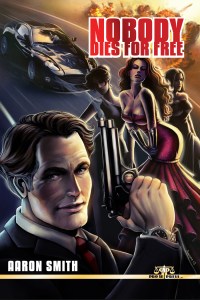
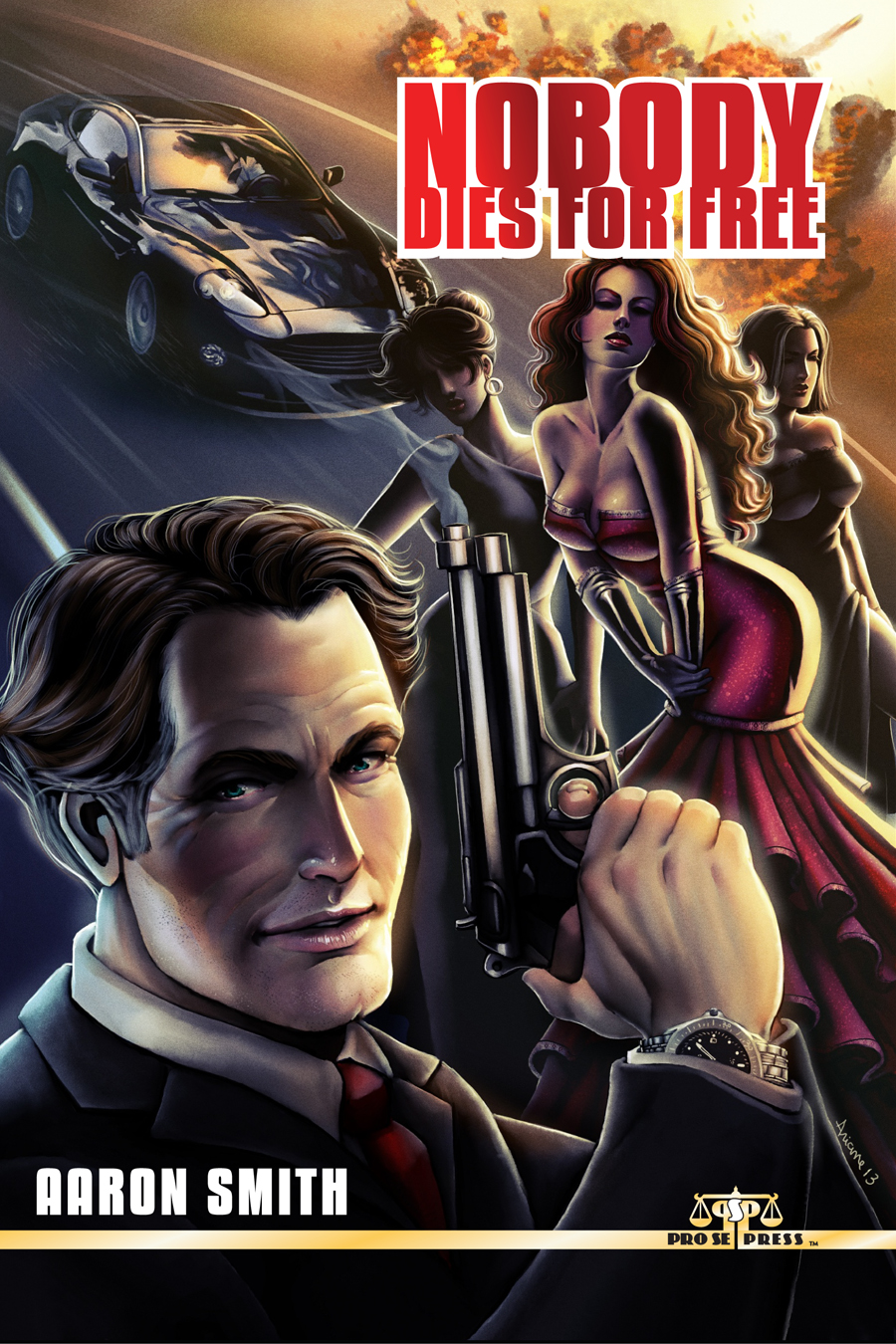
Nobody Dies FCHere’s a look at the cover of Nobody Dies For Free, along with the back cover blurb.

After years of loyally serving his country in the CIA, Richard Monroe wants nothing more than early retirement and a peaceful life in Paris with the only woman he’s ever truly loved. But when an assassin’s bullet takes his happiness away, Monroe embarks on a quest to find the man responsible for the tragedy. Monroe is soon recruited back into the clandestine services, but with a difference. Now he’s a lone agent reporting to a supervisor so mysterious that the official agencies don’t even know he exists. In his new position, Monroe will deal with situations too delicate and too dangerous for the CIA or FBI to handle. On his first assignment, he discovers a connection between the mission and the criminal mastermind behind his wife’s killing. Business becomes personal again and Richard Monroe sets out to teach his enemies a brutal lesson: NOBODY DIES FOR FREE!

Nobody Dies For Free is available in print or for Kindle or Nook.

At Amazon: http://www.amazon.com/Nobody-Dies-Free-Aaron-Smith/dp/1490367586/ref=sr_1_7?s=books&ie=UTF8&qid=1374860949&sr=1-7

Amazon UK: http://www.amazon.co.uk/Nobody-Dies-Free-Aaron-Smith/dp/1490367586/ref=sr_1_1?ie=UTF8&qid=1374861049&sr=8-1&keywords=nobody+dies+for+free

Barnes & Noble: http://www.barnesandnoble.com/w/nobody-dies-for-free-aaron-smith/1115568615?ean=9781490367583

For further information on Nobody Dies For Free and all my other books, visit my Amazon author page at http://www.amazon.com/Aaron-Smith/e/B0037IL0IS/ref=sr_tc_2_0?qid=1374366653&sr=1-2-ent

Or visit my blog at http://godsandgalaxies.blogspot.com/

 

[Guest Post] Paige Dearth – write what you know.

Tags

, , , , , , , ,


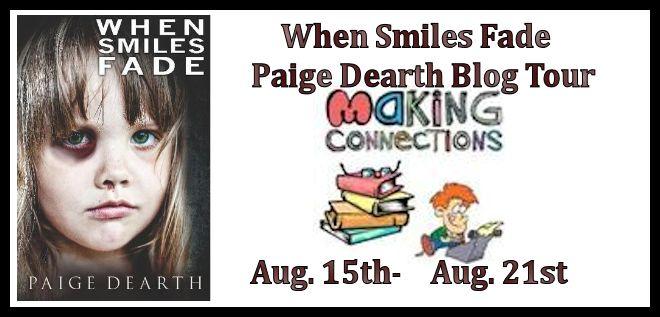
Making Connections Paige Dearth

Today we focus on the work of Paige Dearth, author of Believe Like a Child and When Smiles Fade.

In her debut novel, Believe like a Child, the main character Alessa is the victim of child abuse from her uncle. The story is one of redemption and of a woman taking control of her own life.

In When Smiles Fade, her latest novel released this year, the main character Emma is also abused as a child as you can see from this synopsis:

Emma was unloved from the moment she was born. Her earliest memory is being severely beaten by her father, Pepper Murphy, when she was just eight-yearsold. Seething with resentment over the sacrifice of his dreams for a woman he cares little about and children he never wanted, Pepper chooses to blame his older daughter. Her mother, Valerie, makes matters worse with her verbal abuse, leaving Emma isolated with a man that had no boundaries in punishing his daughter, taking his abuse to unimaginable levels. Emma’s father’s coldblooded beatings and the ultimate abuse to which he subjects her, lays the foundation of the person she becomes. As she matures into a resourceful teenager, she is unwilling and unable to stifle her desire for revenge. Reaching her breaking point she can no longer control the impulse to fight back and finally takes matters into her own hands. Having learned the art of hatred from her father and the mastery of manipulation from her mother, young Emma now sets out to make a better life for herself, leaving the memory of the abused child she had once been behind her. Hardened by the heartless brutality she encounters and the dangerous situations she must overcome in the course of her journey, she faces every challenge that comes her way in her quest for a normal life for herself and for those she loves. Finally a person emerges from within that guides her toward a better life until she learns of a secret that sets her on the path of ultimate redemption.

Both stories contain inspiration taken from Paige’s own life. She herself was a victim of child abuse at an early age and spent her childhood not believing that she had the potential to much in the way of ambition. When she finally went to college at the age of 29, she did not even believe that she was capable of passing the college level courses and yet she finally left college with an MBA 8 years later and a feeling that she had conquered her fear of learning. There followed a successful career in corporate America and finally a writing career that has seen her earn a finalist place in the thriller category of the National Indie Excellence Book Awards. Paige’s own life is an example of someone seeking to improve their lot.

So, both novels mirror events in Paige’s life, she has used her real life to inspire her writing. This ties in with the common author’s adage of ‘write what you know’. This saying is often mocked, especially in fantasy and SF, because you cannot ‘know’ what it is like to be a Dragon or an Orc or a wizard. However, this is applying an ad absurdum argument because there are still elements of a person’s life which will apply to any fictional character. Likewise in a suspense thriller, there are almost certainly going to be things in there that an author has not experienced but the trick is to take the things that have happened to you and apply them. Writing what you know is all about adding a level of emotional veracity to the writing that is conveyed to the reader. The use of the term ‘what you know’ is actually a misnomer as it really is not about knowledge at all. Knowledge is what you get from books and, these days, from the internet – whether by looking something up on Google or (as commonly happens) asking a question on a forum populated by experts in that area. Instead it is all about the experience – the emotional and physical impact that this has on you as an individual. I believe that this level of veracity is important. You don’t need to necessarily add emotional context to every event in your story but it does help if you have some personal life experiences you can call upon if needed. They may not be as traumatic as those described here, I would not wish such things on anyone if it could be at all avoided, but any life event can be useful – the tastes of food, the smell of the inside of a car, what it feels like to spend all day in a library reading ancient books. An author should be prepared to reflect upon their experiences and consider what they can learn from them and what they can use to improve their writing.

You can find out more about Paige on her website: www.paigedearth.com.

You can buy her books on the following links:

Believe Like a Child (US)

Believe Like a Child (UK)

When Smiles Fade (US)

When Smiles Fade (UK)

Later this year she also plans to release her third novel so please keep an eye out for that.

[Guest Post] Jill Sanders

Tags

, , , ,


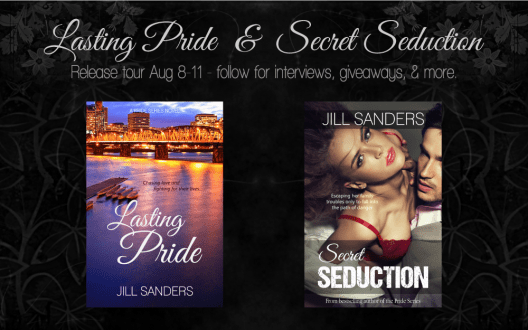
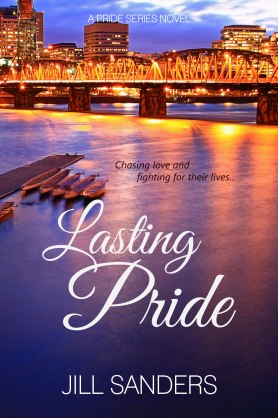
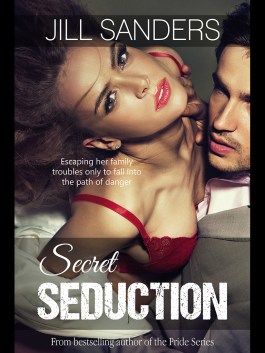
Today we have a visitor in the form of Jill Sanders, a highly successful romantic suspense author with a #2 Bestseller on Amazon and a shortlist in the Amazon Breakthrough awards. She is here to promote her latest releases. That’s right… Releases. Because, not content with merely producing one novel like other authors do, she’s produced two of them. So below we have extracts from the latest in Jill’s Pride series, Lasting Pride, and her new novel, Secret Seduction, which is the first part in the Secret series. Read, enjoy and please click the links to find out more about Jill and her work.

Click the image below to go to her site for a giveaway and to find out details of the other blogs involved in this tour!

blogtour

LASTING PRIDE
An hour later, she walked into his room to wake him and check on him. When she walked in, she was shocked to see his large bed empty. There was a soft light coming from under the bathroom door. The first thing that flashed in her mind was fear that he’d passed out on the bathroom floor. Rushing into the large room, she looked around and she saw him. Lying in the large jacuzzi tub with it’s jets still on and she could see steam rising from the water. His head was rested against a pillowed head rest and his eyes were closed, he looked completely relaxed and wonderfully naked.4LastingPride

Walking over, she took in her fill of him. The man had some great muscles, she could see the bruises running up and down his side that he must have landed on.

He was resting so that his left shoulder and arm were dangling out of the water, keeping his stitches dry. Her eyes ran down his chest and enjoyed the view of his pecks. His stomach was tight and she could just make out a very sexy six pack. His sandy blond hair ran in a light trail, pulling her eyes downwards. Noticing that he was hard all over, she smiled. Then, she moved down to his thighs, which were very muscular and covered with a light coating of blond hair. He was too tall for the bathtub so his feet hung off the ends, resting on the ledge of the tub.

Looking back to his face, she watched his dark eyelashes. How was it, that this man was lucky enough to get very long eyelashes? She was cursed with short thin ones.

His face looked totally relaxed. Walking closer to him, she sat on the edge of the tub.

“Damn it Ric, you should know better than to fall asleep in this thing.” When he opened his eyes, she saw him focus, then she noticed the wicked look in his eyes. She tried to pull away, but he was too quick. Before she knew it, she was crushed to his wet body. Her sleeping t-shirt and shorts were soaking wet. Her hair, which had just dried from her own shower, was wet and in her eyes now.

“I was just dreaming of you and this,” his mouth was on hers again. This time, the passion was undeniable. He held her head to his with his right hand as she tried to get away. “Mmmm, you taste so good,” he tried to pull her closer.

***

SECRET SEDUCTION:

1Xseduction768When he’d barged in, she’d jerked her head up, slamming it on the corner of the sharp metal faucet.

“Ouch, damn it, Jason!” She rubbed her head with her fingers, near the spot she’d just hit.

Recovering, he quickly shut the door behind him, locked them in, and walked over to her. He dropped his bag next to hers then took her head in his hands and looked at the small injury.

She was still bent over the sink, her wet hair dripping in her eyes and face. “Here, let me see. Oh, man. You’ve got a small cut here. The faucet must have been sharp.”

“Can’t I just have a few minutes to clean up without having you barge in here acting like you’re a white knight trying to rescue me?” He could see tears of pain in her eyes as she looked up at him. Then again, he thought, maybe they were from the shampoo dripping into her eyes.

“Shh.” He pulled her head back towards the sink. “Here, let me help.” He started splashing water over her soapy head.

She braced her hands on the sink ledge and held on. He could see her shifting her feet to bend over and knew that the position was probably uncomfortable for her.

“There was so much flour in my hair, I just had to clean some of it out,” she said over her shoulder, while trying to look at him.

He turned her head back and placed it over the sink, then he cupped his hands, scooping the water up and gently dumping it over her hair, washing the bubbles from it.

She became very still while holding onto the side of the sink for support, so he continued rinsing her hair until it was clean. When he was done, he bent over and picked up the small hand towel she’d dropped.

He turned her around so she faced the mirror and slowly rubbed her hair dry. He leaned her head down so he could gently part her hair where the small cut was. He noticed the bleeding had stopped thanks to the cold water, but he still made sure it was clean before continuing to dry her hair.

***

Find out more about Jill Sanders and her work:

Jill Sanders survived 80’s pop music, and life as an identical twin in a chaotic family of nine.  A feat by any standard!  She was born and raised in the Pacific Northwest, relocating to Colorado for college and a successful IT career at IBM in Boulder.

Narrowly escaping before all creativity was squashed, she jumped at the chance to trade the mundane world of computers for the sexy, exciting world of her own imagination.  She now lives in charming rural Texas writing wonderful novels such as the Pride series.

Her debut novel, Finding Pride, was shortlisted in the Amazon Breakthrough Novel Awards 2013, and has since climbed to #2 on Amazon Bestsellers – Romantic Suspense. Each book in the Pride Series has found a regular home on Amazon’s Bestseller lists.

Stay tuned for Jill’s newest romantic suspense series – The Secret series.

Coming soon, a new Contemporary Romance Series of three sisters struggling to save their ranch in Texas in the Cowgirls Ride series.

This Christmas unwrap a steamy Christmas romance tale – Red Hot Christmas.

To learn more about Jill, visit her website www.jillmsanders.com, where she blogs daily, or follow her on Twitter: @jillmsanders.

[AW Blog chain] Devil Child

Tags

, , , , , , , , , , , ,


So, after a long absence I am finally back on the old AW blog chain gang, picking up litter from the highways and turning it into readable blogs while men with sunglasses, police uniforms and guns watch us… it’s a hard life. but someone has to do it.

This month the Blogchaintopicomogrifier (patent pending) has beeped and churned and made flashing lights to produce the title of ‘Devil Child’ on its little tickertape printer thing*. At least I think that is what it read. That tickertape font is hard to read sometime, what with all the +++++’s in the middle of everything.

So, ‘Devil Child’. It conjures up several images. The juxtaposition of the traditional root of all evil with something that is considered to be innocent is an intriguing one that does generate a lot of interest. Films have been known to play on the perceived innocence of children. The Omen franchise, for example, bases its entire horror premise on the fact that awful things happen to people, such as sheets of glass decapitating them, quite by accident while a cute, small child smiles happily and entirely innocently several miles away with a perfect alibi. Not to mention various ‘creepy doll’ concepts such as the Childs Play series in which the doll Chucky (coincidentally voiced by the same chap who played Grima Wormtongue in Lord of the Rings) becomes possessed of the devil and wreak murderous havoc.

One film in particular, however, really ramps up the creepy with this concept. Rosemary’s Baby. This film is the perfect example of sixties occult cinema***, filled with some very sinister satanic imagery and derives most of its horror from the psychological effects such things have on the protagonists. It is also filled with various not so subtle references to things linked to pregnancy – cravings, abdominal pains and so on – to the extent that it could be interpreted as a metaphor for the darker aspects of the pregnancy experience. You could also discuss the quite nasty rape implications inherent in the film. In a dream sequence after she faints, Rosemary is raped by the devil and this is bad enough but worse than that when she wakes up and finds she is pregnant her husband tells her that while she was unconscious he decided to have sex with her anyway because he did not want to waste the chance. That to me does not sound like the actions of a concerned husband. Or even a decent human being.

But differences between a ‘happy household’ in the 1960s and today aside, I really wanted to talk about the urban legend that allegedly inspired the book by Ira Levin which inspired Roman Polanski to make Rosemary’s Baby. The Devil Baby of Hull House.

Jane Addams

Hull House was opened by Jane Addams in 1889 as a Chicago based community to help provide social and educational opportunities for working class people. It achieved this by providing lessons in everything from academic subjects such as art and literature to domestic tasks such as sewing. They also provided free concerts, discussions on current affairs and clubs for children and adults. However, far from being known as a place of egalitarian and charitable education and social mobility, Hull house came to be known for something far more sinister. One story goes that the atheist husband of a Catholic wife refused to allow an icon of the Virgin Mary (some versions say Jesus Christ) to be hung on their wall, declaring that he would rather have the devil himself in residence. Another version, the Jewish version, claims that the husband, for want of a son, declared he would rather have the devil himself than another daughter. Whatever the husband declared, whether he cursed god or the prospect of a daughter, the wife gave birth to a creature that has been described as follows:

“The doctor stood and revealed the child cradled in his arms. A monster writhed within the scratched and bloodied arms of the terrified physician. It was larger then a one year old child, its skin like a reptile’s, both scaly and rough. Sharp horns jetted out of its head on either side and a thin, long object swayed in the air, the tip shaped like a two-pronged fork, swayed about the infants head.” (Daniel Cumerlato, founding partner of Haunted Hamilton).

And:

“No amount of denial convinced them that he was not there, for they knew exactly what he was like with his cloven hooves, his pointed ears and diminutive tail; the Devil Baby had, moreover, been able to speak as soon as he was born and was most shockingly profane” (Jane Addams, The Long Road of Women’s Memory, Chapter One, p3)

Jane Addams allegedly had the child locked in the attic of Hull House and made attempts at having it baptised and rumours about the child ran amok in Chicago. Addams strenuously denied the rumours, claiming (quite rightly) that there was no evidence for it other than hearsay. She did later talk at length about the incident in her book, The long Road of Woman’s Memory. Chapter one is subtitled ‘Women’s memories – Transmuting the past, as illustrated by the story of the Devil Baby’ and in it she talks about the ‘power of an Old Wives’ tale’, describing what we would now refer to as an Urban legend in the many visitors who had come to the house to see the baby, convinced that it existed. She gives a fairly involved memoir about her recollections of some of these, including a list of the phrases she had to repeat endlessly to throw off these sightseers and their bizarre counterarguments. However, it seemed as if the more she denied it, the more convinced her visitors were that she was hiding the baby somewhere in one of the many rooms of the house.

Addams makes a lot of good points in that chapter. This story is the perfect example of an Urban legend where a rumour spreads and so many are convinced of it they cannot be persuaded of the truth. The only variations noted by Addams are religious ones – she mentions there are slight differences between the Italian catholic versions of the story and the Jewish ones – so there is a lot of consistency in the legend which only adds to the veracity of it as more and more become convinced of its truth. There is also no way to tell how this story began – no real evidence of any of the variant origin stories.

So, the Devil Baby of Hull house is an example of the power of human imagination gone wild and stories like this have not only inspired films like Rosemary’s Baby, playing on the fears of potential parents over the nature of their offspring, but also such franchises as Hellboy. Can you think of any similar stories, maybe from your local area? Feel free to comment below.

*We could fit it to a proper printer and even a decent LCD screen. Frankly, we could even turn it into a smartphone app but if you are going to have something called a ‘Blogchaintopicomogrifier’ it has to have valves, and Jacobs ladders and switches and flashing lights and steam coming out of it and, yes, print any output onto a tiny slip of paper in a hard to read font that is destined to eventually be thrown at Astronauts coming home from space **

** Yeah, you see America only created NASA and the associated space program because it needed some method to dispose of all the waste tickertape that Wall Street was producing. Clearly the most environmentally friendly and efficient method was to spend billions of dollars to send men to the moon so you can then drive them through the streets of some city and throw waste paper at them. Note how there seems to be no money for a space program now that everything is ‘paperless’ and we have smartphones and LCD screens and decent printers? Coincidence? I think not…

*** And I really, really, really, hope that no one is planning a modern remake of this. They’d do something silly like use CGI and completely miss out the tension…

Now, this is a blogchain and there are rules. The rules are that you must go and look at the other articles in the chain. If you don’t, there will be dire consequences, possibly of a gynaecological nature… List of links to the other blogs is below:

Participants and posts:
ishtar’sgate – http://chickenscratchbc.blogspot.ca/ (link to post)
orion_mk3 – http://nonexistentbooks.wordpress.com (link to post)
BDavidHughes – http://bdavidhughes.com/
Ralph Pines – http://ralfast.wordpress.com/
articshark – http://www.drslaten.com/blog
pyrosama – http://matrix-hole.blogspot.com/
Anarchic Q – http://anarchicq.com/
meowzbark – http://www.lizzylessard.com/
MsLaylaCakes – http://www.taraquan.com/
grace elliot – http://graceelliot-author.blogspot.com/
milkweed – http://www.thistlequill.blogspot.com/